By Staff Reporter
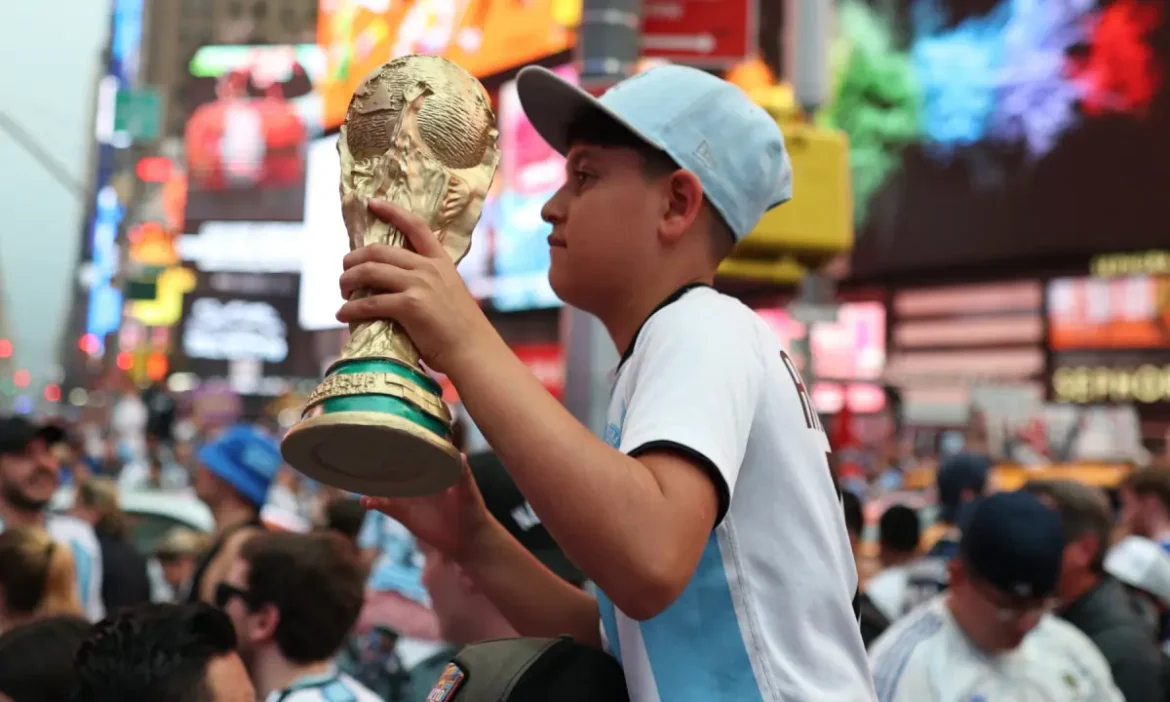
They were meant to meet in Qatar back in March, in a Finalissima billed as a clash of continental champions, before the match was swept aside by the strikes on Iran that reordered so much of the world’s business this year. Today, in the low bowl of MetLife Stadium, Argentina and Spain will finally have their reckoning — only now the stakes have grown considerably. This is not a curtain-raiser. This is the World Cup final.
Kick-off is at 3pm eastern time, with something close to 80,000 supporters expected inside the stadium and, FIFA estimates, some two billion more watching around the globe. It is the 104th and last match of a tournament that has sprawled across the United States, Canada and Mexico, the first with 48 teams, and by any measure the biggest World Cup there has ever been.
Whatever happens over the next two hours will settle one of football’s most beguiling arguments: whether raw, wounded willpower can still overpower a machine built for exactly this. Argentina arrive as reigning champions trying to become the first side to retain the trophy since Brazil managed it in 1962. Spain arrive as the form team of world football, unbeaten in 37 matches stretching back to early 2024, chasing only their second World Cup after the one they won in South Africa in 2010.
A pilgrimage, not a coronation
Argentina have not so much defended their crown as fought to keep it, match by draining match. Seventeen of Lionel Scaloni’s 26-man squad were part of the triumph in Qatar, and this time they have needed extra time to see off Cape Verde, then survived bruising, nerve-jangling contests with Egypt, Switzerland and, in the semi-final, England. Twice in this tournament they have found themselves staring at elimination — 2-0 down against Egypt in the last 16, then behind again against England — before hauling themselves back into contention in the closing stages. Against England, Scaloni’s side had just 12 percent of possession in the 37 minutes between conceding and levelling, a passage of play that told its own story about the character of this Argentina team.
Spain have needed none of that. They have not trailed for a single minute of this World Cup, conceding just one goal across seven matches, a defensive record that places them alongside Italy’s 2006 champions and France’s 1998 winners among the meanest title-winning sides in the competition’s history. If they win today without conceding again, La Roja will have produced arguably the most complete defensive campaign a World Cup has ever seen.
At the heart of that record sits Rodri, the Manchester City midfielder whose reading of the game sets the tempo for everything Spain do, and a back line marshalled with the calm of a side that treats control as a natural state rather than something to be fought for. Luis de la Fuente’s team dismantled France in the semi-final with the kind of relentless, suffocating passing that recalled Sir Alex Ferguson’s old description of Pep Guardiola’s Barcelona — putting opponents on a carousel and picking them apart once they were dizzy.
“It will be a more physical one, and we must be prepared,” Rodri said of today’s final. “But I believe that if we are known for something in this national team, it is that we know how to play different games based on the moment.”
Two coaches, one blueprint
Much of Spain’s coherence traces back to De la Fuente himself, a federation man through and through who has worked with many of this squad since their youth international days rather than arriving as an outside appointment. It is a pattern repeated across the sides that have gone furthest in this tournament — Scaloni, too, moved into the senior Argentina job after coaching the under-21s, and this has, on the whole, been an unforgiving tournament for the bigger managerial names parachuted into national jobs by wealthier federations.
There is a pleasing symmetry to today’s dugout meeting. De la Fuente once tutored Scaloni on a Spanish football federation coaching course, the pupil now facing the teacher with the World Cup itself as the exam.
Messi and Yamal, and the baby photograph that would not go away
But however the tactical battle unfolds, today will be remembered first for what it means for Lionel Messi. At 39, in what he has strongly indicated will be his final World Cup appearance for Argentina, he leads a side trying to hand him a second World Cup and, with it, one more major honour than Diego Maradona — the sort of ledger-settling detail that matters more in Argentina than almost anywhere else in football.
Messi has spoken with a lightness that belies the occasion. “We grew up playing soccer with passion, eager to play,” he said this week, in Spanish. “We played everywhere. We played on the street. We played at school. We played with teams. We didn’t think about the pressure. It was just natural play.” Scaloni, for his part, has been unequivocal about what his captain represents. “He is pure history,” the Argentina coach said. “History. A legend.”
It was not always assured that this story would reach today. Messi walked away from international duty altogether in 2016, distraught after missing a penalty as Argentina lost that year’s Copa América final to Chile — fittingly or otherwise, at this same MetLife Stadium. “I’m done,” he said that night. The retirement lasted a matter of weeks. What followed was a Copa América win in 2021, the long-awaited World Cup in Qatar in 2022, and a second Copa América in 2024, a run of redemption that brings him back, one final time, to the stadium where he once thought his international career had ended.
Standing opposite him will be Lamine Yamal, Barcelona’s teenage prodigy, cast as heir to Messi’s own legend at the same academy, La Masia, that produced them both. Yamal, still only 19, has spent his short career being measured against Messi’s earliest years, and the comparison carries an eerie footnote: a photograph, taken when Messi was a young player at Barcelona and Yamal a baby, shows Messi bathing him. Asked once whether some of Messi’s gift had rubbed off on Yamal that day, Yamal’s father offered a reply that has followed the pair ever since: “Who’s to say it wasn’t the other way round?”
There is history, too, in the shirt Messi is not wearing. Spain made real attempts to persuade him to play for them instead of Argentina, given his upbringing in Spanish football from his teenage years at Barcelona onward. He never wavered. Today will be the first time he has faced Spain since a 2010 friendly, which Argentina won comfortably against the side that had just been crowned world champions.
The conditions, and the questions they raise
The build-up has not been without its complications. Wildfire smoke drifting down from Canada blanketed parts of the north-eastern United States in the days before the final, prompting real concern given the scale of the crowd expected inside MetLife Stadium, before clearer skies returned by Sunday morning. A downpour and a flash flood alert on Saturday added to the unease. The forecast for kick-off itself is largely settled: warm, humid conditions, with temperatures around 80 degrees Fahrenheit (roughly 27 degrees Celsius).
The pitch has drawn its own criticism throughout the tournament, with players and coaches from possession-based sides raising concerns about its playing surface — a factor that could yet work in Argentina’s favour if it disrupts the surface Spain need to build their rhythm.
There is a case, too, that Spain’s attacking threat has been quietly blunted by fitness issues on the flanks. Nico Williams, so influential at last summer’s European Championship, has been restricted mostly to substitute appearances, while Yamal himself came into the tournament carrying a hamstring problem and has needed time to rediscover full sharpness. Should Argentina find a way to unsettle Rodri — whether through Alexis Mac Allister, Enzo Fernández, or a spikier route via Giuliano Simeone against Marc Cucurella — there is a version of this final in which Spain’s control never quite takes hold.
What is at stake beyond the trophy
The scale of the occasion extends well past the touchline. Donald Trump is due to attend his first match of the tournament and is expected to take part in the trophy presentation. Mexican president Claudia Sheinbaum and Canadian prime minister Mark Carney are also expected, meaning the leaders of all three host nations will be present for the tournament’s climax. A closing ceremony fronted by Post Malone and Tom Cruise begins hours before kick-off, followed by a first-of-its-kind World Cup half-time show featuring Madonna, Shakira, Justin Bieber and BTS among others.
England, meanwhile, secured third place on Saturday with a breathless 6-4 win over France, their best World Cup finish since they won the tournament outright in 1966. That match also confirmed that Kylian Mbappé, with 22 goals, has become the tournament’s all-time leading scorer, one clear of Messi — who could draw level again today, and finishes the tournament two goals behind Mbappé in the race for the Golden Boot. “I would have preferred not to be the all-time top scorer and to be playing tomorrow’s match,” Mbappé said afterwards, with the France squad already on their way home.
FIFA president Gianni Infantino has not undersold the tournament that reaches its conclusion today. “This has not just been and is not just the greatest World Cup of all times,” he said on Friday, at a reception in New York alongside Trump. “It is the greatest human, social, and cultural event that mankind has ever witnessed.” Whatever the truth of that, what is not in doubt is that today’s final offers as complete a footballing argument as the sport can construct: instinct against structure, one extraordinary man against one flawless collective, and — win or lose — very possibly the last time the world sees Lionel Messi in an Argentina shirt at a World Cup.
Copyright © 2021 Independent Pakistan | All rights reserved