By Staff Reporter
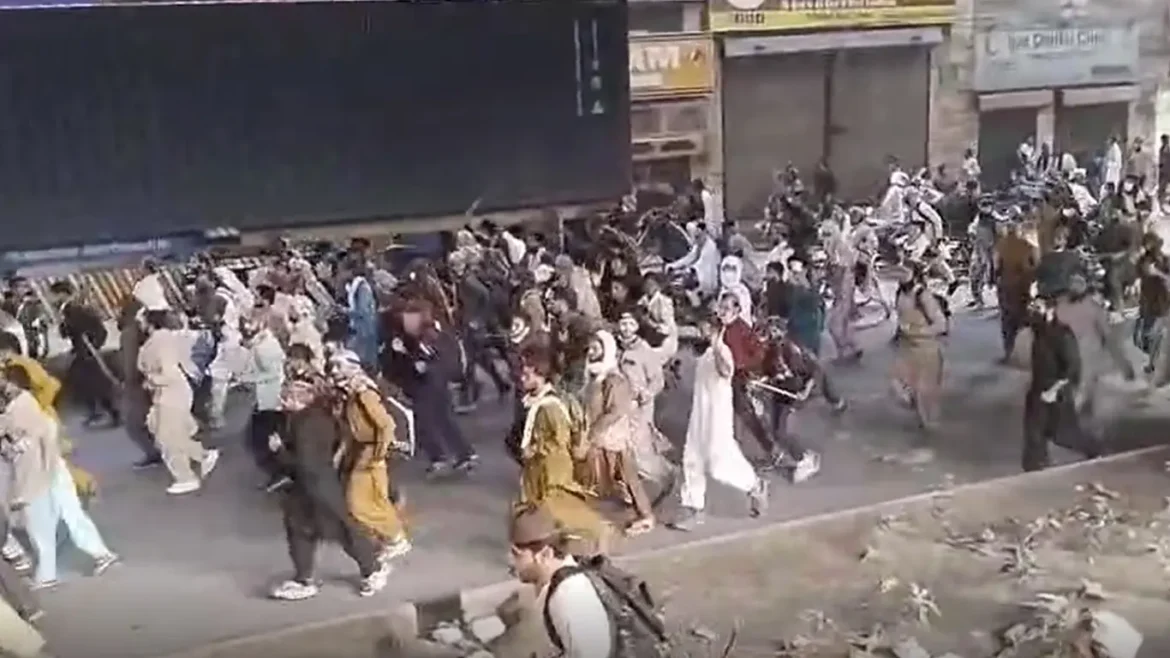
ISLAMABAD: Clashes between protesters from a hard-line religious party and security forces left dozens injured on Friday in Lahore, as authorities scrambled to block a march toward the capital aimed at staging an anti-Israel rally outside the US Embassy.
The protest, organised by Tehreek-i-Labbaik Pakistan (TLP), began in Lahore with plans to reach Islamabad for a demonstration against Israel. Protesters attempted to remove obstacles at the city’s Chauburji Chowk to push forward, leading to confrontations that injured several policemen, according Edhi service. Edhi volunteers transported the wounded officers to various hospitals in the city. TLP spokesperson Usman Naushahi said one protester had died and 22 were injured in the violence.
The unrest prompted sharp condemnation from Minister of State for Interior Affairs Tallal Chaudhry, who accused the TLP of inciting mob violence and attacking security personnel. “The Pakistani government and state are absolutely clear that protesting is a political, religious and fundamental right, but it has been enshrined in the Constitution with certain terms and conditions,” Chaudhry said at a press conference. “If people will exercise their right to protest, they must do so in line with our conditions.”
Chaudhry highlighted the group’s history of bringing mobs to protests, which he said had previously caused deaths and damaged Pakistan’s image. “Mob rule has no place in Pakistan,” he emphasised.
He pointed to a recent peace pact between Hamas and Israel, noting that people in Gaza appeared satisfied with the agreement, and questioned the purpose of the demonstration. Chaudhry described weapons allegedly used by protesters, saying, “I will give the media footage showing them using sticks, chemicals, glass balls and tennis balls with nails lodged in them.”
He added that demonstrators fired these at police and Rangers personnel like slingshots, injuring more than a dozen of them. The minister said the group, numbering under 2,000, left their central office in Samanabad and headed toward Ravi Road via Bund Road, advancing because police refrained from using force despite some blockades. He noted that officers on site were equipped only with anti-riot gear and that even gunmen guarding the deputy inspector general overseeing operations were unarmed.
Chaudhry also cited CCTV footage showing TLP supporters shooting in the air and destroying cameras from the Safe City project when the group claimed injuries among its members. “Why did they do so if they were peaceful?” he asked.
Ahead of the march, the US Embassy in Islamabad, without naming the TLP, posted on the social media platform X. “The US consulates general in Lahore, Karachi, and Peshawar are monitoring planned protest activity across Pakistan on October 10. These protests may cause traffic delays/detours due to closed or blocked roads in the vicinity of the demonstrations. The duration of the protests is unknown. We advise US citizens to avoid large gatherings and remain aware of their surroundings.”
In preparation for the protesters’ arrival, authorities suspended mobile internet services in the twin cities of Islamabad and Rawalpindi. A directive from the Ministry of Interior, dated October 9 and addressed to the Pakistan Telecommunication Authority chairman, approved the suspension of 3G and 4G services starting from 12 a.m. that night until further notice. The ministry instructed the authority to coordinate with local officials but provided no explicit reason, though the move aligned with broader security steps amid the TLP action.
Roads in Islamabad were blocked, with shipping containers placed at Faizabad Interchange, a site of past TLP sit-ins. Around 500 containers would seal the Red Zone, covering Attaturk Avenue, Third Avenue, Margalla Road and Khayaban-i-Suharwardy, as well as the capital’s entry and exit points. Blockades were set at key spots including Serena Chowk, Express Chowk, Nadra Chowk, Agha Khan Road near the Marriott Hotel, Margalla Road near Trail 3 and Luqman Hakeem Road. Others were positioned at Faisal Avenue’s Zero Point and Faisal Chowk.
Entry points from Rawat T-Cross, Chungi No. 26 and Faizabad were also sealed. Metro bus and electric bus services on 21 routes were suspended since Thursday evening and remained halted Friday. Reports indicated roads were blocked in Jhelum as well. Islamabad traffic police issued a diversion plan due to the “law and order” situation in the Faizabad area, barring heavy vehicles from entering the capital until further notice and outlining routes for smaller vehicles.
Security forces ramped up measures, with capital police detaining at least 280 local TLP leaders, activists and workers on Thursday. About 7,000 personnel — including 5,500 policemen, 1,000 from the Frontier Constabulary and 500 Rangers — were deployed in Islamabad, equipped with armored personnel carriers, tear gas shells and rubber bullets to intercept the gathering.
In Rawalpindi, authorities imposed Section 144 of the Criminal Procedure Code until October 11, sealing major routes with more than 300 containers. The provision allows districts to ban assemblies of four or more people temporarily. Over 6,500 police, including 1,150 traffic officers, Punjab Constabulary contingents and the new Riot Management Police, were stationed there, with reinforcements from other districts.
Late Thursday, violence flared in Punjab when police raided TLP headquarters to arrest chief Saad Rizvi, injuring several people, including around a dozen policemen. An October 8 order from the Punjab Home Department imposed Section 144 province-wide for 10 days, citing credible threats from groups like RAW, TTP, BLA and Daesh targeting minorities or scholars to spark sectarian unrest. It warned that assemblies could become terrorist targets and that political or sectarian elements might disrupt public order.The ban extended to carrying arms in public, misusing loudspeakers for inflammatory content and disseminating hateful material.
Copyright © 2021 Independent Pakistan | All rights reserved