By Staff Reporter
ISLAMABAD: The World Bank rated progress toward the goals of a $727 million hydropower and renewable-energy project in Khyber Pakhtunkhwa province “moderately unsatisfactory,” six years after it approved the financing.
The Washington-based lender said in a public disclosure on Wednesday that overall implementation progress was “moderately satisfactory” and that the project’s overall risk is “substantial.” The bank’s project page showed the development-objective measure at “moderately satisfactory” after a review in March 2025.
The bank has disbursed $3.95 million of a $200 million market-based loan, less than 2%, and $34 million of a $250 million concessional credit, about 14%. The board approved both on Sept. 24, 2020. Together the payouts come to about $38 million of the $450 million the bank committed, or roughly 8%.
Macroeconomic conditions, institutional capacity, fiduciary issues and environmental and social factors each carry “substantial” risk, the bank said. Political and governance risk and technical design risk were rated “moderate.” The bank scores each category as high, substantial, moderate or low, based on how likely a risk is to materialize and how severe the impact would be.
The bank said it processed a restructuring at the government’s request to align the project’s scope and financing with implementation priorities. Restructuring documents show the provincial cabinet approved dropping the Madyan hydropower plant, and the bank agreed in principle to cancel all activities tied to it. The changes would shrink the project to about $480.6 million and push the closing date to Nov. 30, 2030, from Nov. 30, 2027.
The province faced a financing gap of $452.5 million, made up of $267.5 million in cost overruns and $185 million in commercial financing that was no longer expected to materialize. A February 2026 mid-term review concluded the extra money for Madyan could not be secured. The planned commercial borrowing is being removed, and the bank’s share of the remaining cost rises to about 93.7%, with the province covering 6.3%.
Madyan had not reached its main construction phase nearly six years after the loan was approved. The plant was redesigned after the August 2022 floods raised dam-safety concerns, and the bank said it had received complaints about its environmental and social impacts. The province was advised to stop acquiring land for it. The cabinet told the provincial power department and the Pakhtunkhwa Energy Development Organization to look for other financing and investment partners so Madyan can be built later under a different model.
Transparency International Pakistan has separately urged the bank to investigate alleged violations in the prequalification and evaluation of bids for the $153 million Madyan contract.
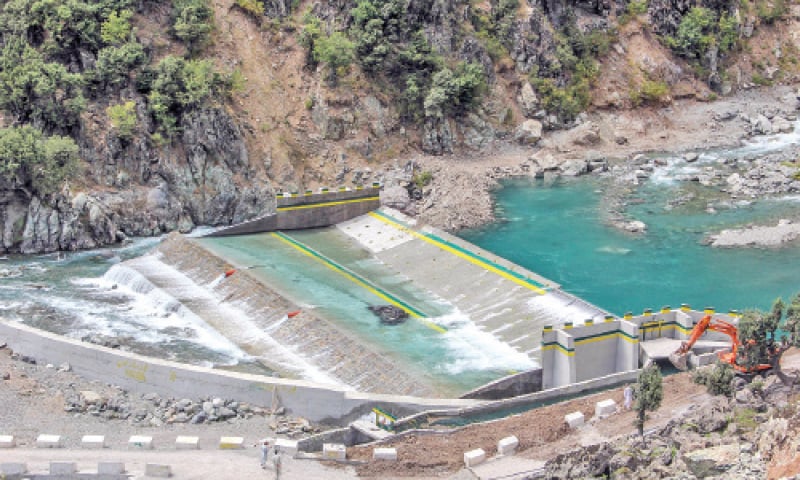
The bank said “implementation has gained momentum” on the 88-megawatt Gabral-Kalam plant, a run-of-river project in Swat capable of generating 339 gigawatt-hours a year. It cited the start of civil works, progress on land acquisition and advancing procurement of electro-mechanical equipment, and said the project would keep its focus on timely delivery, contract management and environmental and social compliance.
Under the restructured plan, about $277.7 million of the bank’s $450 million goes to Gabral-Kalam, $25 million to institutional strengthening and $147.3 million to possible new renewable investments and contingencies. Contracts have been awarded, land acquisition is complete and roughly 70% of the project colony is built, according to the documents. The bank estimates the plant needs nearly 56 months to finish, contingencies included. The cabinet has ordered physical work to begin immediately, saying design and contractor procurement are done.
The project was conceived as a transformational program to build the institutions needed to tap the province’s renewable potential. The original $727 million package set aside $594 million for hydropower and renewable investment, $59 million for environmental and social management and $55 million for institutional strengthening and implementation support, with about $15 million going to financial charges on the loan.
Its four components included public-sector investments such as Gabral-Kalam, and cascade development on the Swat and other river basins, starting with Madyan, which the original plan put at 157 megawatts. The Swat basin’s hydropower potential was put at more than 2,000 megawatts. The design also called for floating or land-based solar panels on hydropower assets.
Uncertainty over whether the plants will be included in future national power-generation expansion plans is among the factors behind the substantial risk rating. In March 2025, the province asked Power Minister Awais Leghari to keep Gabral-Kalam and Madyan in the national plan, noting both had been classified as committed projects in the 2022-31 edition.
Copyright © 2021 Independent Pakistan | All rights reserved