By Staff Reporter
ISLAMABAD: Relentless monsoon rains and widespread flooding have swept through Pakistan’s Punjab province, killing more than 60 people in the past 24 hours and forcing authorities to impose Section 144 and declare a state of emergency in several districts on Thursday.
As rescue teams scramble to evacuate stranded residents, weather officials warn that more heavy rains could exacerbate an already dire situation.
The National Disaster Management Authority (NDMA) issued an alert on Thursday, forecasting torrential rains and wind-thundershowers would continue lashing parts of Pakistan for at least another 24 hours. Disaster management officials have raised alarms about rising water levels and flood risks, particularly in Rawalpindi and Islamabad, as the monsoon’s fury batters northeastern and central regions.
Data from the Punjab Provincial Disaster Management Authority (PDMA) paints a grim picture: 61 deaths and 268 injuries were reported in the last 24 hours, with more monsoon rains expected in the days ahead. Across the province, emergency declarations, evacuation advisories, and heightened alerts have put local administrations on edge.
The Punjab Home Department issued an order on Thursday outlining the mounting dangers posed by the rains. “Dams, rivers, canals, ponds, lakes, and distributaries across the province of Punjab experience heightened water levels and stronger currents during these periods, making swimming and unauthorized boating activities extremely hazardous for human life,” the order stated, citing “a high potential for drowning and other tragic incidents.” It noted a significant buildup of rainwater in low-lying areas, streets, and open spaces, posing particular risks to children who often play in the standing water.
To curb the rising toll, the department invoked Section 144 of the Code of Criminal Procedure, imposing a province-wide ban on bathing in accumulated rainwater, swimming in water bodies, and unauthorized boating. The order, effective for 45 days unless rescinded, reflects the urgency of the crisis. “Prevailing weather conditions and the inherent dangers associated with these activities necessitate immediate preventive measures to safeguard public safety and prevent loss of precious human lives,” the department said.
Punjab Chief Minister Maryam Nawaz announcing that “a rain emergency has been imposed in different areas of Punjab due to unprecedented torrential rains and a flood situation.” She added that authorities were using sirens and announcements to keep the public informed and urged residents to cooperate with local officials and take safety precautions.
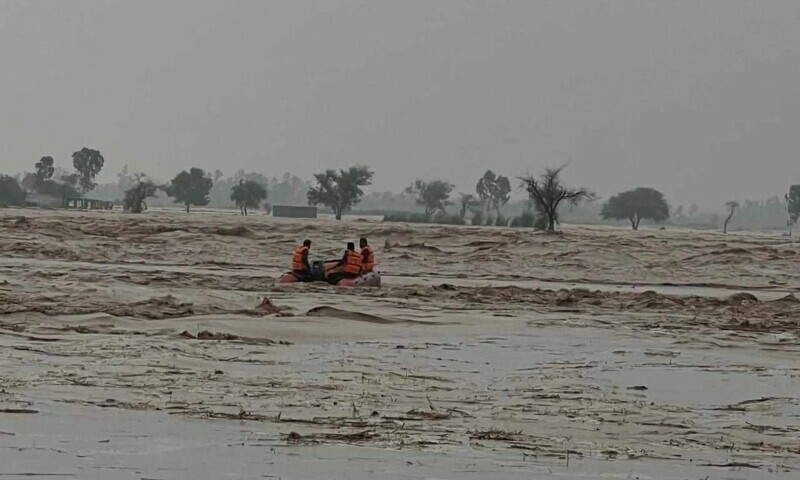
In Jhelum, one of the hardest-hit areas, rescue operations are underway to free residents trapped by floodwaters in villages such as Dhok Biddar, Dhok Shah Arif, Sohawa, Rasoolpur, Chak Muhammad, and Bhampar. Punjab Rescue 1122 spokesperson Farooq Ahmad reported that 57 people have been saved so far, with the Pakistan Army assisting in operations that involve more than 50 boats. “Pakistan Army personnel and rescue teams are currently rushing the citizens to safe locations,” Ahmad said in a statement.
The Pakistan Army conducted an emergency airlift operation in part of Jhelum, after flash floods stranded 40 people in the Deras of Mouza Dhok Biddar and Nakkan Kalan. Due to heavy rainfall, boat rescues were not possible, and helicopters were used to evacuate all individuals safely.
The desperation of those caught in the deluge was captured by Tariq Mehbood Bhatti, a 51-year-old farmer from Gujrat’s Ladian village, who told AFP: “Children were screaming for help, and women stood on rooftops, waving their shawls and begging to be rescued.”
In Chakwal, a cloudburst dumped 440 millimeters of rain overnight, unleashing flash floods that submerged much of the city. “Chakwal recorded over 400mm of rain in 10 hours, which left many areas flooded,” the PDMA said in a statement early Wednesday. While water levels have started to recede, evacuation efforts continue, with the District Emergency Operation Centre and PDMA Control Room on high alert and helicopters on standby.
Chakwal Deputy Commissioner Sarah Hayat briefed PDMA Director General Irfan Ali Kathia by phone, assuring him that Rescue 1122, the Water and Sanitation Agency (Wasa), and other civil personnel were on the ground, with relief arrangements in place at hospitals and public buildings.
Rawalpindi faced its own crisis as the Leh Nullah’s water level surged past the 20-foot mark at the Gawalmandi and Kattarian stations by 10:50 a.m. Thursday, triggering a flood alert and evacuation orders. By 4:21 p.m., levels had dropped to 7 feet at Gawalmandi and 8 feet at Kattarian, offering some respite. The PDMA declared a rain emergency in the district and announced a local holiday. “Citizens have been advised to avoid unnecessary travel, stay away from power lines and open manholes,” said Punjab Wasa Director General Tayyab Farid, who noted that rivers had overflowed in Rawalpindi, Chakwal, and surrounding areas.
Evacuation announcements were being made from mosques in high-risk areas. Authorities called on residents living near Nullah Lai to cooperate with relocation efforts if needed.
The Pakistan Army stepped in elsewhere, using a helicopter to rescue a family stranded on Chakri Road in Rawalpindi, according to Radio Pakistan. Across the province, Ahmad said, more than 15,000 rescue personnel and 800 boats have been deployed to districts including Mianwali, Attock, Dera Ghazi Khan, Rahim Yar Khan, Rajanpur, and Layyah.
In Mandi Bahauddin, where 167 millimeters of rain fell in 24 hours, the storm claimed the life of 10-year-old Shah Hussain, who drowned while bathing in rainwater. Two other boys, 8-year-old Qasim and 6-year-old Huzaifa, were injured by electrocution, and nine people were hurt when the roofs of three dilapidated houses collapsed. Floodwaters submerged areas like College Chowk and Jail Chowk under 2 to 4 feet of water.
The PMD’s Flood Forecasting Division warned that urban flooding could strike Rawalpindi, Gujranwala, and Faisalabad divisions in the next 24 hours, though the wet spell might ease within 48 hours. The agency reported a “significant surge” in water levels at the Tarbela, Mangla, Khanpur, Simly, and Rawal reservoirs, with Khanpur gaining 4.5 feet and the others rising by a foot each. Water flows in eastern rivers are expected to increase from July 21.
Pakistan’s annual monsoon season, running from June to September, often brings deadly floods, landslides, and displacement, especially in vulnerable or densely populated areas. Since June 26, the NDMA reports, monsoon rains have killed 178 people and injured 491 nationwide, with Punjab bearing the brunt at 103 deaths and 385 injuries. Khyber Pakhtunkhwa recorded 38 fatalities, Sindh 20, Balochistan 16, and Azad Kashmir one. House collapses accounted for over 57 percent of deaths, while 610 homes have been damaged and 126 livestock lost.
The NDMA forecasts more heavy rains in the next 24 hours, with thunderstorms and intense downpours likely in districts including Lahore, Chakwal, Attock, Jhelum, Khushab, Sargodha, Gujrat, Gujranwala, Faisalabad, Sialkot, Narowal, Okara, Kasur, Sheikhupura, and Hafizabad over the next 12 hours.
Pakistan, which accounts for less than 1 percent of global greenhouse gas emissions, remains acutely vulnerable to climate change. Shifting monsoon patterns, accelerated glacial melt, and extreme weather have intensified disasters like the 2022 floods, which killed over 1,700 people and displaced more than 8 million after submerging nearly a third of the country.
As the rains persist, authorities in Islamabad are also on high alert. Chief Commissioner Muhammad Ali Randhawa directed field teams to assist citizens in emergencies and ensure strict monitoring of highways, drains, and waterways. Residents were advised to call 16 or 1334 for help.
Copyright © 2021 Independent Pakistan | All rights reserved