By Staff Reporter
QUETTA: Eleven suspects, including a tribal leader, have been arrested in connection with the brutal honor killing of a man and woman near Quetta, Pakistan, as postmortem examinations revealed the victims were shot multiple times at close range.”
The victims, identified as Bano Bibi, in her late 30s, and Ihsanullah, in his mid-30s, were executed in the Sanjidi area of Degari, a remote region on the outskirts of Quetta, three days before the Eidul Azha holiday. According to a first information report (FIR) filed by Station House Officer (SHO) Naveed Akhtar at Quetta’s Hanna-Urak Police Station, the couple was accused of engaging in an “immoral relationship,” locally termed “Karo Kari.”
A tribal jirga, a traditional assembly that often operates outside Pakistan’s formal legal system, found them guilty and ordered their deaths. The jirga was led by Sherbaz Khan, a local tribal elder, who has since been arrested.
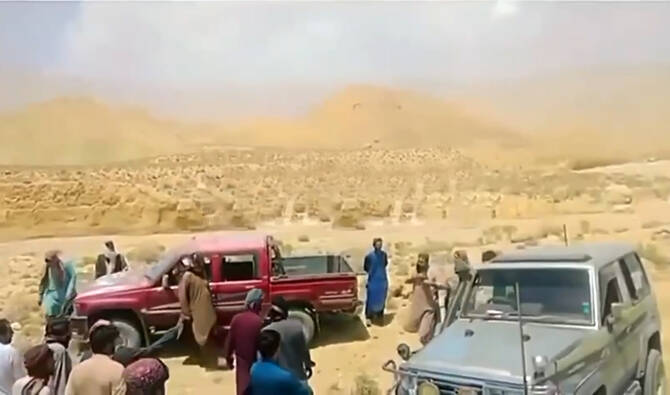
The killings gained national attention when a graphic video surfaced online, showing armed men forcing the couple from a vehicle and leading them into a desert before shooting them at close range. The footage, which police say was filmed to “spread fear and panic among the public,” also captured the assailants firing additional shots into the victims’ bodies after they fell. The video’s release sparked widespread outrage, with activists, politicians, and citizens condemning the act as barbaric and demanding swift justice.
Postmortem examinations conducted by police surgeons from Sandeman Hospital in Quetta revealed the savage nature of the killings. Dr. Ayesha Faiz, the police surgeon who oversaw the autopsies said Bano Bibi was shot seven times, once in the head and six times in the chest and stomach. Ihsanullah sustained nine gunshot wounds to the chest and stomach. “The woman’s body was decomposed but recognizable, and the man’s was in slightly better condition,” Faiz said, adding that DNA samples were collected for potential further testing.
The victims’ bodies were exhumed under a judicial magistrate’s order from separate graveyards, Bibi from the Degari Qadir Bakhsh Coal Mines Cemetery and Ihsanullah from the Sanjadi Cemetery. The autopsies were conducted at the Degari coal mine graveyard, highlighting the remote and rugged terrain where the crime occurred.
Balochistan Chief Minister Sarfraz Bugti announced the arrests during a press conference, vowing that justice would be served regardless of tribal affiliations. “We took action even before the video went viral,” Bugti said, adding that 11 suspects, including tribal leader Khan, had been detained. “More raids are underway to apprehend others involved.” He also confirmed that a deputy superintendent of police posted in Degari had been suspended for failing to report the incident.
Bugti sought to clarify misinformation circulating on social media, rejecting claims that the victims were a newly married couple. “The woman and man weren’t married. The woman had five children, and the man, aged around 45 to 50, also had four or five children,” he said. Still, he emphasized that these details did not excuse the crime. “It is a murder, a crime, no matter what anyone has done. No one has the right to kill a person this ruthlessly and make videos.”
The case has been transferred to the Serious Crimes Investigation Wing (SCIW) for further investigation. “Eleven people have been arrested, including a tribal leader who issued directives to shoot the couple, and all of them will appear before a judicial magistrate today,” SCIW Superintendent of Police Syed Saboor Agha said. Sherbaz Khan, one of the main suspects, was presented before an anti-terrorism court and remanded to SCIW custody for two days.
The FIR, registered under Sections 302 (murder), 147 (rioting), 148 (rioting while armed with a deadly weapon), 149 (unlawful assembly) of the Pakistan Penal Code, and the Anti-Terrorism Act, 1997, names eight suspects and 15 others yet to be identified.
Chief Justice of the Balochistan High Court, Justice Rozi Khan Barrech, took suo motu notice of the incident and summoned the Additional Chief Secretary for Home and the Inspector General of Police to court on July 22, 2025. A press release from the court stated that the chief justice acted in response to “the news circulating on electronic, print, and social media of the murder of a couple for marrying out of choice at Dagari,” though authorities have since clarified that the victims were not married.
Honor killings, often justified by perceived slights to family or tribal honor, remain a deeply rooted problem in Pakistan, especially in regions where tribal customs hold sway. Jirgas, though illegal under Pakistani law, continue to operate in many rural areas, issuing rulings on matters ranging from land disputes to personal relationships. Critics argue that these councils perpetuate a parallel justice system that undermines the rule of law and disproportionately harms women.
In this case, the jirga’s decision to execute Bibi and Ihsanullah for their alleged relationship highlights the dangers of such extrajudicial bodies. “The state must assert its authority and ensure that justice is delivered through the courts, not through tribal edicts,” said human rights activist Tahira Abdullah, who has long campaigned against honor killings. “These murders are not just crimes against individuals; they are crimes against the state and its legal framework.”
According to the Human Rights Commission of Pakistan, 346 people were victims of honor crimes from January to November 2024, with Sindh and Punjab reporting the highest numbers. The past two years have seen a steady rise in such murders, reflecting deeply entrenched societal attitudes about family dignity and shame.
Chief Minister Bugti, addressing the press, pledged that the case would be pursued through constitutional channels, not tribal jirgas. “The state stands with the victims,” he said. “Operations are underway upon his instructions,” Bugti said, promising that all suspects would face due legal process.
Copyright © 2021 Independent Pakistan | All rights reserved