By Staff Reporter
ISLAMABAD: Pakistan’s Deputy Prime Minister and Foreign Minister Ishaq Dar on Sunday articulated a vision for the “strongest relations” with the United States, even as Islamabad fortifies its “iron-clad” partnership with China, a nation increasingly at odds with Washington.
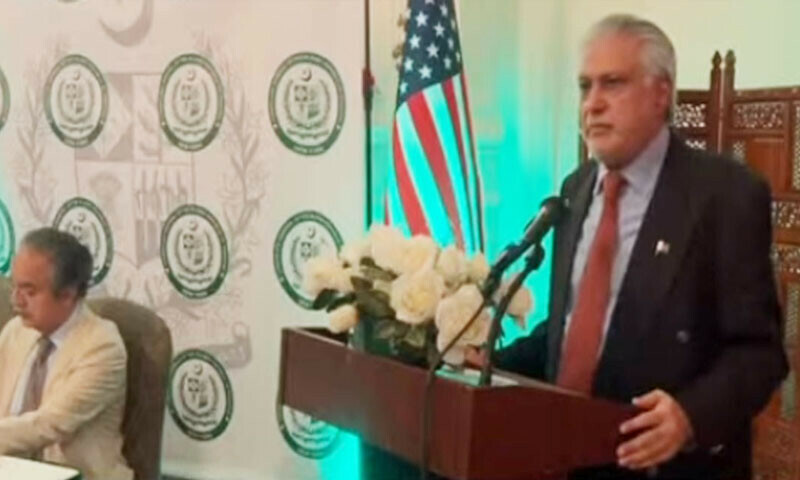
Speaking to a gathering of the Pakistani diaspora at the Pakistan Consulate in New York, Dar emphasized that Pakistan’s ties with Beijing should not cast a shadow over its ambitions for closer cooperation with the U.S.
“Our government and we have emphasized and will continue to emphasize that our relations and iron-clad brother partnership with China, our relations [with the US] should not be looked at through that lens,” Dar said in a televised address. “We want strongest relations with the United States of America as well.”
The remarks come amid Pakistan’s intricate balancing act between its historical security alignment with the U.S. and its burgeoning economic dependence on China, particularly through the $62 billion China-Pakistan Economic Corridor (CPEC), a cornerstone of Beijing’s Belt and Road Initiative. The U.S. and China, meanwhile, remain locked in a rivalry over trade, tariff, and influence in Asia, complicating Pakistan’s diplomatic tightrope.
Dar’s comments capped an eight-day U.S. visit, concluding July 28, which included a significant meeting with U.S. Secretary of State Marco Rubio in Washington on Friday. The 40-minute delegation-level discussion, the first between the nations’ foreign ministers in nine years, marked a step toward mending a relationship that had frayed under the Biden administration. “I would say the meeting was very cordial,” Dar said. “We touched all the regional and global issues. We touched our bilateral issues.”
Rubio, in turn, lauded Pakistan’s “constructive role” in advancing global and regional peace and recognized its “unmatched sacrifices” in the war on terror, a nod to the decades-long partnership that saw Pakistan serve as a frontline ally in U.S.-led counterterrorism efforts. The meeting built on recent goodwill, including a White House reception last month for Pakistan’s Chief of Army Staff, Field Marshal Asim Munir, hosted by President Donald Trump. Dar praised the Trump administration’s approach, contrasting it with its predecessor: “I’m glad that they [the Trump administration] have actively engaged themselves with us.”
The foreign minister credited Trump with helping de-escalate tensions between Pakistan and India earlier this year, calling his mediation efforts “commendable.” That intervention followed Operation Bunyanum Marsoos in May, when Pakistani forces downed six Indian aircraft in response to India’s “Operation Sindoor,” a brief but intense clash that ended with a U.S.-brokered ceasefire.
Dar’s U.S. itinerary also included a discussion at the Atlantic Council think tank, where he hinted at an impending trade agreement with Washington. “I think we are very close to finalizing a deal with the U.S.,” he said. “It’s not going to be months, not even weeks, I would say [just] days.” Such a deal could bolster economic ties, long overshadowed by security cooperation, as Pakistan seeks to stabilize its finances and attract investment.
Addressing the diaspora in New York, Dar painted an upbeat picture of Pakistan’s trajectory. “We have made considerable progress, especially in political and economic fields, in the past three years, despite heavy odds,” he said. “We are indeed a resilient nation.” He cited the completion of an International Monetary Fund program, reduced inflation, and upgraded credit ratings from global agencies as signs of recovery. Dar outlined an ambitious goal of joining the G-20 economies and highlighted the Special Investment Facilitation Council (SIFC), a government initiative to streamline foreign investment in agriculture, energy, and technology.
He urged Pakistani-Americans to contribute, calling them “strategic partners in national development as well as in strengthening mutually beneficial Pakistan-U.S. bilateral cooperation.” Dar also pledged to resume Pakistan International Airlines flights to New York and restore routes to Europe and the U.K., addressing a practical concern for the community.
Afghan Assurances and Regional Stability
Security challenges loomed large in Dar’s address, particularly the threat of cross-border terrorism from Afghanistan. He told the New York audience that Pakistan had secured “recent assurances” from Afghan authorities that their territory would not be used to launch attacks, a critical issue for Islamabad.
“We have received recent assurances from Afghan authorities in that regard,” he said, referencing his visit to Kabul earlier this month. There, he signed an agreement for a railway project linking Pakistan, Uzbekistan, and Afghanistan to enhance regional trade and connectivity.
Relations with Afghanistan have been tense, with Pakistan blaming groups like the Tehreek-e-Taliban Pakistan (TTP) for attacks launched from Afghan soil. In response, Pakistan has conducted military strikes on terrorist hideouts in Afghanistan and expelled large numbers of Afghan nationals. Afghan acting Prime Minister Mullah Hasan Akhund assured Pakistan in April that his country’s territory would not be used for hostile acts against any nation, a commitment Dar underscored as a foundation for improved ties.
Dar struck a resolute tone on Pakistan’s sovereignty, recalling the May clash with India as a testament to its resolve. “Pakistan will defend its sovereignty and regional stability,” he said, praising the unity of the nation and its diaspora during the crisis. He thanked Pakistani-Americans for their support during the India tensions and for amplifying the Kashmiri cause, a persistent source of friction with New Delhi.
The foreign minister’s visit coincided with Pakistan’s rotating presidency of the United Nations Security Council, where he chaired high-profile meetings, further elevating Islamabad’s diplomatic profile. He framed this role, alongside the U.S. visit, as evidence that Pakistan was shedding its diplomatic isolation.
Dar’s push for stronger U.S. ties while preserving Pakistan’s alliance with China underscores the nation’s strategic calculus. The CPEC has transformed Pakistan into a vital node in China’s global ambitions, while its security partnership with the U.S. remains a linchpin for counterterrorism and regional stability.
Copyright © 2021 Independent Pakistan | All rights reserved