By Staff Reporter
ISLAMABAD: Prime Minister Shehbaz Sharif announced a Rs4 billion fund on Monday to repair infrastructure devastated by monsoon floods in Gilgit-Baltistan, a mountainous northern region increasingly battered by climate change-driven disasters.
During a one-day visit to assess monsoon damages and distribute relief to affected families, Sharif emphasized the urgency of preparing for natural disasters as the death toll from heavy rains since late June climbed to 10 in the region, with 10 to 15 tourists still missing.
The floods, triggered by relentless downpours since late June and worsened by a deadly deluge in the Babusar area on July 21, have unleashed landslides and destroyed roads and bridges across Gilgit-Baltistan. The devastation has laid bare Pakistan’s vulnerability to climate change, a country that ranks among the top 10 most affected by global warming despite contributing less than 1 percent of global greenhouse gas emissions.
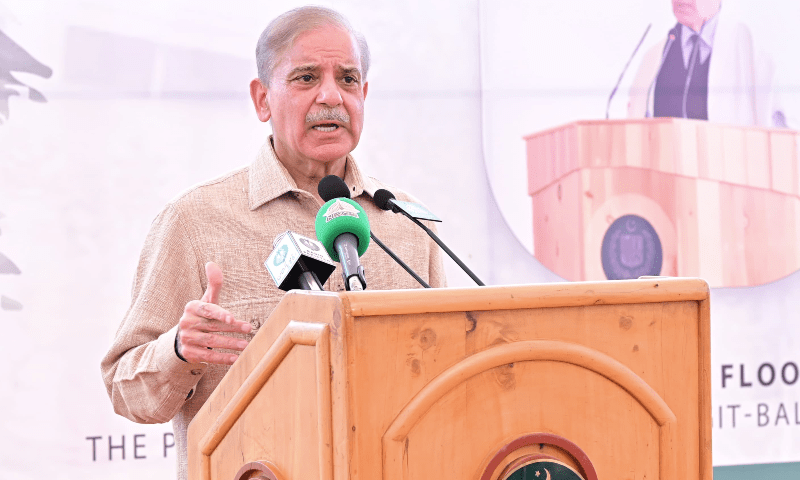
Speaking at a cheque distribution ceremony for flood victims, Sharif offered prayers for the 10 confirmed dead, mostly tourists, and for the recovery of the injured. “I have come here specifically to express my sympathies and to assure you that I will keep coming here till you get resettled in your homes,” he told the crowd.
The situation in Gilgit-Baltistan reflects a broader national crisis. The National Disaster Management Authority (NDMA) reported on Monday that at least 299 people, including 140 children, have died across Pakistan since late June due to flash floods and torrential rains, with more than 700 injured.
In Gilgit-Baltistan alone, the July 21 floods in areas like Thak-Babusar, Thor, Kundus, and Ishkoman prompted the rescue of over 600 people. Five tent villages were set up, and 10 helicopters alongside two C-130 aircraft were deployed to evacuate stranded tourists and residents.
Chief Minister Haji Gulbar Khan briefed Sharif on the region’s losses, pegged at over Rs20 billion by the Gilgit-Baltistan government, and outlined ongoing rescue and relief efforts. The floods have wrecked homes, eroded settlements, and severed communication links, leaving many families desperate. “The hopes of flood affectees are attached to the prime minister,” said government spokesperson Faizullah Faraq, calling Sharif’s visit a “good omen.”
Sharif ordered the NDMA to map the damages and deliver a report, vowing to return in August to monitor progress. He also directed the early completion of an advanced weather warning system and the establishment of a forecasting and monitoring center in Gilgit-Baltistan, efforts aimed at averting future catastrophes. “Pakistan is in the ‘red zone’ of 10 countries most vulnerable to climate change,” Sharif said, stressing that both federal and regional governments must work relentlessly to counter its effects.
At a high-level meeting in Gilgit, Sharif called the destruction from cloudbursts in Diamer and other areas “unfortunate” and pushed for a comprehensive emergency response system. He instructed the NDMA and the climate change ministry to collaborate on a monitoring center within months and ordered Water Minister Mian Muhammad Mueen Wattoo to stay in the region to improve water management. “All rehabilitation measures for those affected by the recent monsoon must be completed promptly,” Sharif said.
The prime minister also leaned on the climate change ministry to secure international funding for resilient infrastructure. “They have attended several meetings,” he said of ministry officials. “They should bring some funds, generate funds for our resilient infrastructure.” The ministry reported progress on an early warning system for glacial lake outburst floods, which Sharif demanded be finalized within two months.
Pakistan’s 7,000-plus glaciers make it a hotspot for climate-related disasters, from unprecedented heatwaves to glacial melting that triggers flash floods. Sharif pointed to the 2022 floods, killing 1,700, affecting 33 million, and costing $30 billion, as a grim benchmark. “After that, each year such destruction comes in less or greater intensity,” he said. On
Amid the relief efforts, Sharif laid the foundation stone for a Daanish School and greenlit a 100-megawatt solar project, pledging to oversee its completion. He met separately with Governor Syed Mehdi Shah and Chief Minister Khan to discuss damages, development projects, and the region’s law and order challenges, including recent honor killings in Tangir district that claimed four lives.
Copyright © 2021 Independent Pakistan | All rights reserved