By Staff Reporter
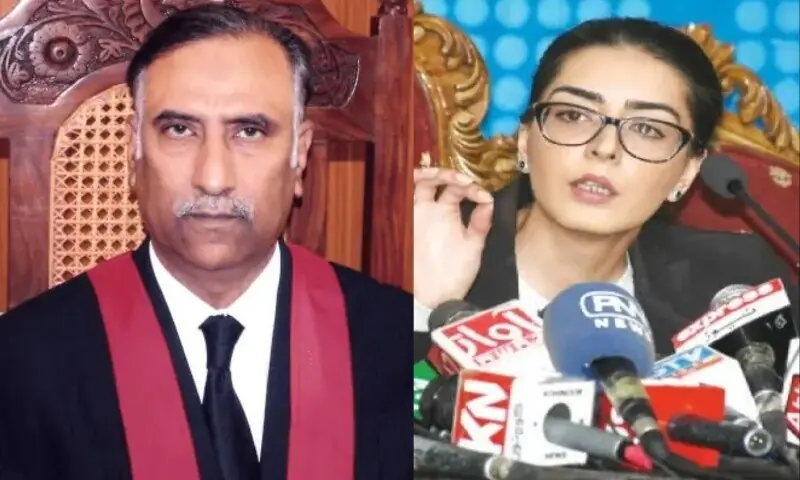
ISLAMABAD: Major lawyers’ associations in Pakistan demanded on Friday the ouster of Justice Sardar Muhammad Sarfraz Dogar as chief justice of the Islamabad High Court, blasting his courtroom conduct as sexist and threatening toward a prominent female attorney.
The furor erupted after a confrontation on Thursday between Justice Dogar and Imaan Zainab Mazari-Hazir, a human rights lawyer renowned for challenging government actions on free speech and disappearances. The clash occurred during a hearing on Abdul Jabbar’s petition to remove his name from the Exit Control List.
Justice Dogar, presiding over the bench, warned Mazari of potential contempt proceedings and was reported to have issued a veiled threat along the lines of “getting a hold of her,” according to witnesses and subsequent social media accounts.
The judge’s remarks, which quickly ignited backlash in legal circles, prompted Justice Dogar to offer a clarification during Friday’s proceedings. He described his words as taken “out of context” and portrayed Mazari as “just like a daughter” to him. “Being the chief justice and an elder, I was trying to make her understand,” he said, adding that “a storm brewed up” from the misinterpretation.
Justice Dogar insisted that he had merely advised Mazari that she could challenge his rulings but should refrain from personal attacks. At one point, he elaborated: “I was explaining to her just as (I would) to a child, but she was not understanding. She was repeatedly mentioning fundamental rights. Does this court not have any fundamental rights?”
The clarification did little to quell the furor. Reports from Thursday’s hearing indicated that Justice Dogar had directly addressed Mazari’s husband, Hadi Ali Chattha, who was present in the courtroom, saying: “Hadi sahib, make her understand; if I get hold of her someday …”
On Friday, Justice Dogar denied uttering any such phrase. “I did not say that I will get hold of her, [but] this [reported remark] is being circulated since yesterday,” he said. “Hadi sahib was standing [there], so I asked him to take her away or I would initiate contempt of court proceedings.” He further warned that any contempt case against Mazari would jeopardize her legal career.
Chattha, a lawyer himself, fired back in a post on X, accusing Justice Dogar of falsehoods and professional misconduct. He quoted the judge’s Friday remarks and declared him “not eligible to hold judicial office” for having “held the entire high court hostage.”
Mazari, whose advocacy work has frequently put her at odds with the authorities on issues ranging from enforced disappearances to curbs on free speech, responded swiftly after Thursday’s hearing. In an X post, she emphasised her dual role in the courtroom. “It is important for CJ IHC to understand that I am not activist Imaan Mazari in his court, I am a lawyer holding a brief for my client and conduct myself according to professional etiquette (and a court should do the same).”
She stressed that her client’s case “should not suffer because of any grievances a judge may have with her lawyer over the right to freedom of expression in a personal capacity.”
Following Justice Dogar’s Friday clarification, Mazari escalated her criticism in another X post, labeling his comments as “sexist” and an act of harassment. “First, the chief justice misbehaved, harassed me at my workplace and threatened me openly in the court … Today again, he is passing sexist remarks,” she wrote. She firmly rejected the paternalistic framing. “I am neither his daughter nor a child. ‘I am a professional lawyer’.”
The episode has exposed raw tensions between bar and bench, coming at a time when the judiciary faces scrutiny over allegations of political interference and erosion of judicial independence.
Justice Dogar’s ascension to chief justice of the Islamabad High Court in early 2025 set off a firestorm of controversy, with detractors charging that his transfer from the Lahore High Court, where he stood 15th in seniority, to the top spot at the IHC amounted to a deliberate reshuffling to upend the court’s lineup and chip away at judicial independence.
Five IHC judges led the pushback, petitioning the Supreme Court to bar Dogar from taking office; they contended that his move, along with those of two other judges, served no evident public good, flouted constitutional rules on seniority and oaths, and looked like a bid to tilt the bench toward the government by marginalising bolder voices.
Legal analysts and bar associations branded the shuffle as nakedly political. A Supreme Court dissenter went further, ruling the transfer order “null and void” over its lack of transparency and aura of outside meddling, a nod, critics said, to orchestration by the powerful establishment, bent on slotting a more amenable jurist into a court that routinely scrutinizes state abuses. Even with an appeal pending, President Asif Ali Zardari ratified the transfers in June, locking in Dogar’s position as questions over the judiciary’s fraying independence lingered.
Bar groups cast it as an attack on lawyers’ dignity.
The Lahore High Court Bar Association (LHCBA), in a statement shared by Mazari on X, “strongly condemn” the exchange. Signed by its president, vice president and secretary, it affirmed lawyers as “officer[s] of the court” whose “respect and dignity was to be prioritised just as those of respected judges who were working within the bounds of law and the Constitution.”
Justice Dogar’s “dictatorial behaviour,” it charged, amounted to “a gross violation of the judge’s code of conduct.” The LHCBA pressed the Supreme Judicial Council, the judiciary’s top disciplinary arm, to remove him and bar him from proceedings.
The Karachi Bar Association (KBA) decried the “highly inappropriate conduct,” saying Justice Dogar abandoned “judicial dignity and impartiality” for “derogatory remarks and threats of contempt proceedings against the counsel.” Such actions, it warned, “undermines the sanctity of judicial forums, intimidates members of the bar and is contrary to principles of justice.”
Lawyers deserve to advocate “without fear or harassment,” the KBA said, urging the Judicial Commission of Pakistan, Supreme Court and Pakistan Bar Council to act. “The judiciary must remain above personal remarks and coercive conduct; respect between bar and bench must always be mutual to protect the integrity of our justice system.”
The Balochistan Bar Council called on the Supreme Judicial Council to dismiss Justice Dogar. A group of female lawyers separately condemned the remarks as “sexist, threatening and unbecoming of a judge,” decrying a “deeply patriarchal attitude.” Contempt laws, their statement said, aim to safeguard justice, “not for judges to hold a sword over the head of lawyers.”
Copyright © 2021 Independent Pakistan | All rights reserved