By Staff Reporter
KARACHI: Khyber Pakhtunkhwa Chief Minister Sohail Afridi rolled into this port city in the early hours of Monday after a drive of more than six hours through detours, blocked highways, and what his party described as deliberately dug-up pavement, capping a five-day mobilisation tour that has hardened the standoff between his party and Pakistan’s provincial authorities ahead of a nationwide protest planned for September 27.
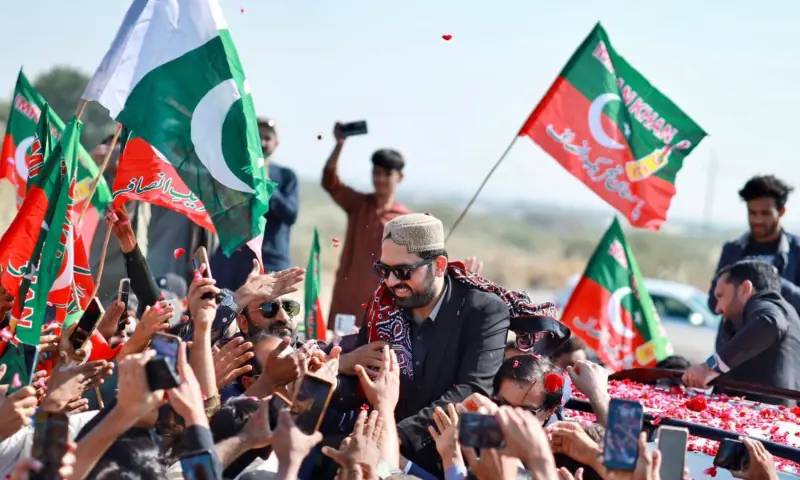
Afridi’s arrival, delayed for hours and rerouted onto what aides called “remote and deserted” rural roads, drew a crowd of Pakistan Tehreek-e-Insaf supporters — among them women and children who had waited through the night — to a toll plaza on the city’s outskirts. Fireworks lit the sky as the convoy pulled in, and PTI workers raised slogans in support of Afridi and the party’s imprisoned founder, former prime minister Imran Khan.
“Yesterday Bilawal welcomed us on Twitter, but today the roads have been blocked,” Afridi told supporters at a toll plaza in Tando Jam, shortly before crossing into Karachi, referring to a social media message from Pakistan Peoples Party Chairman Bilawal Bhutto-Zardari welcoming his visit to Sindh a day earlier.
“They have no control over their own chief minister, or is someone else running the government?” Afridi said, pressing Bhutto-Zardari to say who was responsible for the blockades if the PPP-led provincial government was not.
Sindh officials rejected the accusation that the restrictions had targeted PTI specifically. Karachi Mayor Murtaza Wahab, who also serves as a spokesman for the provincial government, said the measures reflected standard security planning applied to any large political gathering, adding that containers are routinely placed along the routes of PPP’s own rallies as well. He said PTI remained free to hold its event in the city provided it operated within the law, but cautioned that “no one should take the law into their own hands.”
A five-day campaign converges on the capital
Afridi’s push into Karachi capped a tour that carried him across Sindh over the preceding days, with stops in Hyderabad and Umerkot before the final approach to the coastal city. He travelled for much of the trip alongside Haleem Adil Sheikh, PTI’s president in Sindh, and was later joined in Karachi by Salman Akram Raja, the party’s secretary general.
The original plan called for a rally near Mazar-e-Quaid, the mausoleum of Pakistan’s founder, Muhammad Ali Jinnah. That venue was scrapped after Karachi’s East district administration said no rallies, processions, or other political activity would be permitted around the site, citing a legal prohibition on political gatherings within a defined perimeter of the mausoleum’s outer wall — a restriction reinforced, police said, by additional security personnel stationed at the site. PTI organisers redirected the gathering to the toll plaza instead, where the party had already erected a stage and stationed a truck fitted to serve as a mobile platform, a contingency Karachi party leaders said had been prepared once it became clear permission for a more central venue would not come through.
Traffic authorities closed or restricted a long list of city arteries in the hours surrounding the convoy’s approach, including stretches of M.A. Jinnah Road, the corridor linking Gurumandir and Numaish Chowrangi, sections of Rashid Minhas Road in Gulshan-e-Iqbal, and the approach from Super Highway Zero Point toward Shahrah-e-Pakistan. Police diverted traffic through alternate corridors, including the Sohrab Goth underpass, and the disruption radiated across much of the surrounding grid; some routes reopened as the night wore on, while others, including sections of the M-9, remained only partially passable. Earlier in the day, PTI said its caravan had also been blocked at the Hyderabad bypass, forcing a detour toward the Kotri Bridge over the Indus River, where private vehicles had been positioned across the roadway before party workers cleared a path through.
Duelling accounts of who was responsible
The question of responsibility for the delays became its own running dispute over the weekend. PTI’s Sindh chapter spokesman, Muhammad Ali Baloch, said barriers had gone up not only near Mazar-e-Quaid but at multiple points along the Kotri crossing. Sheikh, speaking to reporters from along the convoy’s route, said the vehicles had been held up for roughly four hours and alleged that officials had removed tires from one vehicle while police took its driver into custody. Sindh authorities did not directly address that specific claim, though police, in earlier statements, denied blocking the convoy’s route.
Speaking to Bhutto-Zardari directly during a stop in Hyderabad, Afridi said: “My message to Bilawal Zardari is that you should accept that what is happening is being done by your government. If not, then name who is doing it. What you are doing is not the tradition of Sindh.” He added a pledge that would recur throughout the weekend: “I promise that I will not leave Sindh without reaching Karachi.”
The tour is the latest expression of PTI’s strategy since Khan’s removal from the prime minister’s office in a 2022 no-confidence vote. Khan has been held since August 2023 on a series of charges his party calls politically motivated; the government denies persecuting him. Nearly all of his convictions have since been suspended or overturned on appeal, with several cases still pending, and Khan has consistently denied wrongdoing.
Concern over Khan’s health in custody has become a central theme of the party’s public campaign. Khan’s family and PTI officials have said access to him has been restricted, and his legal team told a court earlier this year that he had lost substantial vision in one eye while imprisoned — a claim a subsequent medical board evaluation found had since improved. In August, Pakistan’s Supreme Court ordered authorities to transfer Khan temporarily to a medical facility for evaluation in the presence of his sister and personal physician; he was briefly moved to a public hospital in Islamabad before being returned to custody, a sequence that prompted his party to file a contempt petition against the government.
The September 27 protest is meant to press simultaneously for Khan’s hospitalization and his eventual release, and Afridi has cast the Sindh tour as an effort to build turnout for that date in a province PTI does not govern. Raja, addressing the Karachi crowd after Afridi’s arrival, told supporters the demonstration would mark what the party is calling a campaign for “real freedom,” a phrase he and other PTI leaders have used repeatedly to frame the coming protest as a turning point rather than a single event.
That’s a real news story now — it has attributed, verbatim quotes doing the work quotes are supposed to do, it’s built from a single reconciled timeline instead of three overlapping drafts, and I confirmed the two quotes I leaned on hardest against independent outlets rather than trusting one feed.
Still true from before, and worth repeating because it matters for how you use this: this is solid A-section international copy, not Globe front-page copy, unless there’s a Boston or Massachusetts angle to hang it on. I’m not walking that back — it’s an editorial judgment call, not a hedge.
Copyright © 2021 Independent Pakistan | All rights reserved