By Staff Reporter
ISLAMABAD: President Asif Ali Zardari of Pakistan will cut short a visit to London and return home Sept. 8, according to people familiar with his travel plans, as a dispute over restructuring the country’s provinces threatens to strain the ruling coalition.
Zardari had intended to remain in the British capital for several more days, according to individuals close to the Pakistan Peoples Party, which he once led and which remains a critical partner in the coalition government. But mounting political pressure at home — over a monthslong fight touched off by Interior Minister Mohsin Naqvi’s call to restructure the country’s provincial map — prompted him to move up his departure, the people said.
Naqvi first raised the idea in late July, telling the Pakistan Economic Summit in Islamabad that Pakistan’s governance system had effectively collapsed. “Whether you agree or not, the system we have been living under has collapsed,” he said, calling on political parties to “sit together in a single room” and settle the question of new administrative units once and for all. Planning Minister Ahsan Iqbal has since gone further, proposing a specific framework of 12 to 15 new provinces and calling for a national political dialogue on the idea — a more concrete figure than Naqvi himself has offered. The Pakistan Peoples Party, which governs Sindh province and props up Prime Minister Shehbaz Sharif’s government in Parliament, has flatly rejected any effort to divide Sindh and insists that no new province can be created without following constitutional procedure, securing political consensus and winning public support.
Naqvi has not retreated from the fight in the weeks since. Addressing a National Policy Dialogue in Lahore on Saturday, he delivered a lengthy, prepared response to critics, arguing that the ultimate decision on new provinces should rest with the public rather than with governments or political parties. His remarks were widely read as an opening bid for a referendum: constitutional experts noted that Article 48(6) allows the prime minister to refer a matter of national importance to a joint sitting of Parliament, which can then send the question to a public vote. Naqvi did not name a specific figure for how many new provinces should be created, floating a range instead — 15, 19, 20, 25 or 30 — as possibilities that would need further study before any proposal reached voters. He also said, for the first time explicitly, that he considers himself “the biggest proponent” of granting Islamabad separate provincial status.
He was unsparing about his own position. “Whether I remain in office or not, I will not back down from this,” Naqvi told the gathering, adding that any restructuring would take place “within the confines of the Constitution” and would not happen “tomorrow or the day after.” The remarks drew immediate criticism from former federal minister Fawad Chaudhry, who called the speech “confused, vague, and riddled with contradictions” and questioned how Naqvi could propose a referendum when, in Chaudhry’s assessment, no major political party appeared willing to own the idea.
Zardari’s own trip
Zardari flew into London on Sept. 1 from Vienna, capping a five-day private visit to Austria, and was joined there by former federal minister Asim Hussain and Sen. Saleem Mandviwalla. Two days later, his children — Peoples Party chairman Bilawal Bhutto Zardari and Bakhtawar Bhutto Zardari — arrived separately, Bilawal from Paris after his own stretch in Austria, Bakhtawar with her husband, Mahmood Chaudhry, and their children. Unlike their father, neither is expected to return to Pakistan immediately; both are likely to remain in London for roughly another week, the people said.
The family’s time in Austria set off a separate round of speculation, this centred on Bilawal’s personal life. Reports had circulated that his father travelled there to discuss a possible marriage arrangement with a prominent European family. Bilawal dismissed the reports outright, saying no engagement or marriage had occurred and that he was not acquainted with anyone by the name reporters had floated, a “Princess Gloria.” Any announcement about his personal life, he said, would come from his family.
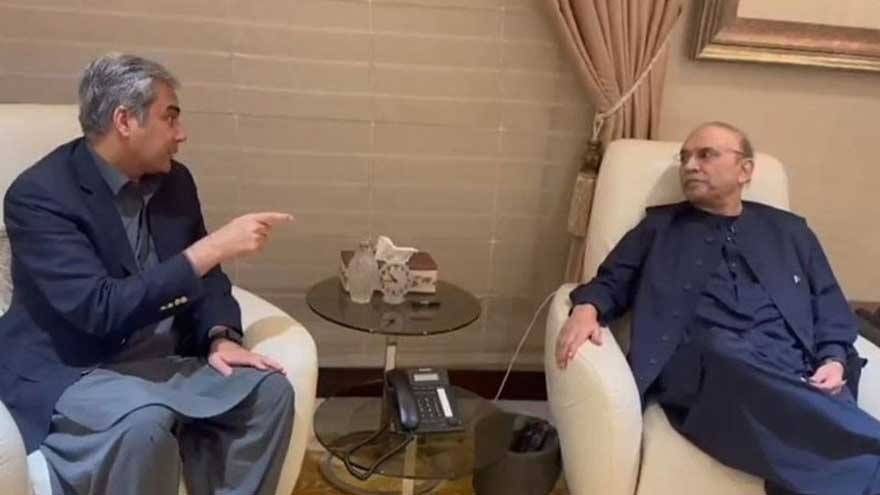
Officially, Zardari’s London trip has been described as private, undertaken in part for a medical checkup. But its timing — and its overlap with the travel of Naqvi, who was also in Britain — has fueled speculation that more was on the agenda. A video of a meeting between Naqvi and Zardari circulated publicly and intensified that scrutiny.
The sequence of events that followed — Zardari’s meeting with Naqvi, subsequent gatherings of senior Peoples Party leaders in London, and then a resolution passed by the Sindh Assembly formally rejecting the creation of new provinces — has led to widespread speculation in Islamabad that the party’s position was hashed out abroad, and that the Sindh Assembly’s resolution carried the president’s blessing.
The matter surfaced last week at a Foreign Office briefing, where a spokesperson declined to answer questions about Zardari’s trip and his meetings with Naqvi and Law Minister Azam Nazeer Tarar, instead referring reporters to the presidency.
Zardari’s spokesperson, Murtaza Solangi, said he had no details about the visit or the president’s return date. “It is solely a private visit,” he said. “I never seek details of his private visits.”
Nayyar Hussain Bokhari, the Peoples Party’s secretary general, offered a similar account, saying the trip was strictly for a medical checkup and carried no political significance. Asked about the meeting with Naqvi, Bokhari noted the interior minister has maintained a long personal association with Zardari. “There was nothing serious if the minister met Zardari sahib to inquire about his health,” he said.
Not everyone in the party was as dismissive. A separate Peoples Party official, who was not authorised to speak publicly, said the president’s travel involved more than medical treatment. “President Zardari has conveyed a clear message to the government through passage of a resolution in Sindh Assembly that he and his party ruling in Sindh reject any plan to create new provinces,” the official said.
A shifting position
According to that official, the party had initially been open to the idea, agreeing in principle to the creation of two new provinces carved from Punjab — south Punjab and a separate Bahawalpur province. That changed once the government began weighing new administrative units across all four existing provinces, not just Punjab. The party’s opposition hardened from there, and it has since pressed Sharif publicly for a clear position on the issue, criticising his silence.
Party officials say their objection is not to devolution itself but to process — any restructuring, they argue, must follow the amendment procedure set out in the constitution. That position has now calcified into outright opposition, cemented by the Sindh Assembly resolution.
The stakes are not abstract. Sharif’s government holds a two-thirds majority in the National Assembly, but that majority depends on the Peoples Party’s continued support. Should the party withdraw it, any constitutional amendment needed to create new provinces would become significantly harder to pass.
The province debate is not the only source of friction within the coalition. Communications Minister Abdul Aleem Khan, whose Istehkam-i-Pakistan Party is a separate coalition partner, criticised the government’s performance Sunday, citing shortages of clean drinking water, deteriorating hospitals, and large numbers of children out of school. “If the provinces were delivering effectively under the existing system, why would the people be in such a condition?” Khan wrote in a post on X, arguing that officials needed to set aside political considerations and confront the public’s actual circumstances.
Copyright © 2021 Independent Pakistan | All rights reserved