By Staff Reporter
ISLAMABAD: Pakistan pressed Muslim-majority nations on Wednesday to mobilise humanitarian aid for Afghanistan and demand that its Taliban-led government take concrete steps to curb terrorism emanating from its territory.
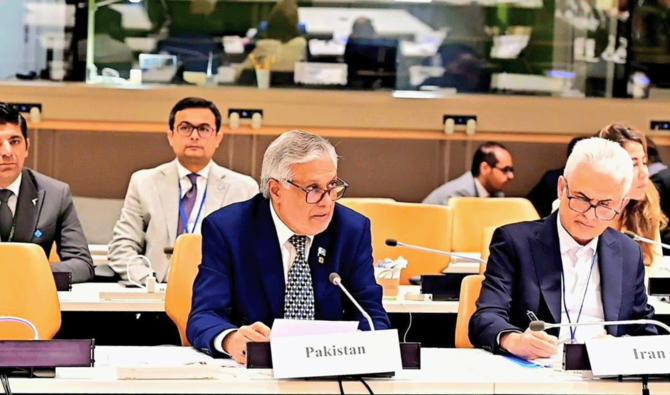
The appeal came during the inaugural meeting of the Organization of Islamic Cooperation (OIC) Contact Group on Afghanistan, convened on the sidelines of the United Nations General Assembly in New York.
The session marked a milestone for the OIC, a 57-member bloc of Muslim countries, which formed the Contact Group in December 2021 during an extraordinary meeting of its Council of Foreign Ministers in Islamabad. That gathering followed the Taliban’s rapid seizure of Kabul earlier that year, a development that upended Afghanistan’s government and deepened its humanitarian and security challenges.
Pakistan, which shares a 2,600-kilometer border with Afghanistan and has hosted millions of Afghan refugees for decades, has walked a delicate line in its approach to Kabul. While urging the international community not to isolate the Taliban, Islamabad has grown increasingly frustrated by a surge in militant attacks within its borders, which authorities attribute to groups operating from Afghan soil. The Taliban denies these allegations, insisting Pakistan’s security woes are an internal matter.
In a speech to the OIC Contact Group, foreign minister and deputy prime minister, Ishaq Dar, underscored the need for robust international support to address Afghanistan’s humanitarian crisis. “The OIC Group must advocate for adequate funding by the international donors to meet Afghanistan’s humanitarian aid requirements without any political considerations,” Dar said.
Dar emphasized the role of OIC member states in stabilizing Afghanistan’s battered economy and reviving its banking system, steps he described as essential for fostering trade and regional connectivity. He also praised United Nations-led efforts to provide alternative livelihoods for former poppy farmers, calling on the OIC to lend its support to these initiatives aimed at reducing Afghanistan’s reliance on illicit drug production.
Shifting to security concerns, Dar expressed alarm over the presence of more than two dozen militant groups operating inside Afghanistan, including the Tehreek-e-Taliban Pakistan (TTP), the Balochistan Liberation Army, the Majeed Brigade, and the East Turkestan Islamic Movement. He accused these groups of collaborating with Al-Qaeda, posing a direct threat to Pakistan and other neighboring countries. “Our law enforcement officials and civilians continue to make enormous sacrifices to terrorism emanating from Afghanistan,” Dar said, citing a recent attack. “Earlier this month, 12 Pakistani soldiers were martyred in our bordering regions while combating TTP terrorist infiltrators from Afghanistan.”
Dar urged the Taliban-led interim authorities to take “concrete and verifiable action” to prevent Afghan territory from being used as a launchpad for attacks against its neighbors. He proposed the creation of an OIC working group of experts to develop a practical roadmap addressing the full range of challenges facing Afghanistan, from security to governance.
The minister also took aim at the Taliban’s restrictive policies on women and girls, particularly their bans on education and employment, which have drawn widespread international condemnation. Calling these measures “unjustified and contrary to Islamic principles and norms of Muslim society,” Dar urged the OIC to engage with the Taliban to reconsider these policies, which he said undermine Afghanistan’s social and economic progress.
On the issue of Afghan refugees, Dar highlighted the need for conditions that would allow millions of displaced Afghans to return home. Pakistan has hosted large numbers of Afghan refugees since the Soviet invasion of Afghanistan in 1979, but growing domestic pressures have led Islamabad to push for their repatriation. “The OIC Group must urge the Afghan interim authorities to create conditions necessary for facilitating the resettlement of Afghan returnees … and to ensure their integration into the political and social fabric of Afghanistan for lasting peace and stability,” Dar said.
Copyright © 2021 Independent Pakistan | All rights reserved