By Staff Reporter
ISLAMABAD The military leadership warned India on Wednesday that any “imaginary new normal” in their fraught bilateral relations would be met with a “new normal of swift retributive response,” escalating tensions between the nuclear-armed neighbors in a fresh exchange of bellicose rhetoric.
The pointed statement, issued by the military’s public relations arm after a high-level conference of top commanders, appeared to directly rebut recent comments from India’s army chief and other officials that suggested a tougher stance against what New Delhi describes as Pakistan-sponsored terrorism.
The warning came in the wake of provocative remarks last week by Indian Army Chief General Upendra Dwivedi, who said Pakistan must stop state-sponsored terrorism if it wanted to retain its place on the map. He added that Indian forces would “not show any restraint this time,” a remark that Pakistani officials interpreted as a potential hint at another military incursion.
The military had already fired back at those comments, cautioning that any future conflict could lead to “cataclysmic devastation” and vowing that the country would “resolutely respond, without any qualms or restraint.” It had asserted that “those seeking to establish a new normal must know that Pakistan has established a new normal of response, which will be swift, decisive and destructive.”
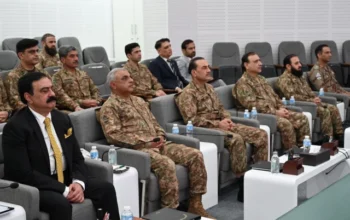
Wednesday’s statement from the Inter-Services Public Relations (ISPR) built on that theme, emerging from the 272nd Corps Commanders’ Conference held at General Headquarters in Rawalpindi. The forum, which included the army’s top brass, took specific notice of the Indian remarks. “The forum pledged to counter any Indian aggression with a swift and decisive response, shattering any perceived notion of India’s relative safety accruing from geography. Any imaginary new normal will be met with a new normal of swift retributive response,” the ISPR said.
The military leadership also expressed grave concerns about the recent “irresponsible and unwarranted provocative statements” by the Indian civil and military leadership. “Such rhetoric conforms to the well-known Indian propensity of whipping up war hysteria for political benefits. The participants agreed that unwarranted warmongering is likely to lead to heightened tensions and will endanger regional peace and security,” the ISPR said.
The meeting opened with prayers for the martyrs of recent terrorist attacks “orchestrated by Indian terror proxies,” according to the statement, underscoring Pakistan’s longstanding stance that India is fueling instability within its borders.
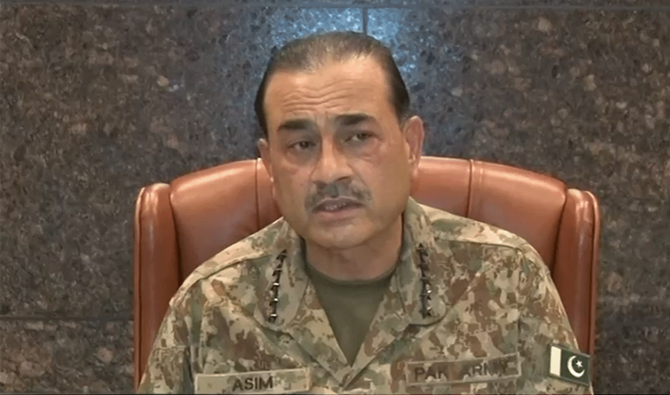
Chief of the Army Staff Field Marshal Asim Munir “commended the spirit, resolve and determination of the Pakistan armed forces in war against foreign-sponsored terror proxies and during extensive relief and rescue operations in the aftermath of recent floods, in conjunction with civil administration and other law enforcement agencies,” the statement said.
The commanders undertook a “comprehensive review” of ongoing counter-terrorism operations, emerging threat paradigms and operational readiness, reaffirming that the military remained ready to “thwart inimical designs of Pakistan’s adversaries across all domains.” The ISPR also highlighted a broader resolve against internal threats, affirming that the “existing nexus between terror and crime with vested political patronage, which is gravely hurting the interests of the state and security of its people, will not be allowed to continue anymore, come what may.”
The participants expressed determination to pursue “comprehensive counterterrorism operations across all domains to continue to dismantle the networks of Indian-sponsored terror proxies” such as the Fitna al-Khawarij and Fitna al-Hindustan. Fitna al-Khawarij is the term used by the authorities for terrorists belonging to the banned Tehreek-i-Taliban Pakistan. In May, the government designated all terrorist organisations in Balochistan as Fitna al-Hindustan — a phrase aimed at framing India’s role in terrorism as a deliberate destabilisation strategy, potentially to galvanize domestic support.
Beyond the focus on India, the commanders acknowledged the significance of Pakistan’s recent high-level diplomatic engagements and reaffirmed their commitment to global and regional peace. They welcomed the landmark mutual defence deal between Pakistan and the Kingdom of Saudi Arabia, saying it underscored “shared values, mutual respect, and a joint vision” for peace and security in the Middle Eastern and South Asian regions.
Pakistan and Saudi Arabia entered into the agreement in September, under which any aggression against one state will be considered an attack on both. The pact was signed by Prime Minister Shehbaz Sharif and Saudi Crown Prince Mohammad Bin Salman at the Al-Yamamah Palace in Riyadh.
The forum reiterated Pakistan’s uncompromising support for the legitimate struggle of the Kashmiri people for their right to self-determination, as enshrined in relevant UN Security Council resolutions. It also reaffirmed Pakistan’s unwavering support for the Palestinian cause and hoped for early ceasefire and delivery of humanitarian aid to the people of Gaza. The forum reiterated Pakistan’s principled stance on Palestine issue, voicing support for the two-state solution with an independent Palestinian state, based on pre-1967 borders and Al Quds Al Sharif as its capital.
In his closing remarks, the army chief directed the commanders to ensure the highest standards of operational readiness, discipline, physical fitness, innovation and responsiveness. The army chief expressed full confidence in the operational preparedness of Pakistan Army to counter threats across the entire spectrum, from conventional and sub-conventional, to hybrid and asymmetric threats.
Copyright © 2021 Independent Pakistan | All rights reserved