By Staff Reporter
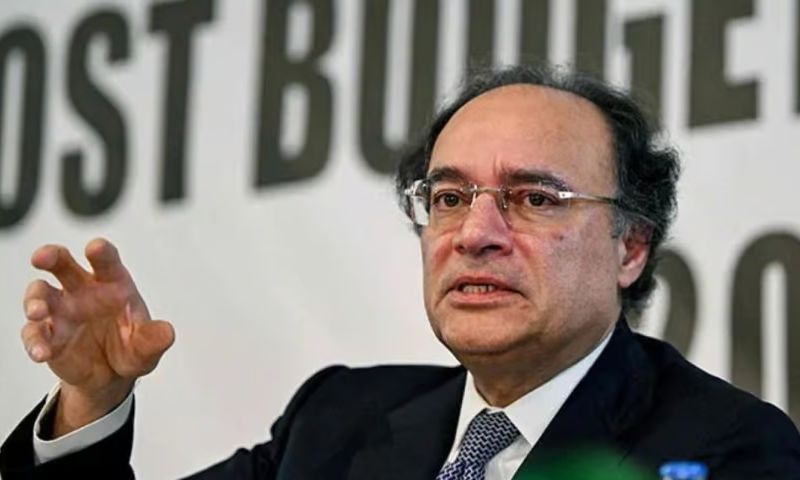
ISLAMABAD: Islamabad is preparing to launch a rupee-denominated, dollar-settled bond and is exploring the tokenization of part of its Eurobond debt, Finance Minister Muhammad Aurangzeb said on Friday, adding a technological dimension to Pakistan’s push to diversify its funding sources beyond traditional international debt markets.
Speaking in Islamabad at “Mobilising Private Capital: National Strategic Dialogue on PPPs and Privatisation,” an event organised by the Asian Development Bank, Aurangzeb said the government has already mandated institutions to help develop the new bond structure. He gave no timeline for its launch.
“There are two other things which we are going to try and move forward with,” Aurangzeb said. “One is a rupee-denominated dollar-settled bond, and we have already mandated institutions who are going to work with us on this.”
The minister said Pakistan is also studying how to tokenize a portion of its existing Eurobond debt, pointing to a model already in use in Hong Kong. Tokenization would involve issuing or representing the securities digitally, a shift that could make them easier to trade and settle while opening them to a broader base of investors. Aurangzeb did not specify which bonds might be included or provide a timetable for the initiative.
The announcement follows Pakistan’s return to the international bond market this week, when the finance ministry said the country had raised $3 billion through a new Eurobond sale. Aurangzeb said the order book was roughly double the amount issued, with demand coming from investors across Asia, the Middle East, Europe and the United States — the bulk of it from Europe and the US. He called the response a vote of confidence in the country’s economic trajectory.
The sale marked Pakistan’s first meaningful return to international capital markets in roughly four years, made possible, Aurangzeb said, by three sovereign credit-rating upgrades the country has received since April 2025.
Reserves, Growth Targets
Aurangzeb reiterated that Pakistan is targeting economic growth above 4% for the current fiscal year. He said foreign exchange reserves stood at $18.4 billion as of June 30 and that the government expects them to climb to $21 billion by the end of fiscal 2027, providing just over three months of import cover — a level he described as consistent with international benchmarks.
The minister flagged the war between the United States and Iran as the most significant external risk to those projections. The conflict has pushed global oil prices higher, a particular concern for Pakistan given its heavy reliance on Middle Eastern crude.
“The conflict, which is still ongoing, is something which we, the governor and myself, are watching very carefully in terms of its impact on our growth projections, and the impact on our inflation projections,” Aurangzeb said, referring to State Bank of Pakistan Governor Jameel Ahmad. He said Pakistan’s leadership, including the prime minister and the chief of defence forces, has been in continuing contact with both the Trump administration and Iranian officials, relationships he described as built on trust, in an effort to help de-escalate the conflict, which he said carries stakes for Pakistan, the broader region and the global economy.
Deepening Capital Markets
Aurangzeb said Pakistan can no longer rely so heavily on its domestic banking system to meet government borrowing needs, calling the current approach unsustainable. He said the country needs to deepen its debt capital markets and widen its investor base to include insurance companies, non-bank financial institutions and other long-term investors.
As part of that effort, he pointed to the finance ministry’s partnership with mobile-payments provider JazzCash and the State Bank’s InvestPak platform, which he described as early steps toward letting retail investors buy government securities directly through digital channels.
Privatization Push
Aurangzeb devoted a significant part of his remarks to the government’s privatization program, describing many of Pakistan’s state-owned enterprises as “beyond repair.” He said 27 state entities have been handed to the Privatisation Commission for sale.
Islamabad sold its flag carrier, Pakistan International Airlines, to a consortium led by the Arif Habib Group in December, part of a broader effort to bring private management into state enterprises that have generated billions of dollars in losses over decades. The government plans to privatize three power-distribution companies — IESCO, FESCO and GEPCO — in the coming months under the same program.
Aurangzeb said some loss-making state bodies would simply be shut down rather than sold, naming the Utility Stores Corporation, the Pakistan Agricultural Storage and Services Corporation and the Pakistan Public Works Department among those affected.
“We decided to close them down,” he said. “Whether it was Utility Services Corporation, whether it’s PASSCO, whether it’s PWD, these are tough decisions. But you have to move on as we go forward.”
Fiscal Repair
Aurangzeb said Pakistan has made significant headway on what he called the country’s structural twin-deficit problem over the past two-and-a-half to three years, with the overall deficit narrowing to 2.6% of gross domestic product from a peak of 12.5%.
He attributed part of the improvement to a 40% increase in revenue collected by the Federal Board of Revenue over the past two years, which he linked to changes in personnel, processes and technology at the tax authority, alongside efforts to rein in government spending. The FBR’s tax-to-GDP ratio has risen to 10.3% from 8.8%, though Aurangzeb said Pakistan needs to push that figure to between 11% and 12% in the near term to move closer to regional peers. He acknowledged that considerable work remains on both revenue collection and expenditure control.
On trade, Aurangzeb said IT exports reached $4.6 billion in the last fiscal year, including $1.6 billion earned by freelance workers. Goods exports, by contrast, have stayed largely flat at around $30 billion, a trend he said the government will need to address to achieve durable, export-led growth.
Pakistan sought an overhaul of its public finances after coming close to a sovereign default in 2022 amid a balance-of-payments crisis. Under a $7 billion loan program with the International Monetary Fund, the government has since removed subsidies on food and fuel, moved ahead with state-enterprise privatizations, and carried out changes in the energy sector.
Looking ahead, Aurangzeb said the government’s priority is to preserve the macroeconomic stability achieved through those difficult decisions while shifting from stabilization toward sustainable growth, continuing structural reforms and giving the private sector room to lead economic expansion. He said privatization and public-private partnerships will be central to that shift, noting that the government can no longer fund every infrastructure and development need from its own resources. Reducing the debt burden, lowering debt-servicing costs and pushing through pension reforms remain key parts of the public-finance agenda, he added.
Copyright © 2021 Independent Pakistan | All rights reserved