By Staff Reporter
MUZAFFARABAD: Lawmakers in Azad Kashmir ousted Prime Minister Chaudhry Anwarul Haq on Monday in a no-confidence vote that capped months of political maneuvering and street protests, installing Raja Faisal Mumtaz Rathore of the Pakistan Peoples Party as his successor in a swift and largely choreographed transition.
The vote in the 53-seat Legislative Assembly was 36 in favor of the motion and 2 against, with the speaker barred from voting and several members abstaining or absent. Under the region’s constitution, the no-confidence resolution simultaneously served as an election for Haq’s replacement, making Rathore the 16th person to hold the office since the introduction of parliamentary government in 1975.
Rathore, 47, a longtime PPP stalwart and son of a former prime minister of the territory, took the oath within minutes of the result and immediately outlined an ambitious reform agenda that included slashing bureaucratic posts, curtailing official perks and resuming talks with a powerful traders’ and civil society alliance whose protests last month paralysed the region and left several people dead.
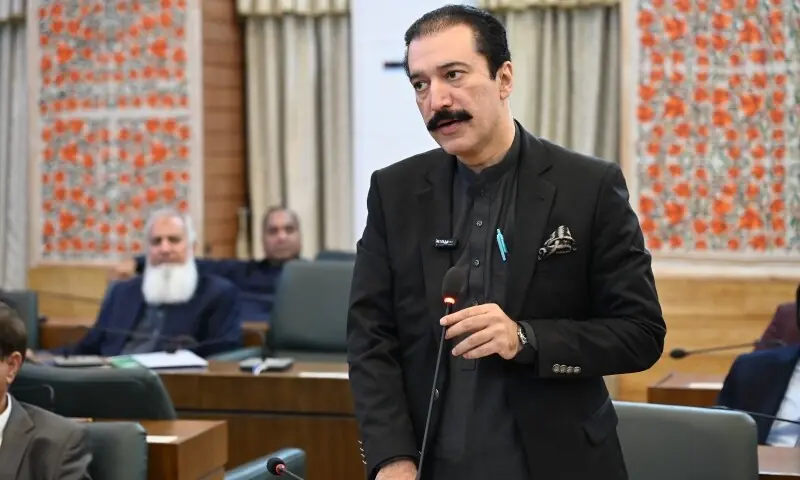
Speaking on the floor of the assembly after his election, Rathore thanked God “for placing a heavy responsibility on the shoulders of a political worker” and said divine responsibility always came with the strength to fulfill it. He traced his political lineage to Zulfikar Ali Bhutto and Benazir Bhutto, both of whom had entrusted his late father with senior roles, including the premiership, and said the mandate handed to him on Monday belonged to every lawmaker who had supported the motion.
In a rare moment of civility amid the partisan shift, Rathore noted that the departing Haq had welcomed the incoming prime minister as he left the chamber, a gesture the new leader described as exceptional. Yet he also delivered a pointed critique of his predecessor’s tenure, saying Haq’s “pen would move only after an earthquake-like situation befell the region,” an allusion to the deadly agitation led by the Jammu Kashmir Joint Awami Action Committee over electricity prices, taxes and subsidies. “We too made some wrong decisions,” Rathore conceded, adding that the committee was a “reality that must be recognised.” Some of its demands, he said, were legitimate, while others were aspirational, and his government would continue negotiations.
He promised to work strictly within available resources, saying, “some matters could have been resolved earlier but were delayed. As prime minister, I pledge that there will be no delay from my pen.” Rathore announced a series of austerity and administrative measures on the spot: only one official vehicle per departmental secretary, the abolition of special and senior additional secretary posts, the merger of technical positions in the Education Department, third-party recruitment for new hires, and a new transport policy that would place surplus government vehicles in a central pool.
Rathore also pledged equal job opportunities for women, judicial reforms, renegotiation of hydropower agreements with Islamabad, and modest benefits for low-wage government workers, including upgrading drivers to grade-5 and granting grade-1 employees an extra month’s salary. Rejecting suggestions that politicians formed a privileged class, he invited public scrutiny of his assets even after leaving office and revealed that the only house his father ever built, with friends’ help, had been sold by Rathore himself to finance his most recent election campaign. All lawmakers who crossed the floor to back the PPP, he said, were now effectively party members and would contest the next election on its ticket.
Haq, of the Pakistan Tehreek-e-Insaf party, arrived in the chamber with four loyalists, delivered a brief farewell address and left before the vote. He said he was departing “in a dignified manner with a contented heart,” held no grievance against those who had moved against him, many of whom had served in his cabinet only days earlier, and wished the incoming government well. Yet he also warned that if the new administration tried to “crush the aspirations of the people of AJK, we will resort to such a severe protest that no one has ever seen before.”
The outcome had been all but certain for weeks. The PPP’s strength in the assembly had grown to 29 after a string of defections from the PTI, giving it a comfortable margin above the 27 votes required. On Sunday, two more PTI ministers formally switched sides after meeting Faryal Talpur, sister of President Asif Ali Zardari, in Karachi. With roughly six months left in the assembly’s five-year term, Rathore becomes the fourth prime minister in four years, a reflection of the chronic instability that has plagued the territory’s politics.
Haq himself had taken office only in April 2023 after his predecessor, Sardar Tanveer Ilyas, was disqualified by the high court for contempt. Ilyas had lasted less than a year after replacing Niazi, who resigned in 2022 amid internal party rifts. Outside the assembly building, large screens broadcast the proceedings live to crowds gathered in the cold mountain air, a measure taken after clashes between police and protesters in recent months.
At the close of his remarks, Rathore, dressed in a black coat over traditional qameez shalwar, reaffirmed the territory’s “unwavering support for the people of occupied Kashmir”, before embracing lawmakers across the aisle, including the two PTI members who had opposed his ascent.
Copyright © 2021 Independent Pakistan | All rights reserved