By Staff Reporter
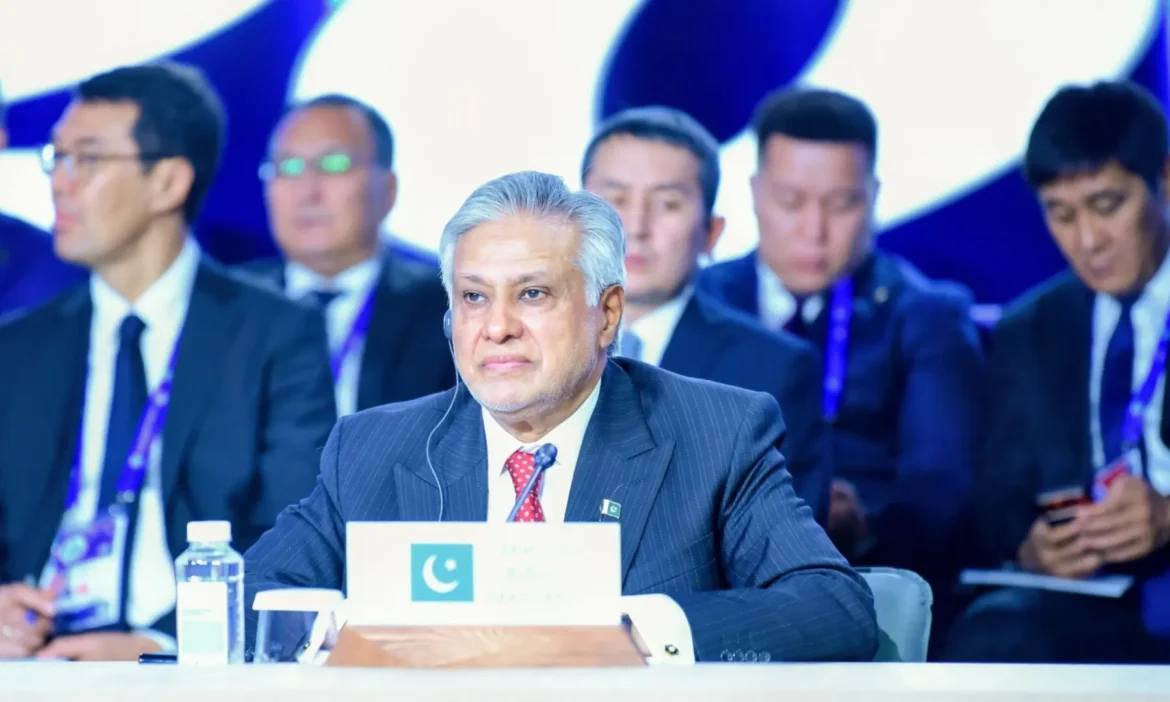
ISLAMABAD: Deputy prime minister and foreign minister, Ishaq Dar, told a high-level gathering of the Shanghai Cooperation Organisation on Tuesday that the eight-member bloc was “well-placed” to strengthen regional humanitarian cooperation in emergencies and should move quickly to modernise its structures, including by adopting English as an official working language.
Speaking at the SCO Council of Heads of Government meeting in Moscow, Dar described the current agenda, trade, economy, culture and humanitarian issues, as “the basis of a mature, future-oriented SCO” and urged members to treat those areas as “interconnected threads in a single, stronger fabric of regional partnership.”
The two-day summit, held under Russia’s rotating presidency, is the first major SCO gathering since the Council of Heads of State meeting in Tianjin, China, in late August and early September. That Tianjin session, which Prime Minister Shehbaz Sharif of Pakistan attended, signaled growing ambition to deepen economic ties across Eurasia.
Dar hailed the Tianjin meeting as evidence that “our organisation is evolving with the resolve to harness the full spectrum of our collective potential” through expanded trade, better infrastructure, investment partnerships, cross-border corridors and digital development. He said the SCO had already laid “a foundation for sustainable economic progress throughout the SCO space.”
On humanitarian cooperation, the foreign minister highlighted his country’s “technology-driven, proactive disaster management system” and said Islamabad was “keen” to organise joint simulation exercises with other members to improve regional preparedness. In a push to broaden the organisation’s reach, Dar called for a fundamental shift in how the SCO engages its observer states and dialogue partners. “Let us move from a model of passive observation to one of real engagement,” he said. “Let us invite them to participate not as guests on the periphery but as stakeholders in specific project-based initiatives that align with their expertise and our collective goals.” Such a “flexible, multi-tiered model,” he argued, would benefit all parties.
Perhaps the most concrete proposal Dar offered was the formal adoption of English as a working language alongside Russian and Chinese. “An important feature of the modernisation of the SCO is the introduction of English as a working language,” he said. “Let us move forward from political declarations and establish a translation unit. The SCO can attract more partners and achieve wider global influence with this only one step.”
To turn momentum into action, Dar presented two Pakistani initiatives. First, he urged fuller use of existing financial mechanisms, particularly the SCO Interbank Consortium, to fund connectivity and technical projects while longer-term institutions such as an SCO Development Bank are still being negotiated. Second, he called for a major expansion of the SCO University network into a full consortium focused on “applied knowledge,” with joint research programs in information technology, artificial intelligence, water-resource management, agriculture and telemedicine. “The ultimate resource of the SCO is our people,” Dar said. “The empowerment of our youth is of foremost importance. We must invest in them directly.”
Dar arrived in Moscow on Monday and was received at the airport by Russia’s Deputy Foreign Minister Mikhail Galuzin, senior protocol and Asia-department officials, and officers from the Pakistani Embassy. Pakistan, which hosted the Council of Heads of Government meeting in 2024, is scheduled to host the next Council of Heads of State summit, Prime Minister Sharif announced in September, though no date has been set. The SCO currently comprises China, Russia, India, Pakistan, Iran, Kazakhstan, Kyrgyzstan, Tajikistan and Uzbekistan, with Belarus having joined as a full member earlier this year. A number of countries, including Turkey and Saudi Arabia, hold observer or dialogue-partner status.
Copyright © 2021 Independent Pakistan | All rights reserved