By Staff Reporter
ISLAMABAD: The newly established Federal Constitutional Court took a decisive step toward full operation on Wednesday by unanimously adopting, with necessary adaptations, the Supreme Court Rules 2025 to govern its proceedings until it drafts its own.
The decision, reached at a full court meeting on Nov. 17 and approved by Chief Justice Aminuddin Khan, was immediately notified across the judiciary and government. It establishes the basic architecture for how the country’s newest apex court will function while it assumes the heavy constitutional docket transferred from the Supreme Court under the 26th Amendment.
Under the adopted framework, every case, appeal, petition or matter before the Federal Constitutional Court will be heard by a bench of at least two judges nominated by the chief justice. Appeals against decisions of a division bench will require a bench of no fewer than three judges, also nominated by the chief justice.
In a parallel move to ensure continuity of legal representation, the court provisionally recognised all senior advocates, advocates and advocates-on-record enrolled with the Supreme Court as entitled to appear before the new court in the same capacities until further orders.
The notification, which takes effect immediately and remains in force until modified or superseded, has been sent to the attorney general, the Supreme Court registrar, high court registrars, the law ministry and other stakeholders.
The rules were finalised against a backdrop of logistical strain and visible friction over courtroom space in the capital. The Federal Constitutional Court, originally slated to occupy the Federal Shariat Court building, was forced to set up temporary operations inside the Islamabad High Court after Shariat Court judges resisted relocation to the high court’s third floor.
To accommodate the new constitutional court, the Islamabad High Court administration has already allocated seven courtrooms to it, a rearrangement that required vacating the offices of the attorney general and the advocate general of Islamabad, among others. The cramped arrangements fueled weeks of uncertainty, including persistent rumors that the entire Islamabad High Court might be shifted away from its landmark site on Constitution Avenue.
On Wednesday, however, the president of the Islamabad High Court Bar Association, Syed Wajid Ali Gillani, announced that the high court would remain at its current location “at least for the time being.” Gillani said he received the assurance directly from Law Minister Azam Nazeer Tarar during a meeting that day. “The law minister assured us that the IHC would stay at Constitution Avenue at least for the time being,” Gillani said. He added that Islamabad High Court Chief Justice Sardar Mohammad Sarfraz Dogar had conveyed the same message.
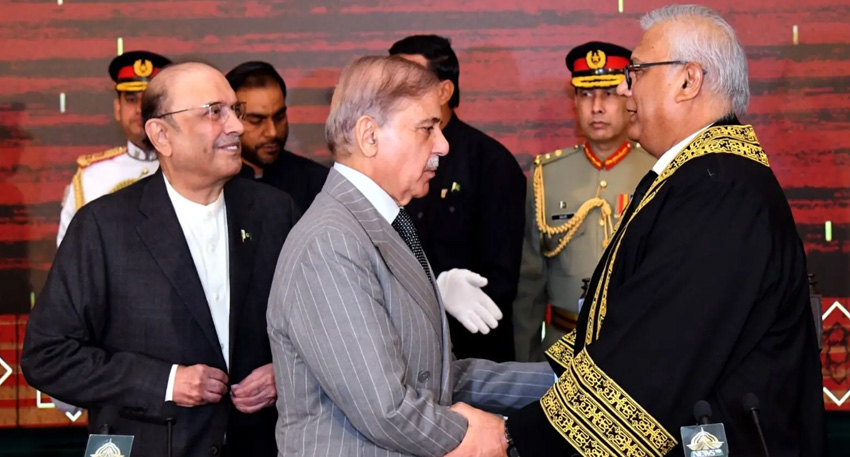
The announcement appeared to ease immediate anxieties within the capital’s legal community, though it was described only as a temporary reprieve. Tensions over shared premises have been palpable. On Tuesday night, Chief Justice Aminuddin Khan of the Federal Constitutional Court held a late-night meeting with Chief Justice Dogar to address day-to-day coordination. On Wednesday morning, Justice Khan met the law minister and Attorney General Mansoor Usman Awan in his chamber to discuss the accommodation issue .Unease was also evident during the recent oath-taking ceremonies for newly appointed Federal Constitutional Court judges. A group of Islamabad High Court judges, Mohsin Akhtar Kayani, Babar Sattar, Tariq Mehmood Jahangiri, Sardar Ejaz Ishaq Khan and Saman Rafat Imtiaz, conspicuously absented themselves from both events. One of the ceremonies, for Justice K.K. Agha, was held in what participants described as a congested conference room. The boycotts sparked intense speculation in legal circles, including social-media rumours that several high court judges were preparing to resign. Staff for Justice Sardar Ejaz Ishaq Khan publicly denied that he intended to step down, but knowledgeable sources said some resignations from the Islamabad High Court bench remain possible before the end of next month.
Copyright © 2021 Independent Pakistan | All rights reserved