By Staff Reporter
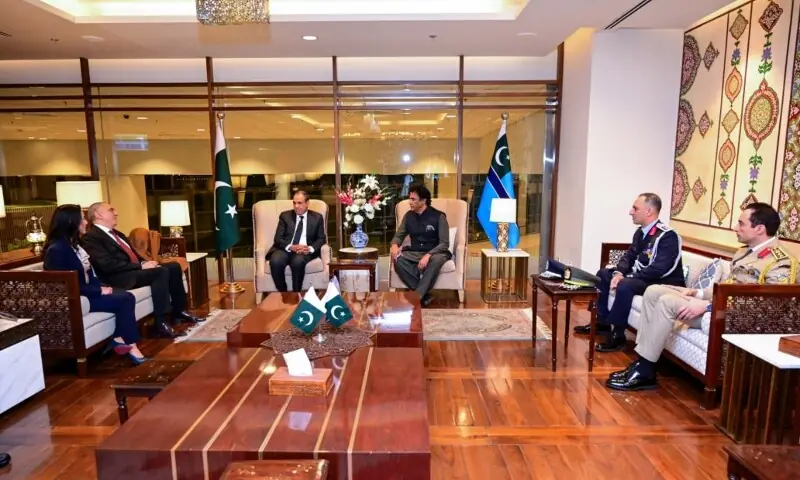
ISLAMABAD: Egypt’s foreign minister on Saturday outlined a narrowly defined mandate for a proposed international force to stabilise Gaza, emphasising its role in monitoring a ceasefire and securing borders, while calling for an expanded Pakistani contribution to the territory’s reconstruction amid ongoing devastation from the conflict.
“Our position on the stabilisation force is clear that its main mandate must be monitoring the ceasefire on the ground to ensure that both sides abide by their commitments, and securing the borders of Gaza,” Foreign Minister Badr Abdelatty told Dawn, a Pakistani newspaper, shortly after arriving in Islamabad for a two-day visit.
The comments came as Pakistan publicly signalled its readiness to participate in such an effort. Abdelatty’s visit underscores the deepening consultations between Egypt and Pakistan on a range of regional crises, including the wars in Gaza and Sudan, as well as the dispute over Iran’s nuclear program. The agenda also includes efforts to bolster economic ties between the two nations.
Details of the International Stabilization Force, remain under negotiation, Abdelatty said, echoing Pakistan’s reluctance to engage in contentious aspects like disarming Hamas, the group that controls Gaza. “We are working with various partners, including the United States, to agree on a specific mission and mandate which should be focused on peacekeeping, not peace enforcement,” he said. “We must agree on the countries that will contribute troops, the mission, the mandate, the guarantees, and the safeguards.”
He added that “everything remained under discussion.” Beyond the force, Abdelatty highlighted Egypt’s plans to host a reconstruction conference for Gaza and appealed for broader Pakistani involvement in recovery efforts. “Regarding Gaza, we need everything from Pakistan, not only funding, but also participation from private companies in reconstruction and recovery efforts,” he said. “We also need technical assistance and medical support. There are 50,000 medical cases in Gaza that require urgent intervention.” “We are expecting a more engaged role from your great country.”
Both countries, he noted, share the view that establishing a Palestinian state is essential for lasting peace in the region. The Gaza conflict is not the only crisis on the table during Abdelatty’s meetings with Pakistani leaders. He pointed to the dire situation in Sudan, where civil war has led to widespread civilian deaths and displacement. “We are also discussing other issues, including Sudan, where the situation is disastrous,” he said. “We must intensify efforts to stop this ugly war and the killing of civilians.”
On Iran’s nuclear program, Abdelatty stressed the need for restraint and negotiation. “The same applies to other regional files, including the Iranian nuclear issue,” he said. “We need de-escalation, dialogue and peaceful settlement of disputes. Egypt and Pakistan share the same views. We believe in de-escalation with Iran, resuming peaceful processes, and upholding the principles of international law and the UN Charter.” “There are no military solutions, only political and peaceful ones,” he said. “We must work together for de-escalation.”
Shifting to bilateral relations, Abdelatty called for a significant expansion of economic cooperation, urging both sides to double their trade volume and increase mutual investments while strengthening South-South partnerships. He outlined several proposals under discussion, including the reformulation of the Pakistan-Egypt Business Council and the organisation of a business forum in either Karachi or Cairo to foster connections between the private sectors of the two countries. Cooperation should extend to key sectors, he said, such as energy, textiles, food processing, agriculture, information technology, digitisation, artificial intelligence and petrochemicals.
In addition, Abdelatty advocated for enhanced collaboration on security issues, including counter-terrorism, combating illegal migration and trafficking, and defence ties focused on technology transfer and joint projects.
Copyright © 2021 Independent Pakistan | All rights reserved