By Staff Reporter
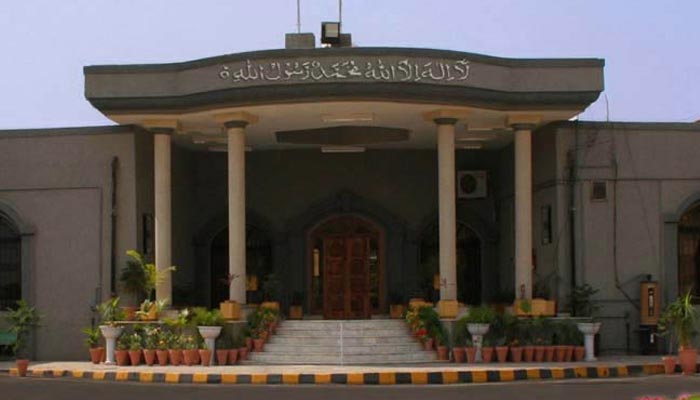
ISLAMABAD The Islamabad High Court ruled Tuesday that a petition challenging the legitimacy of a sitting judge’s law degree is maintainable, ordering the judge to respond within three days and clearing the way for a potentially explosive judicial inquiry into whether he lawfully holds office.
The decision by a two-member bench, led by Chief Justice Sardar Muhammad Sarfraz Dogar and including Justice Muhammad Azam Khan, came after months of legal wrangling over allegations that Justice Tariq Mehmood Jahangiri obtained his LLB degree from the University of Karachi through unfair means, including the use of multiple identities and conflicting enrollment records. The petition, filed by lawyer Mian Daud, seeks a judicial determination on Jahangiri’s eligibility and could lead to a writ of quo warranto, a legal action requiring him to prove his right to the position. The case has stirred debate in Pakistan’s legal circles, highlighting tensions over judicial accountability and the boundaries between constitutional provisions governing high court jurisdiction and the Supreme Judicial Council, the body responsible for probing misconduct by judges.
The controversy erupted last year when a letter purportedly from the University of Karachi’s controller of examinations began circulating on social media, questioning Jahangiri’s credentials. The high court reserved its judgment on the petition’s maintainability in July, but Tuesday’s hearing delved into sharp exchanges over jurisdiction and the merits of the claims. Ahmed Hassan Shah, representing the District Bar Association, argued that the matter should be referred to the Islamabad Bar Council, which issues licenses to lawyers. He contended that allegations against a judge fall under Article 209 of the Constitution, which deals with the Supreme Judicial Council. At that, Chief Justice Dogar observed that the case did not pertain to misconduct but the eligibility of a judge to hold office. Shah insisted that the council, the top forum for judicial accountability, was the right venue. He further argued that Article 199, the provision under which Daud’s plea was filed and which outlines high court jurisdiction, should not be invoked where Article 209 could apply. “The judges cannot proceed against one another,” Shah said. “The court cannot exercise its jurisdiction under Article 199 in competing circumstances.”
Aleem Abbasi, representing the Islamabad Bar Council, echoed concerns about overlapping authority but noted what he called a “new trend” emerging in such cases. He said Justice Jahangiri held three licenses, and the matter of his qualification needed to be addressed by a competent authority. Abbasi reminded the court that an intra-court appeal was pending, seemingly a reference to a plea filed in the Federal Constitutional Court by five IHC judges, including Justice Jahangiri, and the appointment of one of the judges hearing the case had previously been questioned. “Your lordship may help him if a judge is being arm-twisted,” Abbasi remarked.
Amicus curiae Barrister Zafarullah Khan raised questions about the petition’s maintainability and whether it should proceed under Article 209 or Article 199. Highlighting that the case concerned the “integrity of a judge,” he noted that sub-clause 5 of Article 199 excluded courts and sub-clause 3 excluded the armed forces. Khan pointed out that the Supreme Court had also previously dealt with the matter.
Chief Justice Dogar remarked that the Supreme Court had directed the IHC to proceed with the plea. He also observed that a writ of quo warranto could be issued against a judge. During the hearing, Advocate General Ayaz Shaukat read out a report by the University of Karachi. At a previous hearing, the Higher Education Commission, in its detailed report submitted to the court, had endorsed the university’s findings that Jahangiri’s LLB degree was obtained through unfair means. In its submission, the commission enclosed the university’s inquiry report, which revealed glaring discrepancies in the judge’s academic record. Reading the report Tuesday, the advocate general said Justice Jahangiri had been debarred from appearing in an LLB exam for three years in 1988, but he still sat an exam under a different name. Abbasi argued that the Sindh High Court had suspended the university notification cancelling the judge’s degree.
Chief Justice Dogar, however, observed that the degree had not been restored. The court then declared the plea maintainable and issued notices to the respondents, directing them to submit replies within three days. The University of Karachi’s inquiry report detailed the allegations at the heart of the case. It stated that candidate “Tariq Mehmood” obtained an LLB degree in 1991 under enrollment number 5968, but records showed that another student, Imtiaz Ahmed, had been enrolled under the same number in 1987, while the transcript for LLB Part-I was issued in the name of “Tariq Jahangiri.” The report added that the judge had also enrolled for LLB Part-I under a second enrollment number, 7124 — a violation of the university’s rules, which permit only one enrollment number for the entire duration of a degree program. The inquiry committee refrained from labeling the degree as “bogus,” but it declared the credentials invalid on account of multiple identities and conflicting enrollment records. The university alleged the judge “used and appeared in LLB examinations on false identities having different enrolment numbers of Karachi University in collusion with university staff.” It further stated that he had “personified different other regular/ex-regular students of Islamia College, i.e., Mohammad Naeemuddin, son of Mohammad Moinuddin, and Imtiaz Ahmed.” As a result, the university declared the candidate guilty of using unfair means, cancelled the result, and imposed a three-year ban, allowing him to reappear in examinations in 1992.
The dispute has followed a protracted legal trajectory since Sept. 16, when the same IHC division bench first took up the petition and issued an interim order restraining Justice Jahangiri from performing judicial functions until the maintainability could be decided. The decision, made without issuing prior notice to the judge, sparked debate within the legal community over whether a high court could suspend a sitting judge through an interim order. On Sept. 29, the Supreme Court intervened, setting aside the restraining order. A five-member constitutional bench, headed by Justice Aminuddin Khan, held that a high court could not bar a judge from performing judicial functions while hearing a quo warranto petition. The ruling clarified that it addressed only the legality of the interim order and not the merits of the allegations. The Supreme Court later directed the IHC to decide all preliminary objections and proceed with the matter in accordance with law.
Copyright © 2021 Independent Pakistan | All rights reserved