By Staff Reporter
ISLAMABAD: Leaders of Pakistan’s ruling Pakistan Muslim League-Nawaz (PML-N) accused the opposition Pakistan Tehreek-e-Insaf (PTI) on Saturday of sending conflicting messages about potential talks with the government, emphasising that progress in the country’s democracy depends on negotiation rather than impasse.
The remarks came as a delegation of PML-N figures, including Rana Sanaullah, the prime minister’s adviser on political affairs; Ayaz Sadiq, the speaker of the National Assembly; and Tariq Fazal Chaudhry, the parliamentary affairs minister, spoke to reporters en route to Garhi Khuda Bakhsh to mark the 18th anniversary of the death of former Prime Minister Benazir Bhutto.
Their comments followed Prime Minister Shehbaz Sharif’s offer of talks to the opposition earlier in the week, an overture that has exposed divisions within the PTI-led alliance. While the PTI has rejected negotiations on the instructions of its founder, Imran Khan, the broader Tehreek Tahafuz Ayeen-i-Pakistan (TTAP) coalition, which includes the PTI, has indicated a willingness to engage.
“On one hand, they say we should hold dialogue and then on the other hand, Aleema Khan says anyone in favor of dialogue can not be a part of the party,” Chaudhry said, highlighting what he described as the PTI’s inconsistency. Sanaullah, responding to questions about the prospects for talks and rumors that Khan might be transferred to Balochistan, reiterated the government’s commitment to dialogue. “As a political party, we believe that democracy is advanced through dialogue, not deadlock, which is why both PML-N and PPP have always tried to ensure that all political parties sit down and resolve their political issues through dialogue,” he said.
Sanaullah attributed the PTI’s reluctance to Khan’s long-standing approach. “The PTI founder has had this attitude since 2011 and then from 2018-2022 and now in 2025,” he said. “He does not believe in political dialogue.”
Addressing restrictions on visits to Khan, who is imprisoned, Sanaullah said that “no one can be allowed to plan chaos and anarchy in the country,” alleging that Khan had used meetings, messages and social media posts to do just that. He accused Khan of “badmouthing the political leadership” and defended the visitation ban as “in accordance with the law.” “As for dialogue, we have always remained ready; we still are. If they want to talk, that’s fine; if they don’t, it’s their decision.” He also pointed to a court hearing on the visitation issue, where PTI lawyer Salman Akram Raja had assured the judge that no press conferences or political messaging would follow meetings. “But now they are going against their own statement,” Sanaullah said.
Sadiq echoed the call for talks, noting that the prime minister “has repeatedly said that we are ready for dialogue.” As speaker, he added, “I have also said that the office of speaker is available whenever you want to come and talk, but it seems they will have to make a decision.” “Once the PTI agrees, some way forward can be found.” Inviting direct engagement, he said, “They tell the media that they want to talk; there is an office available, they should come, and we will welcome them.”
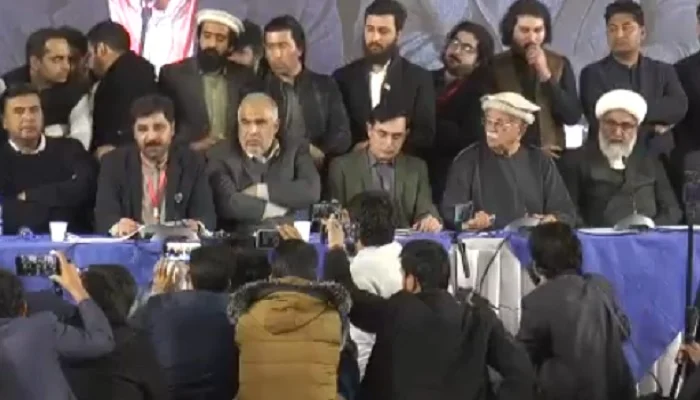
The push for dialogue follows a national conference last weekend organized by the TTAP, where participants agreed that “the door to dialogue must never be closed in a democracy.” That same day, leaders from across the political spectrum, including PML-N figures, urged restraint to curb instability and violence stemming from confrontation. In Islamabad, government officials have privately conveyed to PTI leaders that any talks would exclude revisiting the February 2024 general elections, which the opposition has contested as rigged, local media reported.
They said there would be no negotiations on rejecting the polls, forming a commission to investigate them or transferring power through dialogue. Instead, election disputes must be resolved through tribunals and courts, with verdicts binding even if unfavorable to the government. Reopening the 2024 vote could unravel earlier elections, including those in 2018, a step deemed impractical.
The government has signaled openness to discussions on institutional reforms, constitutional changes, strengthening Parliament, the rule of law and broader democratic improvements. Talks on political prisoners and other issues could proceed within legal bounds. On the May 9, 2023, violence — when PTI supporters attacked military installations following Khan’s arrest — the officials noted that resolution involves stakeholders beyond the civilian government, with the military’s stance remaining resolute.
PTI Chairman Barrister Gohar Ali Khan confirmed receiving messages from the government but declined to elaborate on their content. Prime Minister Sharif, speaking on Wednesday, reiterated his offer but set boundaries: Negotiations could address “legitimate demands,” but “blackmailing under the guise of dialogue will not work.”
TTAP leaders have responded with cautious optimism, affirming openness to talks on national issues and constitutional restoration, even as the PTI maintains its refusal. Political observers note that while both sides seek to ease tensions, deep rifts over the 2024 elections and accountability for May 9 could stall progress. One officials familiar with the discussions said extraordinary circumstances demand that the PTI take bold steps toward dialogue, as “more than anyone else, it is the PTI that needs dialogue at the earliest to pave the way for normalcy.”
It is widely known that Khan authorized TTAP leader Mahmood Khan Achakzai and Allama Raja Nasir to pursue talks on Nov. 4, but little headway has followed. “Any future progress would require both sides to have direct contact with good intentions,” the official added.
Copyright © 2021 Independent Pakistan | All rights reserved