By Staff Reporter
LAHORE: Facing 19 straight days of street protests and a nationwide strike that emptied marketplaces from Karachi to Peshawar, the government agreed on Thursday to form a joint committee with the country’s largest religious political party to study whether the fuel taxes squeezing ordinary drivers can be rolled back.
The agreement, hashed out at the headquarters of Jamaat-e-Islami in a Lahore’s Mansoora neighborhood, does not commit the government to cutting the levy. It commits both sides to talking about it — a modest step, but one that came only after weeks of shuttered shops, blocked roads, and a party leader warning he might march on the capital.
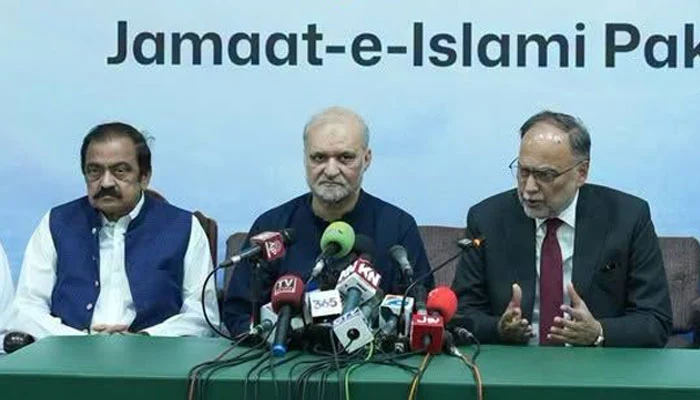
Planning Minister Ahsan Iqbal, Prime Minister’s Adviser on Political Affairs Rana Sanaullah and Jamaat-e-Islami Emir Hafiz Naeemur Rehman announced the arrangement at a joint news conference following the closed-door meeting. Hafiz Naeem’s delegation, led by his deputy, Liaquat Baloch, laid out three core demands: abolishing the petroleum levy outright, revisiting the government’s power-purchase agreements with independent electricity producers, and bringing down the price of bread.
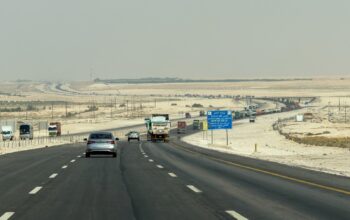
The dispute centers on a tax that has become a lightning rod for public frustration over the cost of living in Pakistan. Under the current structure, the government collects Rs114 — roughly 40 cents — in taxes and duties on every liter of petrol sold, and Rs100 on every liter of diesel, figures confirmed separately by officials on both sides of the negotiating table. Pakistan adopted the levy as part of its commitments under an International Monetary Fund loan program, and it has become considerably more painful for consumers since energy markets convulsed amid the ongoing conflict between the United States and Iran, which has disrupted supply routes through the Strait of Hormuz and pushed prices at the pump sharply higher.
Hafiz Naeem, addressing reporters after the session, said his party had no interest in occupying public squares for weeks on end but felt it had no alternative. He said the government had, since the levy’s introduction, collected roughly 8 trillion rupees through the tax and had actually exceeded its collection target for the year — a detail he offered as evidence that officials could afford to ease the burden. He also argued that the tax structure falls hardest on people least able to pay it, telling reporters that a motorcyclist earning too little to owe income tax still hands over 35 percent of what he spends on a liter of gasoline in duties alone. He put a rough figure on the broader economic strain as well, saying poverty had climbed by roughly a third nationwide over the past six years.
Iqbal, for his part, framed the government’s posture as one of openness rather than concession. He said the government has already assembled its own panel of experts and asked Jamaat-e-Islami to do the same, so the two sides can examine the party’s proposals on a technical level rather than through dueling press conferences. Officials said those technical-level talks are expected to begin Monday, with representatives from the finance and petroleum ministries sitting down opposite the party’s nominees to pick through what, if anything, is workable.
Sanaullah struck a similarly measured tone, saying the government intends to weigh whatever recommendations emerge and expressing hope the two sides can land on a feasible solution within roughly two weeks. He noted that international pressures — the Iran conflict chief among them — have already strained the government’s ability to manage prices, but said officials remain willing to examine what relief might still be possible.
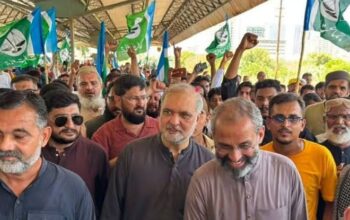
Neither side treated the meeting as a resolution. Hafiz Naeem made clear that the demonstrations his party has organized in more than two dozen cities will continue regardless of how the talks proceed, telling reporters plainly that the sit-ins and the negotiations will run on parallel tracks. Government officials, he said, had asked that the protests be suspended while talks were underway; his party declined.
That refusal was on vivid display Thursday across the country, as the strike Jamaat-e-Islami had called for the same day produced an uneven but often disruptive shutdown. In Karachi, party officials said more than 300 markets, large and small, stayed closed, and commercial strips in several neighborhoods sat largely dark. Bus rapid transit service on one of the city’s lines was suspended entirely because of a sit-in blocking its route, while near one major intersection, unidentified individuals set fire to a tire and two motorcycles, snarling traffic. Elsewhere in Sindh province, the response varied by town: Thatta saw a near-total shutdown of shops, hotels, and gas stations; Larkana and a town in Matiari district closed almost completely; and in the desert district of Tharparkar, party workers staged a pointed piece of theater, selling gasoline to residents at a symbolic price of 225 rupees a liter.
In Khyber Pakhtunkhwa province, the picture was similarly mixed. Most shops along one of Peshawar’s principal commercial streets stayed shuttered, even as markets elsewhere in the city carried on business largely as usual. Lawyers there declined to appear in court in solidarity with the strike. Further north, in Lower Dir, the shutdown was close to total, with traffic thinned noticeably and courts there closed as well.
Punjab and Balochistan, by contrast, largely shrugged off the call to strike. In Rawalpindi, major commercial roads stayed open and traffic moved normally. In Quetta, shops in the city’s principal bazaars operated without interruption. The exception was Lahore, where the day produced its most visible confrontation: party workers and shopkeepers on the city’s Mall Road got into a heated dispute over whether businesses should comply with the strike, a disagreement that escalated into a scuffle serious enough to draw a heavy police response.
Copyright © 2021 Independent Pakistan | All rights reserved