By Staff Reporter
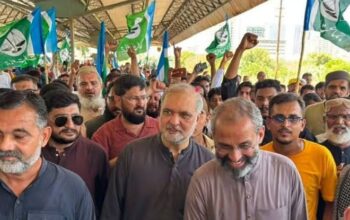
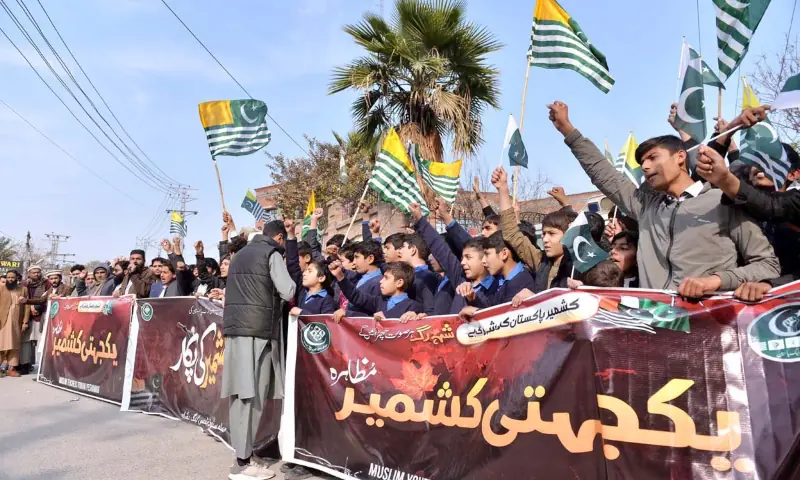
ISLAMABAD: Pakistan marked Kashmir Solidarity Day on Friday with a wave of rallies, seminars and human chains across the country, as leaders from the government, military and parliament reaffirmed their support for the Kashmiri people’s right to self-determination and urged the international community to pressure India over human rights abuses in the disputed Himalayan region.
The annual observance, held every 5 February, saw citizens and officials gather in cities and towns to express solidarity with those in Indian-occupied Kashmir, amid accusations of repression and demographic changes by New Delhi. A one-minute silence was observed nationwide at 10am to honour those killed in the long-running freedom movement, according to state broadcaster Radio Pakistan.
In Muzaffarabad, the capital of Azad Jammu and Kashmir (AJK), prime minister Shehbaz Sharif addressed a special session of the AJK legislative assembly, having arrived on Thursday to a welcome from AJK Prime Minister Raja Faisal Mumtaz Rathore and other senior officials. Sharif was joined by a high-level delegation including deputy prime minister and foreign minister Ishaq Dar, planning minister Ahsan Iqbal, information minister Attaullah Tarar, religious affairs minister Sardar Yousaf, and adviser on inter-provincial coordination Rana Sanaullah.
Elsewhere, Kashmir affairs minister Engineer Amir Muqam led a rally from China Chowk to D-Chowk in Islamabad, while at Kohala Bridge, a ceremony featured flag hoisting, the national anthem and a human chain formed by officials, community leaders and residents. Similar demonstrations unfolded at entry points to AJK, showing the day’s theme of unity and resolve.
In a message issued to coincide with the day, President Asif Ali Zardari emphasised Pakistan’s “steadfast moral, diplomatic and political support” for the Kashmiri people, invoking their “inalienable right to self-determination” as outlined in United Nations Security Council resolutions. He noted that the observance began 36 years ago under former prime minister Benazir Bhutto, in response to the 1989 Kashmiri uprising that persists today.
Zardari called on the global community to compel India to halt human rights violations in the territory, accusing New Delhi of intensifying control through “administrative and legislative measures, curbing media freedoms, incarcerating Kashmiri leadership and attempting to alter the demographic composition”. He cited international reports highlighting a surge in arbitrary detentions, collective punishment and house demolitions, alongside the suppression of digital freedoms through the blocking of thousands of social media accounts.
Prime Minister Sharif, in his own statement, reiterated the demand for resolution in line with UNSC directives, pressing for a “free and impartial plebiscite under the auspices of the United Nations”. He announced measures to support Kashmiri refugees, including raising their monthly per capita subsistence allowance to Rs5,000 and launching a pilot project to build 750 residential houses at a cost of Rs3 billion, with land provided by the AJK government. Sharif described the full rehabilitation of Jammu and Kashmir refugees as a “national duty”, vowing Pakistan’s continued backing until self-determination is achieved.
The military leadership also weighed in, with chief of army staff General Asim Munir – who holds the title of Chief of Defence Forces – alongside Naval Chief Admiral Naveed Ashraf and Air Chief Marshal Zaheer Ahmed Baber Sidhu, issuing a joint message via the Inter-Services Public Relations directorate. They condemned “grave violations of human rights in IIOJK [Indian Illegally Occupied Jammu and Kashmir]”, including extrajudicial killings, enforced disappearances, arbitrary detentions and efforts to reshape the region’s demographics and politics in defiance of international law.
The services chiefs stressed that a “just and peaceful resolution” aligned with UNSC resolutions and Kashmiri aspirations was vital for South Asian stability, urging the international community to take “concrete and meaningful action” to ease the suffering. They affirmed the armed forces’ commitment to defending Pakistan’s sovereignty while standing in solidarity with Kashmiris in their “rightful quest for freedom and dignity”, ending with the rallying cry: “Long live Pakistan! Long live Kashmir!”
Foreign Minister Dar, in a separate statement, described the Kashmiri people as deprived of fundamental rights, their resilience underscoring the validity of their cause. He attributed the core of the dispute to India’s refusal to enact UNSC resolutions promising a plebiscite, a stance he said violated the UN charter and the Fourth Geneva Convention. Dar portrayed the situation in occupied Kashmir as having escalated from sporadic abuses to a “sustained system of repression”, particularly since India’s actions on 5 August 2019, which he claimed aimed to artificially shift the demographic balance and reduce the Muslim majority.
He highlighted “constant discrimination” under a “Hindutva-driven framework”, including the recent profiling of mosques where religious leaders must submit personal details, photographs and sectarian affiliations – a move he labelled as institutionalised Islamophobia. The foreign minister detailed further violations such as fake encounters, enforced disappearances, arbitrary detentions and curbs on basic freedoms, calling for decisive international intervention to address the deteriorating human rights landscape, hold India accountable for its “illegal and unilateral actions”, and enforce UNSC resolutions to grant Kashmiris their pledged self-determination.
The day’s events reflect Pakistan’s longstanding position on the Kashmir conflict, which has simmered since the 1947 partition and erupted into multiple wars between the nuclear-armed neighbours.
Copyright © 2021 Independent Pakistan | All rights reserved