By Staff Reporter
The news from Islamabad this week should have registered as standard middle-power diplomacy in a region on fire. Pakistan, citing its long border with Iran, its ties to both Washington and Tehran, and its newly burnished personal relationship between its army chief and President Donald J. Trump, has positioned itself as a potential host and facilitator for direct talks aimed at ending the fighting between the United States, Israel and Iran.
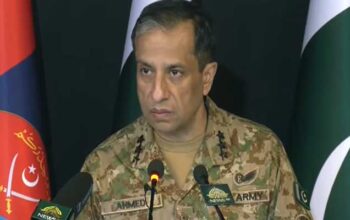
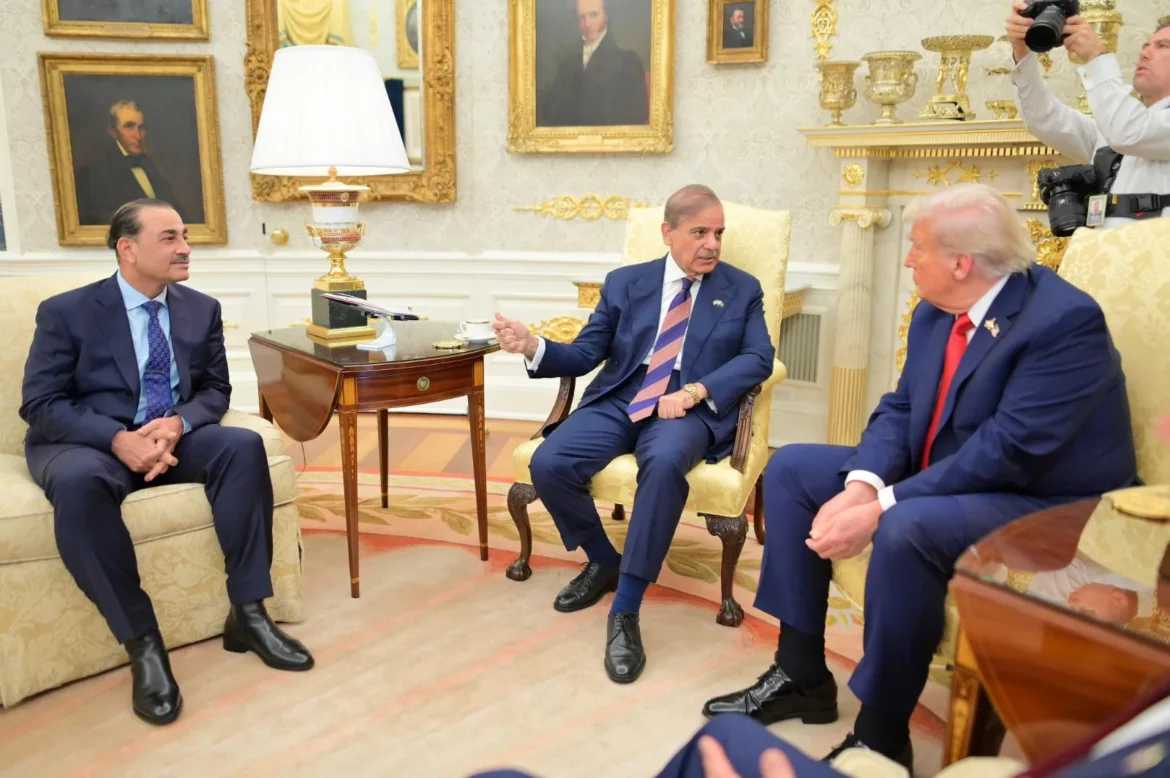
Pakistan’s army chief, Field Marshal Asim Munir spoke by telephone with Trump on Sunday, offering Pakistan as a venue. Prime Minister Shehbaz Sharif followed up with direct conversations with Iranian President Masoud Pezeshkian. According to the Financial Times, negotiations involving senior Trump administration figures — possibly Vice President JD Vance, special envoy Steve Witkoff and Jared Kushner — and Iranian officials such as parliamentary Speaker Mohammad Bagher Ghalibaf or Foreign Minister Abbas Araghchi could open as early as this week.
It is the sort of back-channel diplomacy that middle powers have practiced for decades when great powers stumble into conflict. Pakistan’s pitch rested on the obvious: a 560-mile porous border with Iran, one of the world’s largest Shiite populations outside Iran itself, and military-to-military ties with Washington that have endured even after the American withdrawal from Afghanistan. For Islamabad, the stakes are immediate. Prolonged conflict risks sectarian spillover, fuel shortages and economic shocks in a country already strained by economic instability. Mediation, in this context, is less grand strategy than self-preservation dressed up as statesmanship.
Yet in New Delhi the reaction was visceral. Indian External Affairs Minister S. Jaishankar dismissed Pakistan’s role with a word that still reverberates: “dalal” — broker, middleman, a term freighted in Hindi with connotations of shady dealing. Pakistan, he said, had been playing this part since 1981. India, by contrast, would not act as a “middleman” or “broker nation.” The remark was not a slip; it landed with the force of an official doctrine.
What makes the language so striking is not merely its undiplomatic tone — though that alone would raise eyebrows in any other capital — but the deeper worldview it reveals. It revealed more than irritation. It exposed a worldview in which offering to facilitate peace between warring parties is somehow beneath a rising power’s dignity. Mediation, in Jaishankar’s framing, is not a legitimate instrument of statecraft; it is a concession, a diminishment, a role fit only for those who lack the stature to stand above the fray. Peace, in this telling, is everyone’s business except India’s — or at least not in any way that might require New Delhi to risk its carefully cultivated image of resolute autonomy.
The Indian opposition has seized on the episode with predictable glee. Rahul Gandhi, the Congress leader, called India’s foreign policy under Prime Minister Narendra Modi “a universal joke.” Congress’s Pawan Khera noted that while Modi was “lauding himself at home,” Pakistan had secured a seat at the diplomatic table. They pressed the obvious questions: Why the government’s initial silence on the assassination of Iran’s Supreme Leader Ayatollah Ali Khamenei? Why did Prime Minister Narendra Modi visit Tel Aviv only days before the American and Israeli strikes? What tangible benefits had come from India’s visible alignment with Washington and Jerusalem? Why the reluctance even to issue a timely condolence for a head of state with whom India maintains formal relations?
Former Indian diplomat and politician Shashi Tharoor, rarely one to indulge in rhetorical excess, captured the broader frustration: “If there are peace talks in Pakistan, India has nothing to do with it. I have been calling for almost three weeks now for India to take a leading stand, leveraging its good relations with both sides into a peace initiative. Now, apparently, Pakistan, Egypt and Turkey have done it. Good luck to them, we all want peace. But India gets no credit while Pakistan is holding the peace talks.” Indian domestic backlash was blunt. Sanjay K Jha wrote on X: “Mediation for peace is dalali? All efforts to end war were dalali? That’s his understanding of diplomacy? Jaishankar shows education doesn’t make you civilized.” Jeetender Gupta observed: “That awkward moment when the entire nation talks about using #Mediation to resolve disputes and a minister uses derogatory words like #Dalaal to describe the mediation process.”
The defensiveness is striking because no one prevented India from making its own overtures. Mediation is not a zero-sum prize. Smaller Gulf states — the United Arab Emirates, Qatar, Oman — have repeatedly carved out roles precisely by embracing the ambiguities New Delhi now shuns. Saudi Arabia, according to one retired Indian diplomat with long experience in West Asia, informally asked India to use its good offices with Iran. New Delhi declined, citing insufficient “outreach.” India’s relations with Iran have cooled noticeably. The government’s initial silence on Ayatollah Khamenei’s killing, followed only days later by the foreign secretary signing a condolence book in Delhi, struck many in Tehran — and in the broader region — as too little, too late. The Modi government’s visible warmth toward Israel, including the timing of his visit to Tel Aviv, has been read by some as alignment rather than balance. Perception, as one Indian commentator noted, defines role. Once a country is seen as leaning too visibly toward one side, its usefulness as a bridge shrinks.
Pakistan, by contrast, has leaned into its own contradictions. It maintains military-to-military ties with the United States that have survived even the strains of the post-Afghanistan era, deep strategic links to Saudi Arabia and cultural-religious bonds with Iran. That triangulated connectivity — often criticised inside Pakistan as inconsistency — has become, for the moment, a diplomatic asset. And at the center of it stands Field Marshal Munir himself. Pakistani analysts have celebrated the moment in almost operatic terms. Dawn columnist Nadeem Farooq Paracha hailed “the rise and rise of Asim Munir,” describing him as “clear-headed and decisive. A man who faced outright hatred by the usual idiots.” British-Pakistani journalist Reham Khan asked on Instagram, “Is General Asim Munir now the new candidate for the Nobel Peace Prize?” Columnist Cyril Almeida wrote, “Rumour is reputation… Asim became a global player today,” and later quipped, “Overheard… Nobel for Asim.” Analyst Burhan-ud-din Awan declared on X that “the era of Pakistan’s rise has begun.”
A career military officer who rose through the Inter-Services Intelligence before taking command of the army in 2022, Munir now enjoys sweeping legal immunity after a constitutional amendment last year expanded his authority over all military branches and curtailed the independence of the country’s highest court. He has met Trump twice; the American president has referred to him as his “favorite field marshal.” Pakistani security analyst Qamar Cheema noted that “Pakistan likely never had the kind of access to the White House it has now.” Kamran Bokhari of the New Lines Institute in Washington observed that “it is in Pakistan’s interest to ensure that the United States reach an understanding with Iran…. Islamabad does not want the state to collapse in Tehran even as the regime is being severely degraded.”
Other say geography and self-interest converge: prolonged war risks sectarian spillover, fuel shortages and economic shocks in a country already battling inflation. Mediation here is not grandstanding; it is survival dressed up as statesmanship.
The Indian reaction — the “dalal” slur, the insistence that India will not “run around asking countries what kind of brokerage we can do” — feels, at times, less like principled restraint than fear of missing out. The discomfort is palpable. For a nation that has spent the past decade projecting itself as a decisive global player — a voice of the Global South, a Quad partner, a member of the G-20 inner circle — being absent from the high table at a moment when energy prices spike and supply lines from Qatar (which supplies 41 percent of India’s LNG) tremble is galling. The result is a curious spectacle — a rising power treating a neighbour’s pragmatic initiative not as a contribution to peace but as a personal slight.
Yet the deeper irony is this: no one in Washington, Tehran or Riyadh prevented India from offering its own good offices. Pakistan’s success does not preclude parallel efforts. Mediation is not a zero-sum game; it is, at its best, a multiplication of channels until one proves fruitful. Countries far smaller than India — the United Arab Emirates, Qatar, Oman — have carved out roles in regional de-escalation precisely by embracing the ambiguities that New Delhi now seems to shun. India’s reluctance is not about capability but about choice: a choice to prioritise narrative control over diplomatic agility, to treat neutrality as weakness rather than strength. The language of brokerage and middlemen may play well in domestic politics, but it reveals a curious insecurity: a rising power that fears being seen as merely useful.
The United States and Iran may yet reach an understanding, or they may not. The five-day pause in strikes on Iranian energy infrastructure that Trump announced is already qualified and fragile. If talks in Islamabad produce even a temporary truce, credit will accrue less to Pakistan’s genius than to the raw logic of exhaustion on all sides. What Pakistan has demonstrated, however, is a willingness to be useful — to absorb the contradictions of geography, history and great-power politics without demanding ideological purity first. In the end, peace in West Asia is not Pakistan’s prize to claim or India’s loss to resent. It is a shared necessity.
Copyright © 2021 Independent Pakistan | All rights reserved