By Staff Reporter
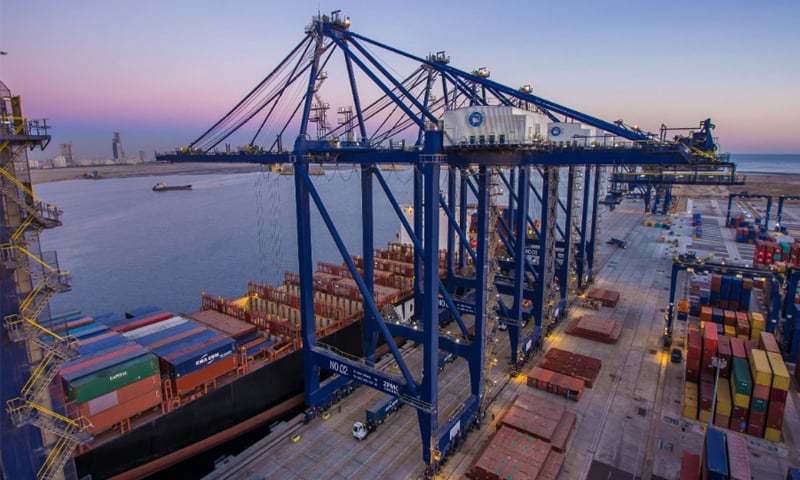
KARACHI: Long queues of container ships have begun forming at Pakistan’s Karachi ports as global shipping lines divert vessels from the Strait of Hormuz amid heightened risks from the ongoing Middle East conflict, with government facilitation measures accelerating the shift.
The rerouting has produced a sharp, if still limited, rise in transhipment activity, positioning Karachi — and potentially Gwadar — as alternative hubs outside the region’s vulnerable maritime chokepoints. Official data show transhipment volumes at Karachi reached 8,860 containers in the past 24 days alone, already eclipsing the full-year 2025 total of 8,300 containers.
The Karachi Port Trust reported that three private terminals handled more than 8,300 twenty-foot equivalent units, or TEUs, of transhipment cargo so far this month. Karachi Gateway Terminal Ltd., operated by UAE-based AD Ports Group, managed 1,200 TEUs; Karachi International Container Terminal, run by China’s Hutchison Ports, handled 1,827 TEUs; and South Asia Pakistan Terminal Ltd., also under Hutchison, accounted for 5,286 TEUs.
Pakistan revised its international transhipment rules last week to allow cargo handling both inside and outside its sea and airports, including storage in bonded areas, off-dock terminals and other facilities to prevent congestion. The changes followed direct appeals from shipping-line representatives as Dubai, Salalah and other Middle Eastern ports faced closures tied to the conflict.
“We told the government that all Dubai, Salalah and the Middle Eastern ports are closed,” said Syed Tahir Hussain, secretary-general of the Pakistan Ships’ Agents Association, which represents carriers including Maersk and China Ocean Shipping Co. “Shipping lines are all worried.” He added that the government responded by permitting storage of transhipment goods — containers, bulk, break-bulk or liquid cargo — in bonded areas and off-dock terminals. “Ships that were supposed to go to Dubai and Salalah have already unloaded transhipment cargo here.”
The conflict, which began with U.S.-Israeli strikes on Feb. 28, has already driven up oil and gas prices and increased insurance and security risks for vessels transiting Gulf waters. Shipping companies are now favouring Karachi to sidestep those concerns and maintain supply-chain continuity.
The government has moved quickly to capitalise on the opportunity. It has formed specialised sub-committees to recommend structural reforms in the maritime and logistics sectors, reduced port charges to improve competitiveness, expedited clearance of long-pending cargo and introduced targeted policies to support transhipment.
Both Karachi and Gwadar, located outside narrow chokepoints, are now being tested as potential gateways for trade with Gulf Cooperation Council countries and beyond, particularly in petroleum products and liquefied petroleum gas.
Industry officials described the diversion as an unprecedented surge that has turned Pakistan into an emerging alternative hub. Yet analysts caution that the gains, while notable, remain modest. “From an economic standpoint, while this activity does generate some incremental port-related income through standard handling and dues, there are no additional windfall gains,” said Unzilla Shaikh, an investment analyst at Karachi-based Arif Habib Ltd. “The overall benefit remains modest.”
Private terminals currently pay royalties to port operators ranging from $15 to $36 per container for vessel moves, according to officials who asked not to be identified because they were not authorized to speak publicly. South Asia Pakistan Terminal pays $17.72 per container to the Karachi Port Trust; Karachi International Container Terminal pays $32; Karachi Gateway Terminal pays $36; and Qasim International Container Terminal pays $15 to the Port Qasim Authority.
Even with the uptick, volumes are still small relative to the potential. “This 8,000 TEUs local terminals have handled this month is still a very little volume,” one terminal official said. The influx has already created congestion. Hussain noted that storage at two or three ships has filled up, leaving “no more space left.” A Karachi Port Trust spokesman did not respond to questions about the congestion, citing the need for higher-authority approval.
Khurram Mukhtar, patron-in-chief of the Pakistan Textile Exporters Association, said the evolving global trade dynamics have made Pakistan a safer, more stable and increasingly attractive destination for international trade, investment and transhipment.
The association has proposed creating a centralised monitoring and response unit within the Pakistan Single Window system to act as a real-time control tower. The unit would track import and export cargo flows, identify bottlenecks at ports, terminals, shipping lines and transhipment hubs, and coordinate with stakeholders for rapid resolution.
It has also called for comprehensive service-level benchmarks across the maritime chain — covering ports, terminal operators, shipping lines and allied providers — aligned with international best practices to improve predictability, cut dwell times and sharpen competitiveness. In addition, the group wants mandatory advance manifest filing by all shipping lines to boost planning and operational efficiency.
Hussain, whose association represents about 50 foreign shipping lines, said the current disruption offers Pakistan a rare opening to become a permanent transhipment choice. “Previously, we were not even in the race,” he said. “Now, due to the Middle East disruption, Pakistan has a unique opportunity as ships are looking for nearby alternatives, and Pakistan is the closest. They can unload here and move later when conditions improve.”
To lock in those gains, he added, Pakistan must make port tariffs more competitive than those in Dubai, Salalah, Colombo, India or Hong Kong. Whether the current surge translates into lasting structural advantage will depend on how quickly the government and port operators can address congestion, deliver on promised reforms and sustain the momentum once Gulf routes eventually reopen.
Copyright © 2021 Independent Pakistan | All rights reserved