By Staff Reporter
ISLAMABAD: Pakistan is organising a high-level national dialogue early next week to hammer out an “all-inclusive” strategy on austerity and energy conservation, after the country’s four provinces signalled they are unwilling to shoulder a collective Rs200 billion share of the fuel-subsidy bill amid surging international oil prices.
Background talks with senior officials indicate the provinces made their position clear on Friday during a consultative meeting chaired by Finance Minister Muhammad Aurangzeb. Punjab and Sindh—the two largest provinces, which together account for more than three-quarters of the national economy—explicitly recommended letting global prices flow through to domestic consumers to encourage behavioural change and reduce consumption.
A national leadership dialogue is now set for March 30 or 31 and will bring together President Asif Ali Zardari, Prime Minister Shehbaz Sharif, the four chief ministers and their senior teams, according to a senior government official. The goal, the official said, is to build consensus on measures that can contain the fiscal and external-account fallout with the least possible economic and social disruption.
At the Friday meeting, provincial representatives questioned the logic of asking citizens to cut fuel use while prices remain artificially suppressed by federal and provincial subsidies. Their scepticism was reinforced by data from the Petroleum Division showing that consumption in March has so far run significantly higher than the same period a year earlier.
The federal government has assembled a Rs160 billion pool—built largely from Rs100 billion in development-program cuts and austerity savings—but made clear that its fiscal capacity is limited. Provinces were asked to contribute the remaining Rs200 billion. Punjab was expected to provide more than Rs102 billion and Sindh roughly Rs60 billion. Khyber Pakhtunkhwa and Balochistan were penciled in for about Rs30 billion and Rs20 billion, respectively and did not object outright, apparently mindful of the firmer stance taken by the larger provinces.
Participants also reviewed a menu of contingency steps should the Middle East crisis drag on and global conditions deteriorate further. Options discussed included fuel rationing, potential lockdowns, extended school holidays, shorter workweeks in both public and private sectors, and a 50% work-from-home policy across the economy. Each proposal was presented with its estimated financial impact and potential savings.
At least three provinces argued that the immediate problem is not physical supply constraints but pricing policy and the architecture of subsidies. Khyber Pakhtunkhwa, in particular, opposed any lockdown-style measures, warning they would cripple economic activity and hit daily-wage earners and private-sector workers hardest.
Sindh’s Murad Ali Shah stressed the importance of sending clear price signals to educate consumers on conservation. Punjab’s representative noted that the province had already spent more than Rs100 billion on last year’s flood relief and rehabilitation while still being asked to find a similar sum for fuel subsidies and maintain a budget surplus required under the International Monetary Fund program.
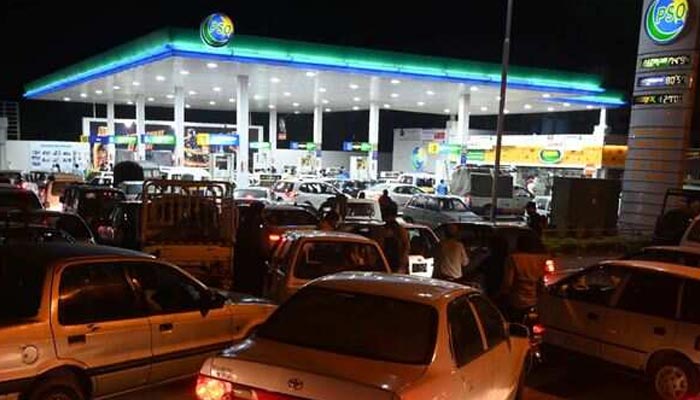
Petroleum Minister Ali Pervaiz Malik and his team reported that diesel prices have risen 5-6% since the previous Friday, while petrol prices have fallen about 6%. They noted that virtually all oil-importing countries—and even some producers—have passed higher costs on to consumers, with Bangladesh the only notable exception currently experiencing runs on fuel pumps.
The meeting reached broad agreement on a narrowly targeted subsidy for motorcyclists, capped at 20 liters per month per user, while higher-volume consumers would pay full market rates. The mechanism would be delivered through a mobile-application-based quota system designed to reach low-income groups and limit leakages.
The Ministry of Information Technology presented technical details of the proposed platform. A free, pre-installed app would be provided to retailers, while consumers would use a separate application. Vehicle-specific quotas would be linked to registration numbers and Computerised National Identity Cards (CNICs). Users would generate digital vouchers that retailers scan or input; the system would automatically enforce the remaining quota—for example, dispensing only 15 litres if a 20-litre request exceeds the user’s balance. Final quota limits will be set by the relevant cabinet committee.
Each of the roughly 12,000 petrol pumps nationwide would designate two nozzles for subsidised fuel and must maintain at least two mobile devices for system operations. The ministry is coordinating with manufacturers to supply specialised Android smartphones at an estimated cost of Rs36,000 per unit (retail price around Rs72,000). Petrol stations have been instructed to deposit the necessary funds into a designated government account to expedite procurement.
Copyright © 2021 Independent Pakistan | All rights reserved