By Staff Reporter
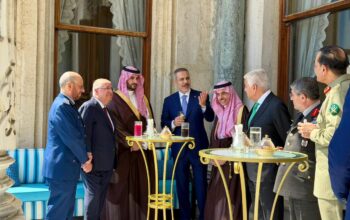
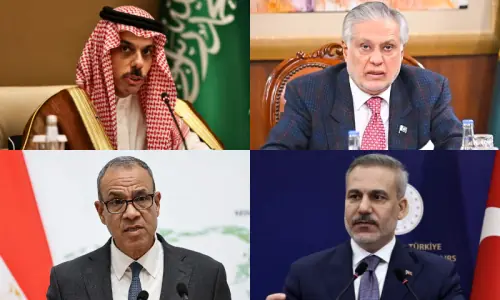
ISLAMABAD: Pakistan will host the foreign ministers of Saudi Arabia, Turkey and Egypt this weekend for two days of discussions focused on de-escalating the widening regional conflict sparked by the U.S.-Israeli war against Iran, the Foreign Office said on Saturday.
The meetings, scheduled for March 29 and 30 in Islamabad, come at the invitation of Deputy Prime Minister and Foreign Minister Ishaq Dar. Saudi Arabia’s Prince Faisal bin Farhan Al Saud, Turkey’s Hakan Fidan and Egypt’s Badr Abdelatty are expected to hold in-depth talks on a range of issues, including efforts to reduce tensions across the Middle East, the Foreign Office said in a statement. The visiting ministers will also call on Prime Minister Shehbaz Sharif.
“Pakistan highly values its relations with the brotherly countries of Saudi Arabia, Türkiye, and Egypt,” the statement said. “The visit will provide an opportunity to further strengthen Pakistan’s cooperation and coordination with these countries across multifaceted areas of mutual interest.”
The gathering was originally planned for Turkey but was moved to Islamabad, reflecting Pakistan’s deepening role as a potential broker in indirect talks between the United States and Iran. Officials said the shift underscores Islamabad’s growing centrality in the diplomatic manoeuvring, making a meeting on Turkish soil less practical. The change has fueled speculation that Pakistan could soon host direct or indirect negotiations between Iranian and American officials. On Tuesday, Sharif formally offered Islamabad as a venue for such talks, “subject to concurrence by the US and Iran,” according to Pakistani officials.
The four-country mechanism involving Pakistan, Saudi Arabia, Turkey and Egypt took shape on March 19 on the sidelines of a gathering of 10 Arab and Muslim nations in Riyadh. What began as discussions framed around defence cooperation has evolved into a more explicit diplomatic track aimed at mediation, according to officials familiar with the process.
Egyptian intelligence officials subsequently opened channels with Iran’s Islamic Revolutionary Guard Corps, after which Pakistan emerged as the lead facilitator in the broader engagement, the officials said.
Dar has maintained an active pace of diplomacy in recent days. On Friday, he held separate telephone conversations with the Egyptian and Turkish foreign ministers to review the rapidly evolving regional situation. All three emphasised the need for dialogue and collective action to promote peace, the Foreign Office reported.
Dar also spoke by phone with United Nations Secretary-General António Guterres, who “extended his full support for Pakistan’s ongoing diplomatic efforts in pursuit of peace and stability in the region,” according to the Pakistani readout.
China has signalled strong backing for Islamabad’s role. In a conversation with Dar on Friday, Chinese Foreign Minister Wang Yi told his Pakistani counterpart that Beijing endorsed Pakistan’s mediation efforts and had urged Tehran to engage, noting that the moment was opportune given the pressure on the United States. The same day, Kuwait’s Crown Prince Sheikh Sabah Al Khaled Al Hamad Al Sabah called Sharif and “fully endorsed” Pakistan’s mediation initiative, the prime minister’s office said.
Pakistan has positioned itself at the center of an emerging mediation process between Washington and Tehran, working in close coordination with Ankara and Cairo. Dar confirmed Thursday that indirect U.S.-Iran talks are underway, with messages being relayed through Pakistani channels. He said a 15-point framework proposed by the United States had been shared with Iranian officials and was under deliberation in Tehran. Turkey and Egypt are supporting the effort, Dar added.
Iranian media, citing an unnamed official, have reported that Tehran has outlined five conditions under which it would agree to end the current conflict. The weekend meetings in Islamabad are expected to build on these parallel diplomatic threads, even as the broader regional crisis continues to unfold. Pakistani officials have described the gathering as part of a sustained push to prevent further escalation and create space for negotiated de-escalation.
Copyright © 2021 Independent Pakistan | All rights reserved