By Staff Reporter
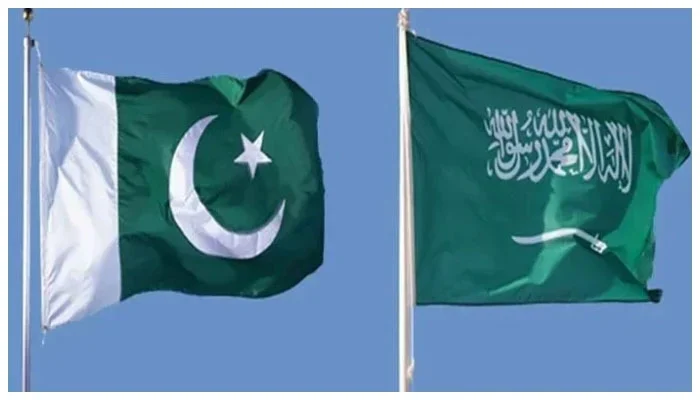
ISLAMABAD: Pakistan has dispatched fighter jets and support aircraft to Saudi Arabia, the Saudi defense ministry announced on Saturday, in the latest sign of deepening military ties between the two longtime allies as Islamabad works to broker an end to the conflict with Iran.
The deployment, which arrived at King Abdulaziz Air Base in Saudi Arabia’s eastern province, comes days after Iranian strikes hit key Saudi energy infrastructure, including a major attack on the sprawling Jubail petrochemicals complex on Monday that killed a Saudi national, according to three sources familiar with the matter, including a senior Pakistani government official.
Saudi officials described the move as a step to bolster joint defence cooperation and promote regional and international security and stability. The Pakistani official emphasised that the aircraft “were not there to attack anyone.” Instead, the sources said, the deployment was intended to reassure Riyadh that Islamabad would stand ready to help defend the kingdom against further Iranian attacks — a commitment that could otherwise complicate the delicate US-Iran peace negotiations now underway in the Pakistani capital.
The arrival of the jets was first reported by Saudi state media as occurring under the terms of a mutual defence pact the two countries signed in September 2025. The agreement treats any aggression against one as an attack on both, formalising and significantly expanding a security partnership that has endured for decades. Pakistan has long provided military training and advisory support to Saudi Arabia, while Riyadh has repeatedly extended financial lifelines to Pakistan during periods of economic distress.
The timing of the deployment is particularly striking. Pakistan is simultaneously hosting high-level US-Iran talks aimed at ending the Middle East war that has drawn in much of the Gulf. Pakistani, Saudi, Egyptian and Turkish officials have been engaged in parallel mediation efforts, including a round of talks last month, to find an off-ramp from the fighting. Iran’s retaliatory strikes have hit Gulf targets repeatedly, with the United Arab Emirates sustaining more attacks than any other country and adopting a notably hawkish stance toward Tehran. Some Emirati analysts and pundits have publicly criticised Pakistan and Egypt for their mediation roles, though Abu Dhabi has not issued an official comment on the diplomatic track.
The military move coincided with a high-profile economic visit. Saudi Finance Minister Mohammed al-Jadaan arrived in Islamabad in what one source familiar with the discussions described as a show of “economic support.” He met Friday with Prime Minister Shehbaz Sharif, along with Deputy Prime Minister and Foreign Minister Ishaq Dar, Chief of Defence Forces Field Marshal Asim Munir, Finance Minister Muhammad Aurangzeb and Petroleum Minister Ali Pervaiz Malik.
According to an official readout from Sharif’s office, the prime minister conveyed greetings to King Salman bin Abdulaziz and Crown Prince Mohammed bin Salman, recalling a recent cordial telephone conversation with the crown prince. Sharif expressed appreciation for Saudi Arabia’s “longstanding economic and financial assistance,” which he said had been “vital” to Pakistan’s economic stability. He reaffirmed that Pakistan and Saudi Arabia stand “shoulder to shoulder” and emphasized Islamabad’s commitment to expanding cooperation in trade, investment and economic development. Al-Jadaan, for his part, reiterated the kingdom’s resolve to strengthen the “deep-rooted fraternal bonds” between the two countries, as envisioned by the crown prince.
The economic dimension of the relationship is increasingly urgent for Pakistan. Islamabad announced recently that it would return more than $3 billion in loans to the United Arab Emirates — including $3.5 billion that Abu Dhabi had been rolling over since 2018 — part of a broader $4.8 billion in debt repayments due this month. In the absence of fresh assistance, Pakistan’s foreign-exchange reserves could fall to $11.5 billion.
Pakistan relies heavily on International Monetary Fund programs and bilateral loans from friendly governments, including Saudi Arabia and the UAE, to service debt that consumes roughly half its annual revenues. A Saudi oil facility is due to expire this month, and Islamabad has requested a five-year extension. It is also seeking to at least double a $5 billion Saudi cash deposit currently supporting its reserves.
Sharif postponed Aurangzeb’s scheduled trip to Washington for the IMF-World Bank spring meetings by two days to accommodate al-Jadaan’s visit. Before traveling to Washington, the Pakistani finance minister held a telephone conversation with his Saudi counterpart to discuss financial support.
The Saudi visit comes against the backdrop of shifting alliances in the Gulf. Once close partners, Saudi Arabia and the UAE have seen relations sour in recent years over differing positions in Yemen, Sudan and the Horn of Africa. Pakistan, which has maintained strong ties with both, finds itself navigating these tensions while leaning heavily on Riyadh for both security and economic backing.
The defence pact and the current deployment reflect the kingdom’s enduring reliance on Pakistan’s military capabilities, including its status as a nuclear-armed state. For Pakistan, the relationship offers not only financial breathing room but a strategic counterweight in a volatile region.
Copyright © 2021 Independent Pakistan | All rights reserved