By Staff Reporter
ISLAMABAD: Direct talks between the United States and Iran, mediated by Pakistan, stretched into a third round on Sunday as teams of experts from both sides pored over one another’s demands in an effort to convert a two-week-old ceasefire into a permanent end to six weeks of devastating conflict.
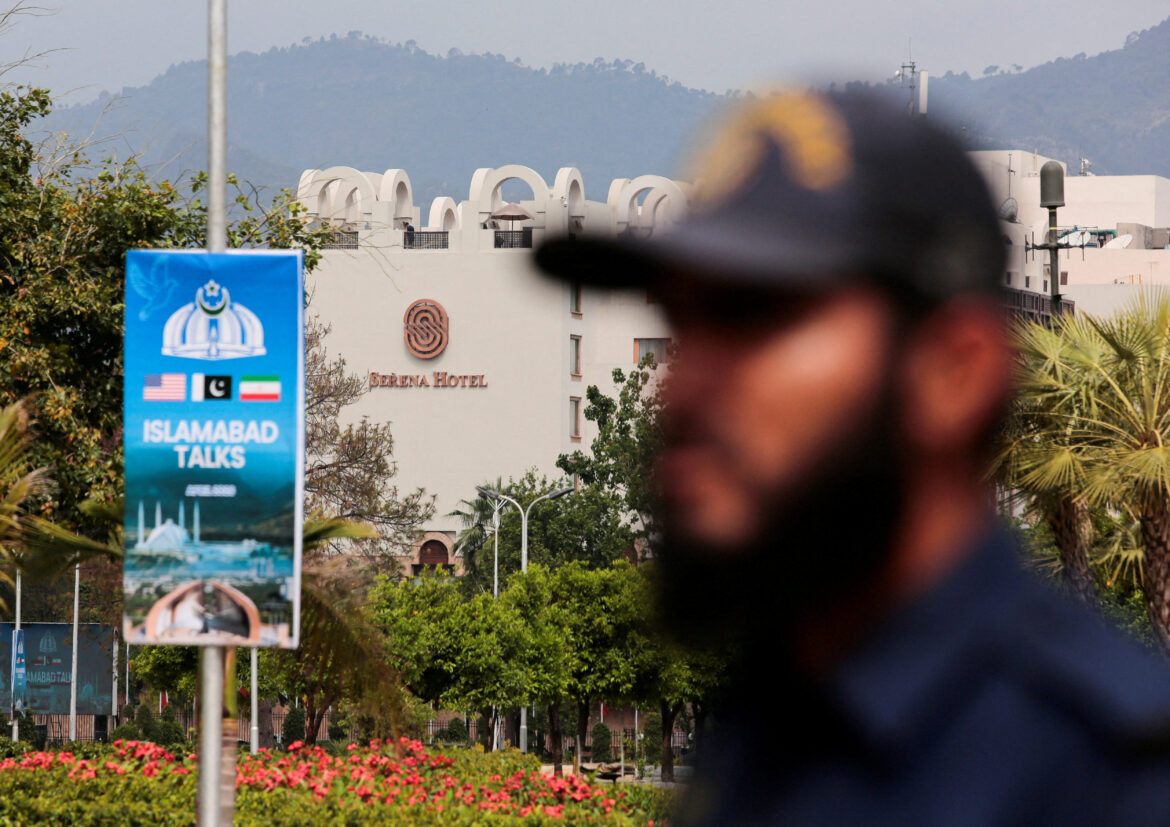
The negotiations, held at the Serena Hotel in Pakistan’s capital, marked the first face-to-face engagement between senior American and Iranian officials since the 1979 Islamic Revolution and the first such talks since the 2015 nuclear agreement that President Donald Trump later abandoned. What began as proximity talks — with the delegations in separate rooms and Pakistani officials shuttling proposals — transformed dramatically Saturday into direct, across-the-table discussions.
Iranian state media and a government post on X described the Saturday session as having reached the “expert-level stage,” with economic, military, legal and nuclear committees joining the deliberations. “Negotiations continue at the Serena Hotel to finalise technical details,” the post added. Earlier Saturday night, after hours of in-person discussion, the teams exchanged written texts.
The shift to direct talks was confirmed by multiple accounts. Pakistan’s state-run PTV reported that “Peace talks of historic significance between Iran and the United States have commenced in Islamabad, where for the first time after tensions, representatives from both sides are sitting directly at the same table.” Al Jazeera, citing sources close to the mediation, called the development dramatic.
The American delegation is led by Vice President JD Vance. The Iranian side is headed by Parliament Speaker Mohammad Bagher Ghalibaf and includes Foreign Minister Abbas Araghchi, Supreme National Defence Council Secretary Ali Akbar Ahmadian and central bank governor Abdolnaser Hemmati. Prime Minister Shehbaz Sharif, whose government brokered the April 8 ceasefire after weeks of intensive behind-the-scenes diplomacy, met separately Saturday with both delegations. In a statement issued by his office, Sharif commended the commitment of both sides to engage constructively and expressed hope that the talks would serve as “a stepping stone toward durable peace in the region.” He reiterated Pakistan’s readiness to continue facilitating the process.
Sharif first received Vance, who arrived shortly after 11 a.m. at Nur Khan Air Base and was greeted on the tarmac by Deputy Prime Minister and Foreign Minister Ishaq Dar, Interior Minister Mohsin Raza Naqvi and Chief of Army Staff Field Marshal Syed Asim Munir. Vance was accompanied by Jared Kushner, President Trump’s son-in-law and senior adviser, special Middle East envoy Steve Witkoff, and officials from the National Security Council, State Department and Pentagon.
Later, Sharif met the Iranian delegation. The Prime Minister’s Office said he appreciated Iran’s engagement and affirmed Pakistan’s “sincere resolve to continue playing its role as a mediator to help build momentum towards achieving meaningful results in the interest of regional and global peace and stability.”
The talks represent the highest-level direct contact between Washington and Tehran since the revolution. They opened after a six-week war that began Feb. 28 with coordinated US-Israeli strikes that assassinated Supreme Leader Ali Khamenei and targeted Iranian military and nuclear sites. Iran responded by disrupting shipping through the Strait of Hormuz, firing missiles at Israel and striking US bases across the Gulf. More than 2,000 people died in the initial phase alone, with the fighting spreading instability across the region and triggering the largest oil supply shock in memory.
The Iranian delegation arrived dressed in black in mourning for Khamenei and other Iranians killed in the conflict. According to the Iranian government, they carried shoes and bags belonging to students killed when the United States bombed a school next to a military compound. The team’s arrival came only after a last-minute crisis over Israeli strikes in Lebanon was eased. Tehran had insisted the talks could not begin without a halt to those attacks — a condition Pakistani officials said was part of the original ceasefire understanding.
Ghalibaf stated Friday evening that participation hinged on two non-negotiable steps: an immediate ceasefire in Lebanon and the release of about $7 billion in Iranian assets frozen abroad. “These steps must be fulfilled before negotiations begin,” he said. An Iranian official told local media that Tehran had drawn a firm red line: “We forced a pause in attacks in Beirut and Dahieh by making it a red line in negotiations and also made it clear that if Israel crosses it again, talks would be off.”
The agenda is built around Iran’s 10-point proposal, which Washington has accepted as a general framework. Deep differences remain. The United States is expected to demand limits on Iran’s nuclear program — including curbs on uranium enrichment and possible removal of nuclear material — along with restrictions on ballistic missiles, verifiable sanctions relief tied to concessions, and the full reopening of the Strait of Hormuz.
Iran is seeking full sanctions relief, formal recognition of its nuclear rights, greater control over the strategic waterway including the right to impose transit tolls, an end to regional military operations including in Lebanon, and immediate access to its frozen funds. Regional proxy networks, missile ranges and the sequencing of any concessions are additional flashpoints.
Tensions over the ceasefire’s scope have shadowed every step. Iran insists any durable agreement must extend to all fronts, including Israel’s operations against Hezbollah in Lebanon. The United States and Israel have treated the Lebanon theater as outside the truce, despite what Tehran and Pakistan describe as an initial understanding. That divergence nearly derailed the talks before they began and continues to threaten the process.
Trump has described the negotiations as “very deep” while cautioning that “regardless of what happens, we win.” Vance, speaking before departure from Washington, described the expected outcome as potentially “positive” while cautioning that the U.S. team would negotiate in good faith but would not be “receptive” to stalling tactics. Trump struck a sharper tone, warning that Iran had “not many cards” left and that military action could resume if the talks failed. He has criticized Tehran for ongoing restrictions on shipping through the Strait of Hormuz, which remains a central point of leverage. On Friday, Trump told reporters the waterway would open “fairly soon,” noting that other countries using it would help, and expressed frustration with NATO allies for not committing more quickly to secure the route.
Ship traffic through the Strait of Hormuz has remained at a virtual standstill despite the April 8 ceasefire. MarineTraffic and other trackers reported only 14 vessels — half laden — had crossed since then, compared with more than 100 daily before the conflict. Sanctioned or shadow-fleet vessels made up nearly two-thirds of the limited traffic. Britain has scheduled a senior officials’ planning meeting next week with about 30 nations to discuss reopening the strait, explicitly opposing any Iranian-imposed tolls. Prime Minister Keir Starmer has called it essential to restore a “viable plan” for global energy flows. Foreign Minister Araghchi said Tehran was entering the talks with “deep distrust” rooted in past broken agreements and remained prepared to retaliate if attacked again.
A Pakistani source familiar with the arrangements said it was too early to predict whether Saturday’s opening round would conclude the same day, adding that there was no fixed time limit. Officials and analysts agree that the breadth of issues makes immediate breakthroughs improbable in the opening two-day session. At best, the talks could map a pathway for future rounds and produce limited de-escalation steps on Lebanon and the Strait of Hormuz.
Pakistan’s leadership has framed the moment as “make or break.” Sharif described the negotiations as a critical opportunity to resolve contentious issues through dialogue while acknowledging the complexity. Dar, welcoming Vance, commended the US commitment to regional and global peace. Masood Khan, Pakistan’s former ambassador to the United States, said Pakistan had worked hard behind the scenes and was “very hopeful and optimistic.” He called the war devastating not only for Iran and the Gulf but for the global economy, urging a swift permanent end.
Security across Islamabad remained extraordinarily tight. Authorities declared a two-day public holiday, sealing roads, deploying hundreds of military, paramilitary and police personnel, and locking down the Red Zone around key government and diplomatic sites. The Serena Hotel was cleared and placed under government control. Streets that are normally bustling were largely deserted.
The simple fact that senior delegations from Washington and Tehran are meeting in a third country after decades of estrangement represents a rare diplomatic opening — one now unfolding under the strain of ongoing violence in southern Lebanon, minimal Gulf shipping and profound mutual mistrust. Pakistan has positioned itself as facilitator rather than arbiter, drawing quiet support from Saudi Arabia, Egypt, Turkey and others. The international community has welcomed Islamabad’s role, but the hard decisions — and the risk of failure — rest squarely with the United States and Iran.
Copyright © 2021 Independent Pakistan | All rights reserved