By Staff Reporter
ISLAMABAD: Vice President JD Vance said on Sunday the United States and Iran had made no breakthrough after 21 hours of substantive, face-to-face negotiations in Pakistan’s capital, the first direct talks between senior officials from the two countries since the 1979 Islamic Revolution.
Speaking at a news conference here after the sessions stretched into a second day, Vance said the delegations had engaged in detailed discussions but that Tehran had rejected Washington’s core demands, particularly on preventing Iran from developing nuclear weapons or the means to produce them rapidly.
“We have been at it now for 21 hours, and we have had a number of substantive discussions — that’s the good news,” Vance said. “The bad news is that we have not reached an agreement.”
“We have made very clear what our red lines are, what things we are willing to accommodate them on and what things we are not willing to accommodate them on.” The Iranian side, he said, “chose not to accept our terms.”
The talks, hosted and mediated by Pakistan at the Serena Hotel, began Saturday afternoon as proximity negotiations — with the two delegations in separate rooms and Pakistani officials shuttling proposals back and forth. They quickly evolved into direct, across-the-table discussions, a dramatic shift confirmed by Pakistani state television and multiple diplomatic accounts. The sessions marked the highest-level contact between Washington and Tehran in nearly half a century and the first since the 2015 nuclear accord that President Donald Trump abandoned during his first term.
Vance opened the news conference by thanking his Pakistani hosts, Prime Minister Shehbaz Sharif and Field Marshal Asim Munir, the chief of army staff, describing them as “incredible hosts.” He stressed that any shortcomings in the talks were not the fault of the Pakistanis, who “did an amazing job and really tried to help us and the Iranians bridge the gap and get to a deal.”
When pressed for details on Iran’s objections, Vance declined to negotiate publicly after 21 hours of private bargaining. He emphasised only the central US objective: “an affirmative commitment that they will not seek a nuclear weapon and that they will not seek the tools that would enable them to quickly achieve a nuclear weapon.” That demand, he said, represented “the core goal of the U.S. president.”
The Iranian delegation, led by Parliament Speaker Mohammad Bagher Ghalibaf and including Foreign Minister Abbas Araghchi, Supreme National Defence Council Secretary Ali Akbar Ahmadian and central bank governor Abdolnaser Hemmati, arrived dressed in black in mourning for Supreme Leader Ali Khamenei and other Iranians killed in the conflict. Iranian state media reported that the team carried personal items — shoes and bags — belonging to students killed when the United States bombed a school adjacent to a military compound.
On the Iranian side, Foreign Ministry spokesman Esmaeil Baqaei described the marathon sessions in a series of posts on X. “It was a busy and long day for the delegation of the Islamic Republic of Iran in Islamabad,” he wrote, noting that “numerous messages and texts have been exchanged between the two sides.” Discussions, he said, covered “various dimensions of the main negotiation topics, including the Strait of Hormuz, the nuclear issue, war reparations, lifting of sanctions, and the complete end to the war against Iran and in the region.”
Baqaei added that Tehran’s negotiators were “employing all their capabilities, experience, and knowledge to safeguard Iran’s rights and interests,” their resolve hardened by “the heavy loss of our great elders, dear ones, and fellow countrymen.” He expressed appreciation to Pakistan’s government and people “for hosting the negotiations and their benevolent efforts in advancing this process,” while warning that success would depend on the other side showing “seriousness and good faith,” refraining from “excessive demands and unlawful requests,” and accepting “Iran’s legitimate rights and interests.”
The negotiations are an attempt to convert a fragile ceasefire, brokered by Pakistan on April 8, into a permanent end to six weeks of devastating conflict that began Feb. 28 with coordinated U.S.-Israeli strikes that killed Khamenei and targeted Iranian military and nuclear facilities. Iran responded by disrupting shipping through the Strait of Hormuz, firing missiles at Israel and striking U.S. bases in the Gulf. More than 2,000 people died in the opening phase alone.
The agenda is built around Iran’s 10-point proposal, which Washington has accepted as a framework. Significant gaps remain. The United States is pressing for strict limits on uranium enrichment, removal of nuclear material, curbs on ballistic missiles and verifiable sanctions relief linked to Iranian concessions. Iran is demanding full sanctions relief, formal recognition of its nuclear rights, greater authority over the Strait of Hormuz — including the right to impose transit tolls — an end to regional military operations, including in Lebanon, and immediate access to roughly $7 billion in frozen assets abroad.
Tensions over the ceasefire’s geographic scope have loomed over every stage. Iran has insisted that any durable deal must cover all fronts, including Israeli operations against Hezbollah in Lebanon. Washington and Israel have treated the Lebanon theatre as separate, despite what Tehran and Pakistani officials described as an initial understanding. That dispute nearly prevented the talks from starting and continues to threaten their progress.
Prime Minister Sharif, who met separately with both delegations, issued a statement commending their constructive engagement and expressing hope that the talks would become “a stepping stone toward durable peace in the region.” He reiterated Pakistan’s willingness to keep facilitating. Sharif first received Vance, who arrived shortly after 11 a.m. Saturday at Nur Khan Air Base, and was greeted by Deputy Prime Minister Ishaq Dar, Interior Minister Mohsin Raza Naqvi and Field Marshal Munir. Vance was accompanied by senior adviser Jared Kushner, special Middle East envoy Steve Witkoff and officials from the National Security Council, State Department and Pentagon.
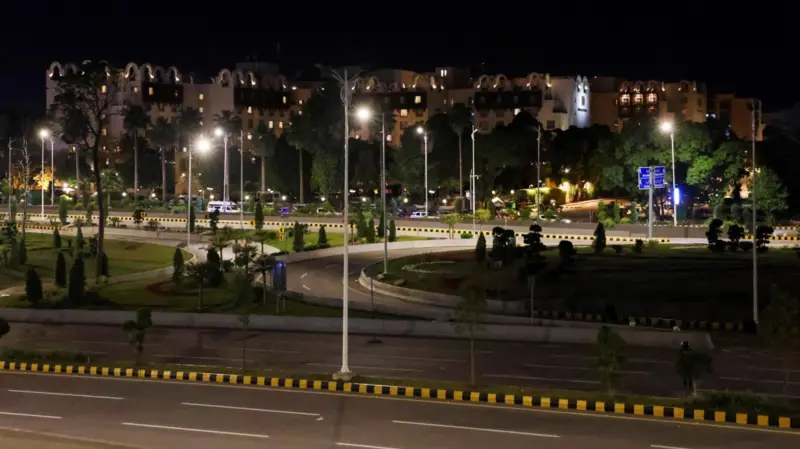
Security in Islamabad was extraordinary. Authorities declared a two-day public holiday, sealed major roads, deployed hundreds of troops and police, and locked down the Red Zone around government and diplomatic sites. The Serena Hotel was placed under full government control; normally bustling streets were deserted.
Ship traffic through the Strait of Hormuz has remained at a near standstill since the ceasefire, with marine trackers reporting only a fraction of prewar volumes. The waterway remains a central point of leverage and contention. Trump has warned that Iran has “not many cards left” and that military action could resume if the talks collapse. Vance, before leaving Washington, described the potential outcome as “positive” but cautioned that the U.S. side would not tolerate stalling.
Pakistani officials and analysts said the breadth of issues made an immediate breakthrough unlikely in the opening two-day session. At best, they said, the talks could outline a roadmap for future rounds and produce modest de-escalation steps on Lebanon and the strait.
For now, the simple fact of senior American and Iranian delegations sitting across from each other in a third country — after decades of estrangement and under the shadow of recent war — represents a rare diplomatic opening. Pakistan has cast itself as facilitator, not arbiter, with quiet backing from Saudi Arabia, Egypt, Turkey and others. The hard choices, and the risk that the process could fail, rest with Washington and Tehran.
Copyright © 2021 Independent Pakistan | All rights reserved