By Staff Reporter
ISLAMABAD: Vice President JD Vance said on Sunday the United States and Iran had failed to reach any agreement after more than 21 hours of direct, high-stakes negotiations here, the first face-to-face talks between senior officials of the two nations in more than four decades and the highest-level contact since the 1979 Islamic Revolution.
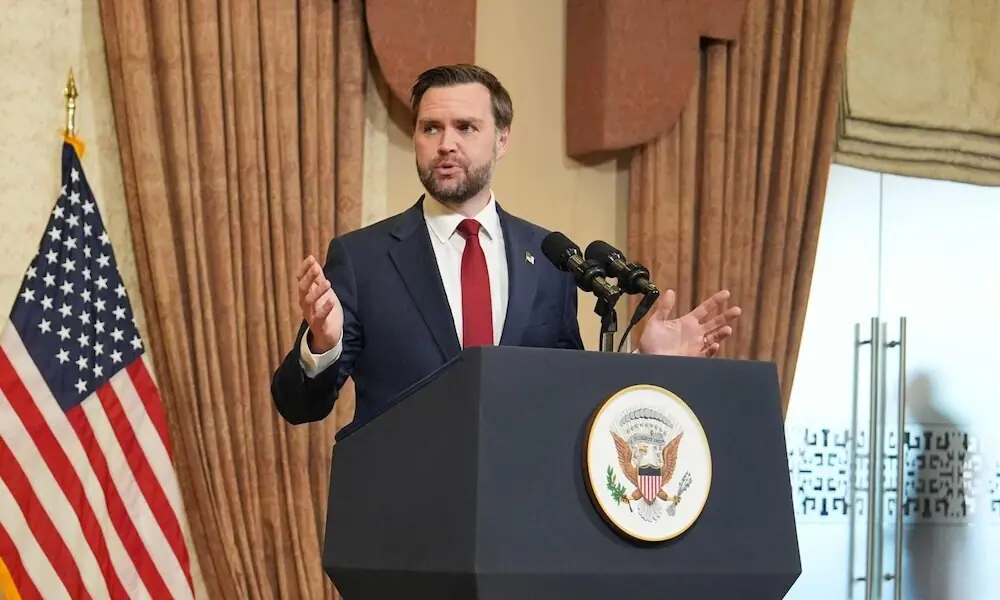
Speaking at a news conference at the conclusion of the trilateral “Islamabad Talks” mediated by Pakistan, Vance described the sessions as substantive but ultimately fruitless, with the Iranian delegation rejecting what he called Washington’s nonnegotiable demands on Tehran’s nuclear program. “We have been at it now for 21 hours, and we have had a number of substantive discussions — that’s the good news,” Vance said. “The bad news is that we have not reached an agreement.”
The vice president, flanked by special Middle East envoy Steve Witkoff and Jared Kushner, President Donald Trump’s son-in-law and senior adviser, said the United States had laid out clear “red lines” and offered flexibility on other issues, only to be met with Iranian refusal on the central question of preventing Tehran from developing nuclear weapons — not only in the immediate term but for the long term. “We need to see an affirmative commitment that they will not seek a nuclear weapon and that they will not seek the tools that would enable them to quickly achieve a nuclear weapon,” Vance said. “That is the core goal of the US president, and that’s what we have tried to achieve through these negotiations.”
He added that while Iran’s nuclear enrichment facilities had been destroyed in the recent US-Israeli military campaign, the fundamental issue remained one of Iranian will. “The simple question is: Do we see a fundamental commitment … not just now, not just two years from now, but for the long term? We haven’t seen that yet. We hope that we will.”
Vance praised Pakistan’s Prime Minister Shehbaz Sharif and Field Marshal Asim Munir, the chief of army staff and chief of defence forces, as “incredible hosts” who had worked tirelessly to bridge gaps. Any shortcomings in the talks, he emphasised, were not Pakistan’s fault. “The Pakistanis did an amazing job and really tried to help us and the Iranians bridge the gap and get to a deal.”
The collapse of the talks leaves the fate of a fragile two-week ceasefire — brokered by Pakistan on April 8 and holding since the US-Israeli offensive against Iran began Feb. 28 — in doubt. That conflict, which spread across the Middle East, killed thousands, disrupted global energy markets and saw Iran block shipping through the Strait of Hormuz, had already sent oil prices soaring and rattled economies worldwide.
Vance departed Pakistan shortly after the news conference aboard Air Force Two, according to a pool report. He told reporters that the American side had communicated constantly with Trump — “half a dozen times, a dozen times” over the 21 hours — along with Secretary of State Marco Rubio, Treasury Secretary Scott Bessent and Adm. Brad Cooper, commander of U.S. Central Command. The delegation left behind what Vance described as “a very simple proposal … our final and best offer. We will see if the Iranians accept it.”
On the Iranian side, the response was measured but firm. Esmaeil Baqaei, spokesman for Iran’s Ministry of Foreign Affairs, posted on X that the day had been “busy and long” for Tehran’s delegation, with “numerous messages and texts” exchanged. Discussions had covered “various dimensions of the main negotiation topics, including the Strait of Hormuz, the nuclear issue, war reparations, lifting of sanctions, and the complete end to the war against Iran and in the region.”
Baqaei expressed gratitude to Pakistan’s government and people for their “benevolent efforts” in hosting the talks but warned that success would hinge on the other side demonstrating “seriousness and good faith … refraining from excessive demands and unlawful requests, and the acceptance of Iran’s legitimate rights and interests.”
Iranian President Masoud Pezeshkian, in a separate post on X, said his delegation remained “fully committed” to safeguarding the country’s interests and would “negotiate courageously.” Regardless of the outcome, he added, the government would “stand by its people.”
The talks, which began Saturday afternoon at the Serena Hotel in central Islamabad, evolved quickly from proximity negotiations — with Pakistani mediators shuttling proposals between separate rooms — into direct, across-the-table sessions involving high-level delegations. Three rounds of expert-level discussions followed, with economic, military, legal and nuclear committees exchanging written texts after each.
The US delegation was led by Vance and included Kushner, Witkoff and officials from the National Security Council, State Department and Pentagon. The Iranian team was headed by Parliament Speaker Mohammad Bagher Ghalibaf and included Foreign Minister Abbas Araghchi, Supreme National Defence Council Secretary Ali Akbar Ahmadian and central bank governor Abdolnaser Hemmati.
The Iranians arrived dressed in black, in mourning for Supreme Leader Ayatollah Ali Khamenei and others killed in the war. They carried personal items — shoes and bags belonging to students killed in a US strike on a school adjacent to a military compound — a gesture noted by Iranian state media. The Pentagon has said the strike is under investigation.
Pakistani officials described “mood swings” and fluctuating tensions during the sessions. One source told Reuters the atmosphere “went up and down” in the first round. Prime Minister Sharif met separately with both delegations before and during the talks, underscoring Pakistan’s role as facilitator. In statements from his office, Sharif commended both sides for their engagement and expressed hope that the sessions would serve as “a stepping stone toward durable peace in the region.” He was joined in the meetings by Deputy Prime Minister and Foreign Minister Ishaq Dar, Interior Minister Mohsin Raza Naqvi and Field Marshal Munir.
Vance arrived at Nur Khan Air Base shortly after 10:30 a.m. Saturday, and was greeted by Dar, Naqvi and Munir. The Iranian delegation landed early the same morning after a last-minute hurdle — Israeli strikes in Lebanon — was resolved. Tehran had insisted that any ceasefire include a halt to attacks on Lebanese targets, a condition Pakistani mediators said was incorporated into the April 8 truce.
Security in Islamabad was extraordinary. Authorities declared a two-day public holiday, sealed major roads, deployed thousands of paramilitary and army troops, and locked down the Red Zone around government buildings and the Serena Hotel. The city of more than 2 million appeared largely deserted as negotiations unfolded.
The agenda was built around Iran’s 10-point proposal, which Washington accepted as a general framework. Yet deep gaps remained. The United States pressed for verifiable limits on uranium enrichment, the removal of nuclear material from Iran, curbs on ballistic missiles and sanctions relief tied strictly to Iranian concessions. Iran demanded full sanctions relief, formal recognition of its nuclear rights under the Nuclear Non-Proliferation Treaty, authority over navigation and toll collection in the Strait of Hormuz, an end to all regional military operations — including Israeli actions against Hezbollah in Lebanon — and immediate access to roughly $7 billion in frozen assets held abroad.
The geographic scope of the ceasefire proved particularly contentious. Iran insisted any durable agreement must cover all fronts, including Lebanon, where more than 2,000 people have died in Israeli operations against Hezbollah, according to Lebanese health authorities. Washington and Israel have treated the Lebanon theater as outside the truce, despite what Iranian and Pakistani officials described as an initial understanding to the contrary. That dispute nearly derailed the talks before they began and continued to cast a shadow over them.
The Strait of Hormuz, through which about one-fifth of global oil and gas supplies pass, remained another flashpoint. Iran has blocked most commercial shipping since the war began, using the waterway as leverage. During the talks, two U.S. Navy guided-missile destroyers — the USS Frank E. Peterson and the USS Michael Murphy — transited the strait for the first time since the conflict started, part of a US Central Command mission to clear mines laid by Iran’s Islamic Revolutionary Guard Corps.
CENTCOM commander Adm. Cooper said US forces were “setting the conditions” to establish a safe passage and would soon share it with the maritime industry “to encourage the free flow of commerce.” Trump, speaking to reporters as talks continued into the early hours Sunday in Pakistan, said, “Whether we make a deal or not makes no difference to me; we’re sweeping the strait.”
Iran’s Islamic Revolutionary Guard Corps warned late Saturday that any military vessels attempting to transit the strait would face “a strong response,” allowing only non-military vessels under strict regulations. Iranian state media reported stark differences over nuclear material removal and reopening of the strait, accusing the United States of making “excessive” demands.
The broader context is one of profound mistrust. The conflict began Feb. 28 with coordinated US-Israeli strikes that targeted Iranian military and nuclear sites and killed Khamenei. Iran retaliated by disrupting Gulf shipping, firing missiles at Israel and striking US bases. The two-week ceasefire paused open hostilities but left underlying grievances unresolved.
Analysts and Pakistani officials had cautioned that the breadth of issues — nuclear restraints, sanctions, regional proxies, missile ranges and sequencing of concessions — made a breakthrough in the opening two-day round unlikely. At best, they said, the sessions might produce a roadmap for future talks or limited de-escalation measures.
Yet the simple fact of American and Iranian officials sitting across from each other in a third country — after decades of estrangement and under the shadow of recent war — represented a rare diplomatic opening. Pakistan, which only a year ago was viewed by some in Washington as a diplomatic outcast, has positioned itself as a facilitator rather than arbiter, with quiet support from Saudi Arabia, Egypt, Turkey and others.
Vance, before departing, made clear that the negotiating channel remained open. “We leave here with a very simple proposal,” he said. Pakistani mediators, too, signalled they would continue their efforts. For now, the ceasefire holds, but its fragility is evident. Ship traffic through the Strait of Hormuz remains a fraction of prewar levels. Violence in Lebanon continues. And the fundamental distrust between Washington and Tehran endures. Whether the Islamabad round proves to be the beginning of a longer diplomatic process or merely a brief, inconclusive interlude will depend on whether both sides choose to return to the table — and on whether the fragile truce survives the expiration of its initial two-week term.
Copyright © 2021 Independent Pakistan | All rights reserved