By Staff Reporter
ISLAMABAD: The US naval blockade of all maritime traffic entering and exiting Iranian ports began on schedule Monday, hours after the collapse of high-level talks in Pakistan, with President Donald Trump warning that any Iranian vessels — including “fast attack ships” — approaching the operation “will be immediately ELIMINATED.”
Speaking at the White House, Trump framed the blockade as a necessary step to stop Iran from engaging in “blackmail” and “extort[ing] the world” through its control of the Strait of Hormuz. He insisted the United States does not depend on the waterway, declaring, “We don’t use the strait,” and claiming America possesses “more oil and gas than Saudi Arabia and Russia.” Many countries, he added, are already turning to the United States for what he called the “best and sweetest” oil, and he suggested the entire standoff “could all be settled before that.”
Trump also said that Washington had been contacted by Iran “this morning” by “the appropriate people” who, he said, “want to make a deal very badly.” He described the core dispute as centered on Iran’s nuclear program, repeating that “Iran will never have a nuclear weapon,” and noted that while “we agreed to a lot of things” during the weekend negotiations in Islamabad, no accord was reached on Tehran’s nuclear capabilities.
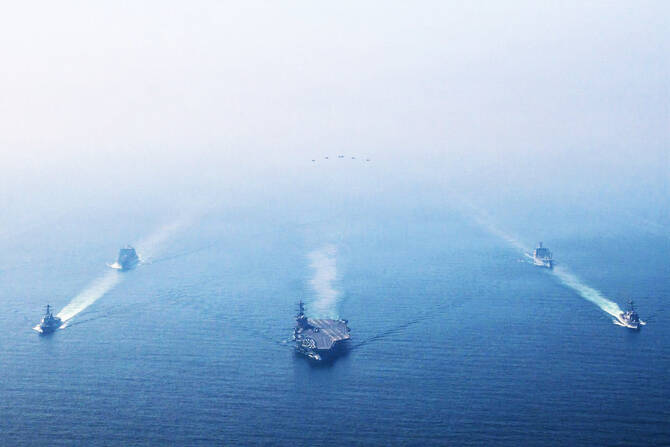
In a separate social media post, Trump sharpened the warning: any Iranian fast-attack ships caught trying to approach the blockade “will be immediately ELIMINATED.” The operation, which U.S. Central Command said would be enforced “impartially against vessels of all nations entering or departing Iranian ports and coastal areas, including all Iranian ports on the Arabian Gulf and Gulf of Oman,” took effect at 10 a.m. Eastern time (1400 GMT). American forces will not impede ships transiting the strait to or from non-Iranian ports. As of mid-afternoon in Washington, commercial shipping data showed tanker traffic in the region had already come to a near standstill, with vessels turning back or anchoring offshore in anticipation.
The blockade followed the abrupt failure of more than 21 hours of direct negotiations in Islamabad early on Sunday — the highest-level face-to-face contact between the United States and Iran since the 1979 Islamic Revolution. Vice President JD Vance, leading the US delegation with special envoy Steve Witkoff and Jared Kushner, described Washington’s final proposal as its “final and best offer.” No agreement emerged on control of shipping lanes through the Strait of Hormuz or on Iran’s insistence that it retain the right to enrich uranium for a civilian nuclear program.
Iran responded swiftly and defiantly. Its armed forces declared the US imposition of restrictions on vessels in international waters “an illegal act” that “amounts to piracy.” In a statement carried by state broadcaster IRIB and echoed by the military and Revolutionary Guards, Tehran warned: “Security in the Persian Gulf and the Sea of Oman is either for everyone or for NO ONE.” It added that “NO PORT in the region will be safe.” Foreign Ministry spokesman Esmaeil Baqaei derided the blockade on the social platform X as a “revenge of choice” against the global economy. “Is it ever worthwhile to cut off one’s nose to spite one’s face?!” he wrote.
Pakistan, which hosted and mediated the talks, continued to press for dialogue. Foreign Minister Ishaq Dar said Islamabad would “continue to play its role to facilitate engagement and dialogue in the days to come” and urged both sides to honor the two-week-old ceasefire.
Oil markets reacted immediately to the escalation. West Texas Intermediate futures climbed above $104 a barrel, while Brent crude topped $101.86 — erasing last week’s gains after the ceasefire announcement and underscoring what analysts have called the most severe energy shock in modern history. Before the conflict erupted Feb. 28 with U.S. and Israeli strikes on Iran and subsequent Iranian retaliation, roughly one-fifth of the world’s oil passed through the strait. That flow has since slowed dramatically, disrupting supply chains worldwide.
Trump said he did not need support from other countries for the operation — “We don’t need other countries” — but claimed some had offered to help and that he would release details “tomorrow.” On the question of whether the blockade would draw in allies, he projected confidence that the situation could be resolved quickly.
International reactions reflected a mix of concern and continued appeals for diplomacy. Turkish Foreign Minister Hakan Fidan told the Anadolu Agency that both sides remained “sincere” about a ceasefire and urged “persuasion methods” to reopen the strait “as soon as possible.” He cautioned that Israeli actions in Lebanon, which he likened to Israel’s campaign in Gaza and described as a “depopulation campaign” destroying housing and infrastructure, could undermine the process. British Prime Minister Keir Starmer ruled out any UK role in the blockade, telling the BBC Britain would not be “dragged in.”
Legal experts have questioned the blockade’s footing under international law, noting that rules governing straits permit only coastal states — Iran and Oman — to regulate passage, and even they may not suspend transit. Shipowners also face practical risks from Western sanctions on Iran. The war that began in late February has already inflicted a staggering toll. Damaged energy infrastructure across Iran and the Gulf has slowed extraction, refining and loading. Prices for fertilizer and helium — critical for food production and semiconductor manufacturing — continue to climb, accelerating inflation already pressuring emerging markets. The IMF and World Bank have signaled downgrades to global growth forecasts and higher inflation projections, with developing economies expected to suffer most.
Copyright © 2021 Independent Pakistan | All rights reserved