By Staff Reporter
KARACHI: The State Bank of Pakistan received $2 billion from Saudi Arabia with a value date of April 15, the central bank said Thursday, delivering immediate relief to foreign-exchange reserves strained by a looming repayment to the United Arab Emirates.
The inflow represents the first tranche of a fresh $3 billion deposit pledged by Riyadh. A day earlier, Saudi Arabia also agreed to extend the maturity of an existing $5 billion deposit at the State Bank for three years, removing it from the previous annual rollover arrangement. The moves come as Pakistan faces a tight external financing environment under its $7 billion International Monetary Fund program.
Saudi Arabia’s support was confirmed by the Saudi Press Agency, which said the assistance was provided on directives from King Salman bin Abdulaziz Al Saud and Crown Prince Mohammed bin Salman. “This assistance aims at supporting Pakistan’s economy and strengthening its resilience amidst evolving global economic challenges, and comes in accordance with the leadership’s directives to strengthen the bonds of brotherhood between the two countries,” the agency said. It added that the package affirms the kingdom’s commitment to Pakistan’s economic growth.
Finance Minister Muhammad Aurangzeb had disclosed the additional $3 billion commitment and the three-year extension of the $5 billion deposit while speaking to reporters in Washington on Wednesday. A Saudi Ministry of Finance spokesperson separately told Reuters: “We can confirm that Saudi Arabia has agreed to a $3 billion deposit with Pakistan to support their balance of payments.”
The developments coincide with Prime Minister Shehbaz Sharif’s visit to Saudi Arabia, where diplomatic efforts to promote peace in the Middle East are under discussion. They also underscore Riyadh’s longstanding role as a financial backer during periods of stress in Islamabad. In 2018, Saudi Arabia provided a $6 billion package that included a $3 billion central-bank deposit and $3 billion in deferred-payment oil supplies. The relationship was further cemented last year by a mutual defense pact.
Pakistan’s foreign-exchange position remains under strain. Total reserves stood at $16.4 billion as of March 27, enough to cover about three months of imports. The State Bank’s own reserves fell $1.32 billion to $15.08 billion in the week ended April 10 after a $1.426 billion repayment on Pakistan’s sovereign Eurobonds, the central bank said on Thursday. That payment included $1.3 billion in principal and $126.125 million in coupon obligations on other Eurobond issuances.
Adding to the pressure is a $3.5 billion repayment due to the UAE this month. Islamabad failed in March to secure a rollover of the facility — the first such lapse in seven years — leaving it to arrange outright repayment. The government is finalizing arrangements to repay about $3.45 billion, with $450 million due immediately, $2 billion on April 17 and $1 billion on April 23. The funds include loans dating back to the late 1990s and subsequent rollovers carrying an interest rate of around 6.5 percent.
The repayment amounts to roughly 18 percent of the reserves recorded at the end of March and has raised concerns about near-term financing gaps. Under the IMF program, Pakistan is targeting reserves above $18 billion by the end of the fiscal year in June.
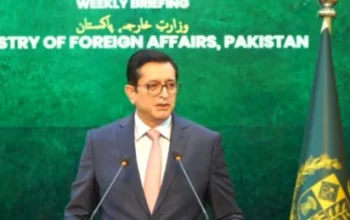
The Foreign Office sought to separate the UAE repayment from regional tensions. Spokesperson Tahir Andrabi told reporters on Thursday that discussions on the repayment predated recent conflicts in the Middle East, including Iran-US tensions, and should not be linked to them. He said the UAE is a “very old, trusted partner” with deep historical, cultural, religious and economic ties, and reiterated Pakistan’s condemnation of any aggression against the Gulf state.
Analysts note that external financing risks remain a core vulnerability for Pakistan, particularly with global oil prices volatile and capital markets constrained. The country relies heavily on bilateral support from allies such as Saudi Arabia and China, alongside IMF disbursements, to meet import needs and debt obligations.
Copyright © 2021 Independent Pakistan | All rights reserved