By Staff Reporter
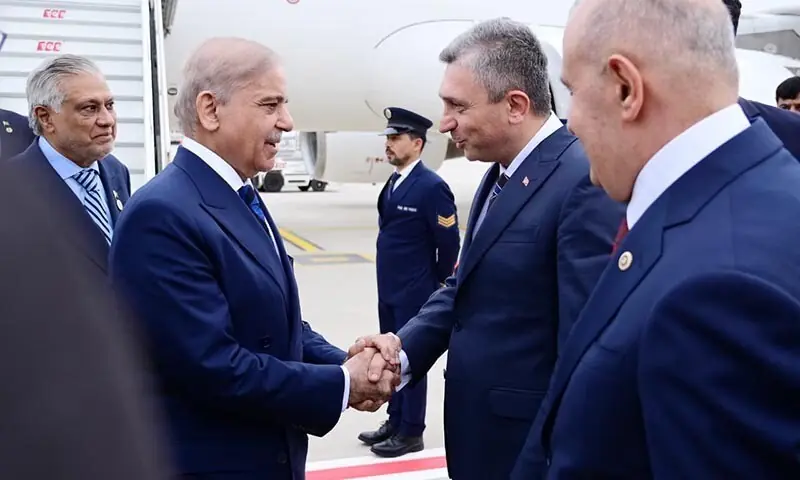
ISLAMABAD: Prime Minister Shehbaz Sharif of Pakistan arrived in the Turkish resort city of Antalya on Thursday, the third stop on a three-nation tour through the Middle East that has underscored Islamabad’s deepening role as a diplomatic bridge in a region still reeling from weeks of war between the United States, Israel and Iran.
The visit came hours after Sharif held talks in Doha with Qatar’s ruler, Sheikh Tamim bin Hamad Al Thani, and a day after he met Saudi Arabia’s Crown Prince, Mohammed bin Salman, in Jeddah. Pakistani officials said the tour, which runs through Sunday, focused on bilateral ties and regional stability. But it unfolded against a backdrop of fragile ceasefires, continuing violence in Lebanon and parallel diplomacy by Pakistan’s powerful army chief, Field Marshal Syed Asim Munir, who was in Tehran on Thursday for talks with Iranian leaders.
In Antalya, Sharif is scheduled to attend the fifth Antalya Diplomacy Forum and address a leaders’ panel, where he is expected to meet President Recep Tayyip Erdogan of Turkey and other international figures. The tour began on Wednesday in Saudi Arabia, where Sharif traveled to Jeddah for a two-hour meeting with Crown Prince Mohammed bin Salman. In that session, Sharif expressed Pakistan’s “full solidarity and support” for Saudi Arabia after Iranian attacks on the kingdom and other Gulf states.
He conveyed condolences for lives lost, praised Riyadh’s “patience and restraint,” and briefed the crown prince on Pakistan’s mediation efforts, which helped produce a temporary ceasefire between the United States and Iran and the first round of direct talks between the two adversaries in Islamabad on April 11. The crown prince, in turn, welcomed Pakistan’s “constructive role” and that of Field Marshal Munir, according to the Pakistani statement. The two leaders also reviewed economic cooperation, noting Saudi support for Pakistan’s stability, and reaffirmed their strategic defense partnership under a mutual agreement.
Sharif flew from Medina to Doha early Thursday. His aircraft was escorted into Qatari airspace by Qatari fighter jets, a gesture he called “exceptionally warm and generous” and emblematic of the two countries’ “enduring ties.” At the emir’s palace, the prime minister and Sheikh Tamim held more than an hour of talks, followed by a one-on-one session. They discussed the “evolving regional situation, particularly in the Gulf region,” Sharif wrote on X. “We underscored the importance of de-escalation, dialogue, and close international coordination to ensure peace and stability.”
Sharif reiterated Pakistan’s condemnation of Iranian attacks on Qatar and other regional countries, and conveyed “full solidarity” with the Qatari people. The two leaders reviewed bilateral cooperation in security, defence and energy, and pledged to expand it. The emir welcomed Sharif and expressed appreciation for Pakistan’s efforts to deescalate tensions, according to a statement from the Prime Minister’s Office.
Pakistan has cast itself as the central facilitator between Washington and Tehran since the outbreak of hostilities in late February. Iranian attacks on Gulf targets, which Tehran described as responses to American and Israeli strikes, drew sharp condemnation from Islamabad even as it worked to broker a truce. The first round of direct United States-Iran talks in Islamabad last weekend lasted 21 hours of actual negotiation — more than 30 hours including breaks — but ended without a full agreement.
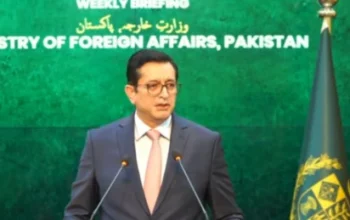
On Thursday, Foreign Office spokesman Tahir Andrabi told reporters in Islamabad that Pakistan was keeping “open channels of communication” with both sides and remained engaged at the highest levels. He noted that Sharif’s regional tour and Field Marshal Munir’s visit to Iran were part of the same effort. In Tehran, Iranian state television reported that Field Marshal Munir met on Thursday morning with Mohammad Bagher Ghalibaf, speaker of Iran’s Parliament. The army chief’s trip followed the arrival of Pakistani mediators pressing for a second round of United States-Iran talks, which the White House has indicated would most likely be held again in Islamabad.
White House Press Secretary Karoline Leavitt said on Wednesday that President Donald J. Trump viewed Pakistan as the “only mediator” between the two countries. “While there have been many countries around the world who want to offer their help, the president feels it is important to streamline this communication through the Pakistanis,” she said. The diplomatic activity coincided with a new, if limited, ceasefire announcement involving two other parties to the wider conflict.
On Thursday, Trump posted on Truth Social that Lebanon and Israel had agreed to a 10-day ceasefire, to begin at 5 p.m. Eastern time, after what he called “excellent conversations” with Lebanese President Joseph Aoun and Israeli Prime Minister Benjamin Netanyahu. Trump said he had directed Vice President JD Vance, Secretary of State Marco Rubio and the chairman of the Joint Chiefs of Staff, Gen. Dan Razin Caine, to work toward a lasting peace. He also announced plans to host Netanyahu and Aoun at the White House for their first direct talks since 1983.
Pakistani officials had earlier signaled that stability in Lebanon was essential to ending the broader war on Iran. Sharif’s government has balanced its mediation role with firm condemnations of the Iranian attacks that struck Gulf energy infrastructure. In both Riyadh and Doha, he emphasised the need for deescalation and the protection of energy supply chains.
In Antalya, Pakistani officials said Sharif would use the Diplomacy Forum to present Islamabad’s position on regional security. The tour, the Foreign Office said, was intended to advance bilateral cooperation while addressing the broader push for peace
Copyright © 2021 Independent Pakistan | All rights reserved