By Staff Reporter
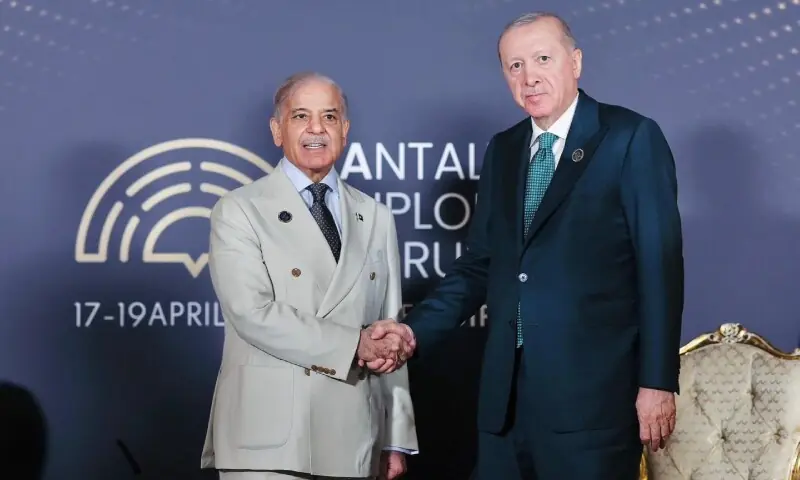
ISLAMABAD: Prime Minister Shehbaz Sharif and Turkish President Recep Tayyip Erdogan on Friday stressed the need to “effectively utilise the current window of opportunity” to forge a durable peace in the Middle East, capping a day of high-level diplomacy here as Pakistan presses to convert a two-week-old ceasefire between the United States, Israel and Iran into a lasting agreement.
The two leaders met on the sidelines of the fifth Antalya Diplomacy Forum, where Sharif is concluding a three-nation tour that has positioned Pakistan as a central broker in the crisis. In a detailed readout from the Prime Minister’s Office, Erdogan welcomed his Pakistani counterpart and thanked him for attending the gathering. Sharif, in turn, expressed gratitude for the invitation and the “traditional Turkish hospitality” extended to him and his delegation. He congratulated Erdogan on the forum’s evolution into a major global platform.
The two men reviewed the rapidly evolving situation in the Middle East, with Sharif thanking Erdogan for Turkey’s “strong support and encouragement” of Pakistan’s mediation efforts. He briefed the Turkish president on steps to extend the ceasefire — reached on April 8 after weeks of fighting that began with US-Israeli strikes on Iran on Feb. 28 — and to resume direct talks aimed at a formal peace agreement. Both leaders, the statement said, “emphasised the importance of effectively utilising the current window of opportunity to advance a durable and lasting regional peace.”
The meeting also highlighted the steady improvement in Pakistan-Turkey ties. The leaders expressed satisfaction with the positive trajectory of bilateral relations and agreed to hold the eighth High-Level Strategic Cooperation Council meeting in Ankara later this year. They called for faster implementation of existing projects and the exploration of new avenues to expand economic cooperation. The discussion ended with both sides reaffirming their commitment to strengthening the strategic partnership “building on fraternal ties, and a shared vision for peace and prosperity,” according to the Pakistani readout.
Sharif’s day in Antalya extended well beyond the Erdogan session. The Prime Minister’s Office reported that he held informal meetings with several other world leaders on the forum’s sidelines, all conducted in a “cordial atmosphere” in which “regional and global situations were also discussed.” Those included Qatari Emir Sheikh Tamim bin Hamad Al Thani — whom Sharif had already met earlier in the week in Doha — Kazakhstan President Kassym-Jomart Tokayev, Azerbaijan President Ilham Aliyev and Syrian President Ahmed Al-Sharaa. He also sat down with Qatari Prime Minister and Foreign Minister Sheikh Mohammed bin Abdulrahman bin Jassim Al Thani and former Kosovo President Vjosa Osmani.
The visit caps a week of intensive Pakistani shuttle diplomacy that began on Wednesday in Saudi Arabia and moved to Qatar before reaching Turkey. In each capital, Sharif has pressed the same message: that the brief pause in fighting, secured on April 8 after weeks of escalating violence that began with US-Israeli strikes on Iran on Feb. 28, must not collapse. Pakistani officials have portrayed their country as an indispensable go-between, hosting the first round of direct US-Iran talks in Islamabad on April 11 and now working to arrange a second.
On the sidelines of the Antalya gathering, Senior Adviser to the US President for Arab and African Affairs Massad Boulos paid a courtesy call on Sharif. According to the Prime Minister’s Office, Sharif conveyed “warm regards” to President Donald Trump and recalled their “cordial interactions.” He expressed appreciation for Trump’s “bold and decisive leadership” in brokering last year’s ceasefire between Pakistan and India when the two nuclear-armed neighbours stood “on the brink of war,” and for the more recent ceasefire in Lebanon.
The two sides reviewed “current regional developments,” including Pakistan’s mediation that produced the April 8 truce and the subsequent “historic Islamabad Talks,” the statement said. Sharif emphasised the importance of expanding economic and trade ties between Pakistan and the United States, as well as cooperation on multilateral issues. Boulos, in turn, relayed Trump’s greetings and Washington’s interest in deepening engagement with Pakistan on counterterrorism, economic development and global challenges.
The Turkish forum has become the latest venue for Pakistan’s unusually prominent diplomatic role in the conflict. Islamabad hosted the first round of direct U.S.-Iran negotiations on April 11 after Sharif helped broker the initial two-week ceasefire. Those talks produced no final deal, leaving key disputes unresolved over Iran’s nuclear program, sanctions relief and Tehran’s blockade of the Strait of Hormuz. Yet Pakistani officials have continued to shuttle between capitals, seeking to narrow differences and schedule a second round.
Pakistan’s diplomatic offensive has unfolded on two parallel tracks. While Sharif has focused on Gulf capitals and now Turkey, Pakistan’s powerful Chief of Defense Forces, Field Marshal Syed Asim Munir, traveled separately to Tehran. Iranian media reported that Munir met President Masoud Pezeshkian late on Thursday and visited the Khatam al-Anbiya Central Headquarters of Iran’s armed forces. He also held talks with Foreign Minister Abbas Araghchi and Parliament Speaker Mohammad Bagher Ghalibaf — both of whom had participated in the Islamabad negotiations the previous weekend.
According to the Iranian government, Munir told Pezeshkian that while the war would end, the region could not simply “return to its previous conditions.” All states, he said, must work together on reconstruction, stability and lasting peace. He noted support for diplomatic efforts from China, Saudi Arabia, Egypt and Turkey, and expressed confidence that “an agreement can be reached soon.” Pezeshkian replied that Iran sought “peace, stability, and brotherly ties,” but voiced deep distrust of the United States over past violations of commitments. He nevertheless praised Pakistan’s mediation and its role in hosting the Iranian delegation in Islamabad.
The Pakistani army chief’s visit is explicitly aimed at narrowing differences that prevented a full agreement in the April 11 talks, which deadlocked over Iran’s nuclear program, sanctions relief and control of the Strait of Hormuz. A senior Iranian official described the meetings as having reduced gaps in some areas and improved prospects for an extended ceasefire and renewed negotiations.
Trump has repeatedly singled out Munir for praise. In an interview with the New York Post on Tuesday, the president called the field marshal “fantastic” and suggested that future talks were more likely to return to Pakistan because of him. On Thursday, Trump told reporters he “might” travel to Islamabad himself if a peace deal is finalised there, adding, “Pakistan has been great” throughout the crisis. “The field marshal has been great, the prime minister has been really great in Pakistan,” he said. The White House press secretary has described Pakistan as “the only mediator” in the current US-Iran channel.
Sharif’s tour began in Jeddah, where he met Saudi Crown Prince Mohammed bin Salman. The Saudi leader “appreciated the constructive role” of both Sharif and Munir in the peace process, according to the Pakistani prime minister’s office. In Doha, Sharif held talks with Qatar’s Emir Sheikh Tamim bin Hamad Al-Thani on de-escalation and the need for coordinated international efforts to stabilize the Gulf. He condemned Iranian attacks on Qatari and other Gulf targets that followed the initial US-Israeli strikes.
Copyright © 2021 Independent Pakistan | All rights reserved