By Staff Reporter
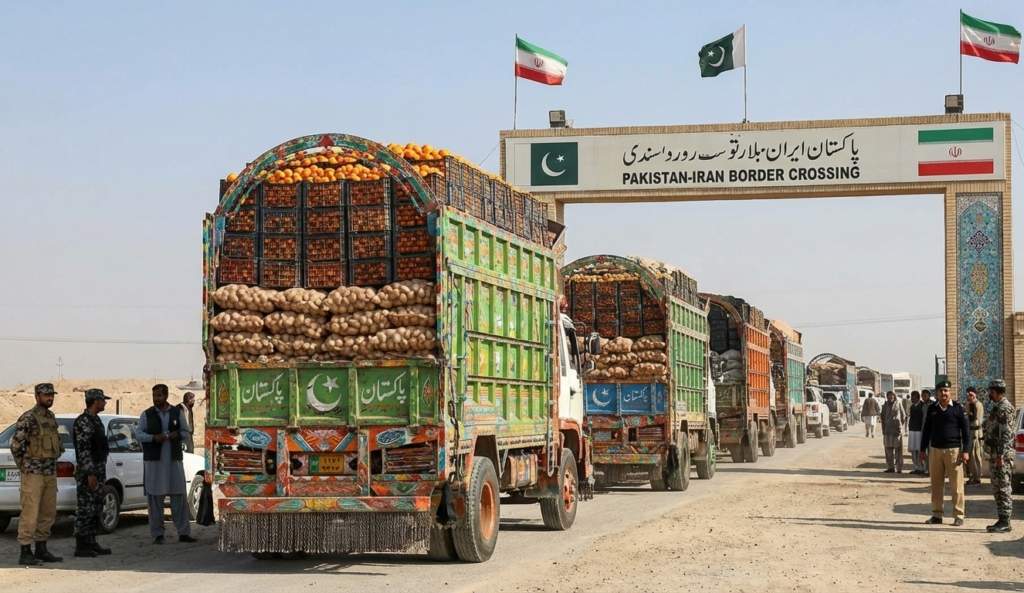
ISLAMABAD: Pakistan has designated six specific overland routes for the transit of goods bound for Iran, clearing the way for thousands of containers that have been stuck at its ports as Tehran’s maritime access remains curtailed under the US-Iran ceasefire.
The Ministry of Commerce issued the Transit of Goods through Territory of Pakistan Order 2026, which came into force on April 25. The statutory regulatory order permits cargo consigned from third countries to move across Pakistani territory to final destinations in Iran, provided it is backed by an encashable bank guarantee equivalent to Pakistani import duties, the ministry said in a notification published Sunday.
The six approved routes run from Gwadar to Gabd, from Karachi or Port Qasim via Lyari-Ormara-Pasni to Gabd, from Karachi or Port Qasim via Khuzdar-Dalbandin to Taftan, from Gwadar via Turbat-Hoshab-Panjgur-Nagg-Besima-Khuzdar-Quetta or Lakpass-Dalbandin-Nokundi to Taftan, from Gwadar via Lyari-Khuzdar-Quetta or Lakpass-Dalbandin-Nokundi to Taftan, and from Karachi or Port Qasim via Gwadar to Gabd. All movements will be regulated under the provisions of the Customs Act of 1969 and related rules issued by the Federal Board of Revenue.
The order applies exclusively to transit goods — cargo that merely passes through Pakistan as part of a complete journey that begins and ends beyond its borders. It explicitly allows cross-stuffing, meaning the transfer of goods from one container to another or by any other mode of transportation, as long as the process complies with relevant customs laws and regulations. Traders or their authorised brokers must furnish customs security in the form of an encashable financial guarantee covering the full amount of Pakistan’s import levies. The notification defines a shipper as any natural or legal person who concludes a contract of carriage or actually delivers the goods to the carrier, and it describes a transit transport corridor as any designated route for such movements.
More than 3,000 containers destined for Iran have been held up at Karachi port for several days, according to shipping sources. The backlog arose after the effective closure of Iranian ports and the Strait of Hormuz — the waterway that normally handles about one-fifth of the world’s oil and gas supplies — in the wake of US-Israeli strikes on Iran that began Feb. 28. A ceasefire is now in effect, but normal maritime operations have yet to resume.
The notification makes no mention of whether Iranian goods could move in the opposite direction through Pakistan to third countries. The move forms part of Islamabad’s broader effort to expand regional trade ties as it seeks to stabilise its economy under a $7 billion International Monetary Fund program. Pakistan has increasingly viewed Iran as an alternative corridor to Central Asia after repeated disruptions on its traditional overland routes through Afghanistan amid heightened tensions with Kabul.
Earlier this month the Directorate General of Transit Trade dispatched Pakistan’s first export shipment to Uzbekistan via the new Iran corridor — a consignment of frozen beef trucked from Karachi across the Gabd-Rimdan border crossing. The corridor will give Iran and Central Asian states direct access to the Pakistani ports of Karachi and Gwadar, the DGTT said in a statement. “The increasing volume of international trade and regional connectivity will bring economic benefit for Pakistan and regional countries,” it added.
The order draws its legal authority from Article 2 of the 2008 bilateral agreement between Pakistan and Iran on the international road transport of passengers and goods, as well as from powers granted under sub-section (1) of section 3 of the Imports and Exports (Control) Act of 1950. Pakistani officials have described the new routes as a practical response to immediate shipping bottlenecks and a step toward longer-term economic integration, particularly as Gwadar — developed with Chinese investment under the China-Pakistan Economic Corridor — gains importance as a potential gateway to the Middle East and Central Asia.
Copyright © 2021 Independent Pakistan | All rights reserved