By Staff Reporter
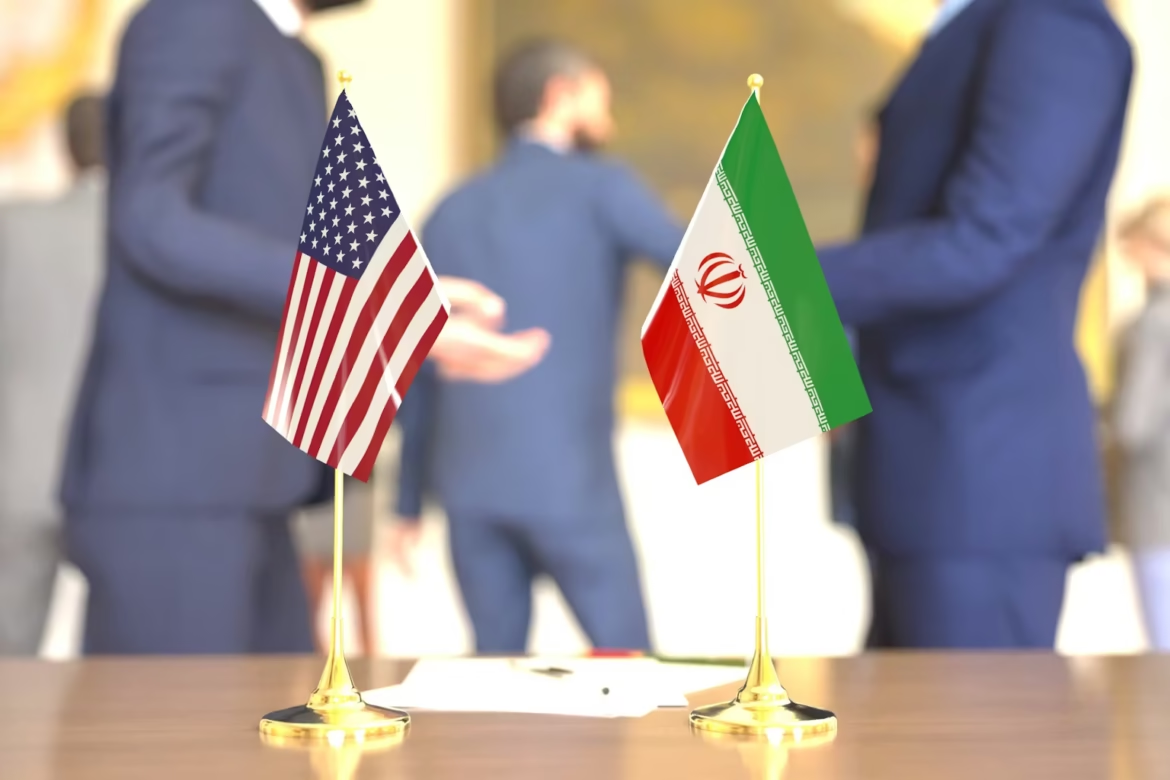
The United States and Iran are locked in a dangerous limbo. A two-month war that began with joint US-Israeli strikes on Feb. 28 has killed thousands, shattered economies across the Gulf, and sent global energy prices soaring. A ceasefire brokered by Pakistan on April 8 has held, but barely. Now President Donald Trump has ordered his national security team to prepare a prolonged naval blockade of Iranian ports, a decision reached in recent Situation Room meetings and confirmed by US officials to The Wall Street Journal. At the same time, Tehran has floated a proposal to reopen the Strait of Hormuz in exchange for lifting that very blockade, while postponing any immediate reckoning over its nuclear program.
Trump’s blunt Truth Social post captured the moment’s surreal tension: Iran, he said, had informed Washington it was in a “State of Collapse” and wanted the strait opened “as soon as possible” while it sorted out its leadership. Trump added, almost parenthetically, that he believed Iran would manage to do so. Secretary of State Marco Rubio called the Iranian offer “better than what we thought they were going to submit,” yet immediately questioned whether the messenger even possessed the authority to make it. The result is a diplomatic fog thick with mutual suspicion, economic pain, and the quiet realisation in both capitals that time is not on anyone’s side.
This is not the clean victory Trump once seemed to promise. It is a grinding test of wills, and the United States should approach Iran’s latest proposal with more seriousness than the White House has so far shown. Rigid insistence that nuclear questions must be settled first risks squandering a narrow opening to de-escalate a conflict whose human and financial costs are already immense.
Iran’s proposal is deliberately staged, and its logic is not obscure. Foreign Minister Abbas Araghchi carried it to Islamabad over the weekend. First, both sides would formally end the war with ironclad guarantees against its resumption. Second, they would resolve the naval blockade and the fate of the Strait of Hormuz, which Iran has effectively closed to international traffic except its own vessels. Only then, Tehran says, would negotiators turn to the nuclear file, where Iran still seeks formal acknowledgment of its right to enrich uranium, echoing the framework of the 2015 deal that Trump himself abandoned in his first term.
Iranian analysts describe the approach as a deliberate shift. The old model of trading nuclear concessions for sanctions relief has lost credibility in Tehran after repeated experiences of bad faith, they argue. A senior research fellow at the Centre for Middle East Strategic Studies said Iran now sees this sequenced path as a trust-building measure to address a deep “trust-deficit.” Another analyst, Negar Mortazavi of the Center for International Policy, called the proposal “reasonable” given the global crisis created by the closed strait. Both sides, she noted, need immediate relief on Hormuz before they can tackle something as technically complex and politically radioactive as the nuclear issue. Tehran, after all, spent two years negotiating the original deal with the Obama administration; it will not be settled “in a few hours in high-level meetings”.
The context inside Iran makes the sequencing understandable, if not automatically acceptable. The killing of Supreme Leader Ayatollah Ali Khamenei on the first day of the war, and the elevation of his wounded son Mojtaba, has left the clerical system fractured. Power has shifted toward hardline commanders of the Islamic Revolutionary Guard Corps. Iranian officials speaking anonymously describe genuine infighting. An army spokesperson told state media that the Islamic Republic does not consider the war over and has updated its target lists. Yet the government has also coordinated public statements to project unity, and it insists Araghchi’s messages stayed within “specified red lines.” In short, Tehran is negotiating from a position of real weakness and real division, precisely the moment when a face-saving off-ramp matters most.
Trump’s team sees the same facts and draws the opposite conclusion. The president, according to officials briefed on Monday’s meeting, is unhappy with any deal that does not confront the nuclear program from the outset. Rubio has been explicit: Iran remains a “radical clerical regime” that will eventually want a nuclear weapon, and any agreement must “definitively” prevent that. Lifting the blockade without nuclear guarantees, the administration fears, would surrender the very leverage that brought Iran to the table. The White House has also canceled high-profile trips, first Vice President JD Vance, then special envoy Steve Witkoff and Jared Kushner, to Islamabad, citing “tremendous infighting and confusion” inside Iran. Trump himself called further travel a waste of time.
That skepticism is not baseless. Iran has used the ceasefire to dig out buried launchers, drones, and munitions. Its closure of the strait, one-fifth of global oil and LNG normally passes through it, has given Tehran a powerful economic weapon. Ship-tracking data show traffic through Hormuz has collapsed from 125-140 vessels daily to just seven in the past 24 hours; none carried oil for the global market. At least six Iranian tankers have already been turned back by the US blockade. Oil prices have climbed above $111 a barrel, and the World Bank warns of a 24 percent surge in energy costs in 2026 if disruptions persist. The United Arab Emirates has announced it is quitting OPEC and OPEC+, exposing fractures among Gulf states. The war’s unpopularity at home is unmistakable: a Reuters/Ipsos poll shows Trump’s approval at 34 percent, with only 26 percent of Americans believing the military campaign was worth the cost.
Yet the administration’s chosen alternative, sustained blockade, carries its own perils. It is less immediately bloody than renewed airstrikes, but it prolongs the economic siege on Iran while leaving the strait’s status unresolved. US Central Command reports 39 vessels redirected since April 13. The Treasury Department just sanctioned 35 entities tied to Iran’s shadow banking system and warned that any “toll” payments to Tehran or the IRGC for passage through Hormuz will trigger further penalties. Iran, meanwhile, claims it is rerouting trade through northern, eastern, and western corridors to blunt the pressure.
The longer this standoff drags on, the greater the danger of miscalculation. European allies are already losing patience. German Chancellor Friedrich Merz bluntly accused Iran of “negotiating very skilfully” while suggesting the Trump administration lacks an exit strategy. Trump responded on social media that Merz “doesn’t know what he’s talking about.” Britain’s King Charles, addressing Congress on Tuesday, felt it necessary to reaffirm the “special relationship” despite “uncertainty and conflict.” Even within the administration, intelligence agencies are quietly studying how Iran would react if Trump simply declared victory and pulled back, precisely because the political costs at home are mounting. A unilateral US withdrawal might embolden Tehran to rebuild its nuclear and missile programs, but staying locked in a slow-motion blockade risks turning a pause into a new normal of attrition.
There is, nevertheless, a narrow path forward. Mediators expect a revised Iranian proposal within days. The United States should treat it as the opening bid it is, not dismiss it out of hand. History shows that nuclear negotiations require technical experts, time, and an atmosphere of reduced tension; trying to settle everything at once in the shadow of active economic warfare invites failure. A sequenced deal, formal ceasefire guarantees, mutual de-escalation in the Gulf, followed by serious nuclear talks, would not be capitulation. It would be realism. Iran’s internal disarray gives Washington leverage, but that leverage is not infinite. The blockade is already biting; using it to force an immediate nuclear surrender may simply harden the very hardliners who now hold more sway in Tehran.
The human stakes are too high for posturing. Thousands are dead. Energy markets are in turmoil. American families are paying more at the pump, and Gulf nations are bracing for prolonged instability. Pakistan’s quiet mediation has kept channels open when flashy summits collapsed. The same patience that produced the 2015 accord, imperfect as it was, may be required again, this time under far more fraught circumstances.
Trump has repeatedly said he wants a deal that is “good for the American people and the world.” The blockade buys time, but time is not neutral. It is eroding global goodwill, inflating energy costs, and testing the fragile ceasefire. A wiser course would be to test Iran’s seriousness on the strait and the blockade first, then move deliberately to the nuclear file once the immediate danger of renewed fighting has receded. Anything less risks turning a two-month war into a generational standoff, one the United States, Iran, and the world can ill afford.
Copyright © 2021 Independent Pakistan | All rights reserved