By Staff Reporter
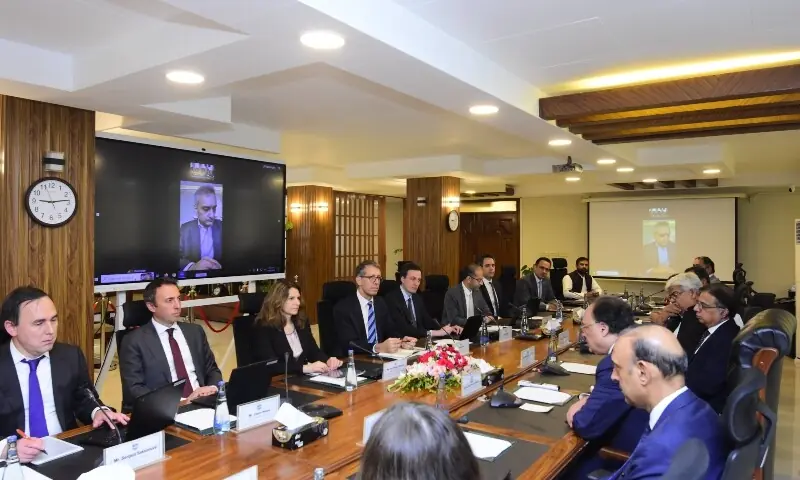
ISLAMABAD: Finance Minister Muhammad Aurangzeb met a visiting International Monetary Fund mission in Islamabad on Wednesday to review preparations for the upcoming federal budget and outline the government’s structural reform priorities, the finance ministry said.
Aurangzeb briefed the delegation, led by Mission Chief Iva Petrova, on Pakistan’s macroeconomic outlook, fiscal strategy and ongoing efforts to lock in sustainable stability and longer-term growth. The discussions, held at the finance ministry, centered on macroeconomic stabilization measures, next year’s budget framework and a broader reform agenda designed to bolster fiscal and external sustainability while supporting durable expansion, according to a ministry statement posted on X.
Both sides exchanged views on keeping reform momentum intact, safeguarding macroeconomic stability and pushing structural changes to lift investment, productivity and export-led growth, the ministry said. Aurangzeb welcomed the IMF team and expressed appreciation for the fund’s sustained engagement and constructive dialogue with the government. He singled out the productive talks that began during the spring meetings in Washington earlier this year.
The minister highlighted encouraging external-sector trends, noting improvements in remittances and export performance. Recent data show exports rising on both a month-on-month and year-on-year basis, signaling greater economic resilience and a gradual strengthening of fundamentals, the statement said. Aurangzeb acknowledged that while stabilization efforts have yielded positive results, the government remains acutely aware of persistent structural challenges — particularly external liabilities — and the urgency of accelerating sustainable, export-oriented growth. He reiterated the administration’s commitment to deepening reforms without sacrificing long-term prospects, stressing the need to break Pakistan’s recurring boom-and-bust cycles through productivity gains, deregulation and enhanced export competitiveness.
The reform program has been calibrated in consultation with international experts and economists and forms part of a technically grounded transformation strategy endorsed at the highest levels, rather than a collection of short-term fixes, Aurangzeb told the mission. He also updated the IMF on Pakistan’s engagement with other development partners, including continued economic cooperation with China and steps to mobilize long-term investment aligned with national priorities.
The IMF mission welcomed the positive progress Pakistan has made in maintaining macroeconomic stability despite a difficult global and regional backdrop. It commended the government’s commitment to prudent economic management and reform implementation, the ministry said. The team underscored the importance of sustaining reform momentum, fiscal discipline and structural changes to deliver durable and inclusive growth. Discussions also touched on the broader macroeconomic framework, the government’s reform agenda and priorities for the upcoming budget.
The mission reaffirmed its commitment to continued engagement and constructive cooperation in support of Pakistan’s economic program and long-term resilience. The session came hours after the State Bank of Pakistan announced it had received about $1.3 billion from the IMF under the Extended Fund Facility and the Resilience and Sustainability Facility. The funds, equivalent to SDR 914 million, were received on May 12 and will be reflected in the central bank’s foreign-exchange reserves for the week ending May 15.
The disbursement follows the IMF Executive Board’s approval last week after completion of the third review under the 37-month EFF program, which was originally approved in September 2024.
Separately, the government is weighing tax relief for salaried individuals in the upcoming budget while holding salaries and pensions at current levels. Aurangzeb has signaled a desire to lower tax rates and, if feasible, raise the taxable income threshold for the salaried class, recognizing their disproportionate contribution to revenue relative to retailers, wholesalers, exporters and real-estate players, sources familiar with the discussions told Dawn newspaper. The resulting fiscal savings from freezing public-sector pay and pensions would instead be channeled into providing equitable relief to both public- and private-sector employees. The government is also unlikely to introduce any new taxes, aiming instead to meet next year’s revenue target through enforcement and administrative measures projected to generate Rs778-780 billion.
Copyright © 2021 Independent Pakistan | All rights reserved