By Staff Reporter
ISLAMABAD: Pakistan’s economy expanded at a slower pace than forecast in fiscal 2026, with gross domestic product growing a provisional 3.7 percent for the year through June, the government said on Wednesday, trimming its earlier projection of 4 percent.
The National Accounts Committee approved the figures at its 117th meeting, held at the Pakistan Bureau of Statistics headquarters in the capital and chaired by the secretary of the Ministry of Planning and Development. The meeting also signed off on revised quarterly growth rates for the first half of the fiscal year and a provisional reading for the third quarter, while finalizing numbers for the two prior years.
The full-year provisional breakdown showed agriculture expanding 2.89 percent, industry 3.51 percent and services 4.09 percent. The services sector was the largest contributor to overall growth, followed by industry and livestock.
The size of the economy reached 126.9 trillion rupees ($452.1 billion) in fiscal 2026, up from 114 trillion rupees a year earlier. Per-capita income, calculated using population projections from the 2023 census, rose to $1,901 from $1,824 in fiscal 2025. It stood at $1,551 in fiscal 2023, $1,766 in fiscal 2022 and $1,677 in fiscal 2021.
Quarterly figures showed upward revisions for the first two periods. Growth in the first quarter of fiscal 2026 was revised to 3.92 percent from 3.63 percent, while second-quarter growth was lifted to 4.05 percent from 3.89 percent. The third quarter posted provisional growth of 3.99 percent, with industry providing the biggest lift at 4.65 percent, followed by services at 4.18 percent and agriculture at 3.01 percent. Final growth for fiscal 2024 was set at 2.62 percent, while the revised reading for fiscal 2025 came in at 3.18 percent.
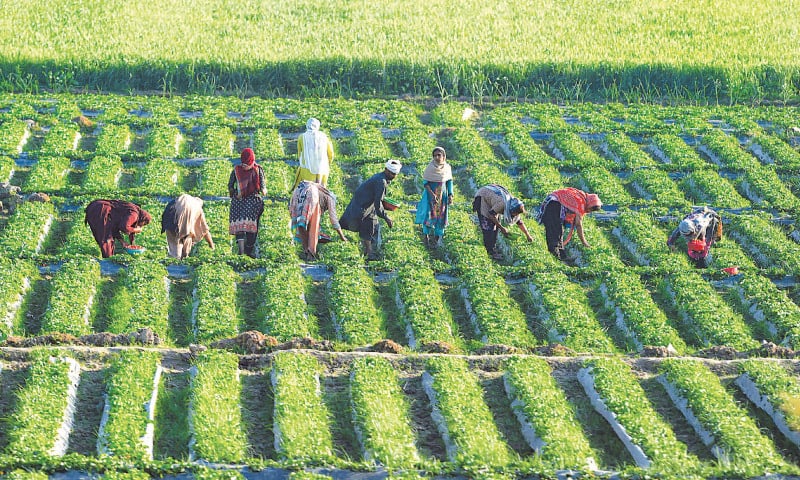
In agriculture for the full year, important crops grew a modest 0.65 percent. Wheat output rose 4.3 percent to 29.605 million tons from 28.396 million tons, rice increased 2.80 percent to 9.998 million tons, and sugarcane climbed 6.20 percent to 89.45 million tons. Maize fell 2.68 percent to 8.794 million tons and cotton declined 0.5 percent to 7.052 million bales. Other crops expanded 2.43 percent, driven by strong gains in grams (50.4 percent), potatoes (27.6 percent), mangoes (11.6 percent), bananas (30.8 percent), turmeric (25.1 percent) and chilies (9.2 percent). Livestock grew 3.75 percent, forestry 2.02 percent and fishing 1.66 percent. Cotton ginning and miscellaneous items edged up 0.07 percent.
Industry’s 3.51 percent full-year gain was shaped by mixed results across subsectors. Mining and quarrying managed only 0.38 percent growth despite a 4.52 percent rise in coal production, as natural gas output dropped 2.63 percent and crude oil slipped 0.38 percent. Large-scale manufacturing, measured by the Quantum Index of Manufacturing for July through March, advanced 6.11 percent, led by automobiles (61.66 percent), transport equipment (39.93 percent), rubber products (14.26 percent), electrical equipment (11.87 percent), tobacco (11.70 percent), petroleum products (10.92 percent), food (9.77 percent), furniture (20.45 percent) and other manufacturing including footballs (23.06 percent).
The electricity, gas and water supply sector contracted 10.63 percent, reflecting a high base from 29.60 percent growth the previous year, lower energy subsidies and slower output from Wapda and other producers. Construction rose 5.73 percent on higher private-sector and government spending, even after a 14.27 percent base in the prior period.
Services grew 4.09 percent for the year, with every major category contributing positively. Public administration and social security expanded 8.54 percent, information and communication 7.52 percent, human health and social work 6.85 percent, education 5.23 percent, wholesale and retail trade 3.71 percent, other private services 3.69 percent, and transport and storage 2.31 percent.
In the third quarter alone, agriculture’s 3.01 percent expansion reflected positive readings across the board: important crops 1.10 percent, other crops 2.27 percent, livestock 3.70 percent, forestry 1.62 percent and fishing 1.37 percent. Industry’s 4.65 percent advance came despite contractions in mining and quarrying (2.55 percent) and electricity, gas and water supply (13.53 percent), driven instead by large-scale manufacturing at 9.53 percent and a modest 0.48 percent rise in construction.
Services grew 4.18 percent, supported by information and communication (9.78 percent), public administration and social security (8.88 percent), wholesale and retail trade (4.13 percent), education (4.14 percent), health and social work (4.07 percent), other private services (3.35 percent), finance and insurance (2.90 percent), and transport and storage (2.02 percent). The data provide the most comprehensive official snapshot yet of Pakistan’s recovery trajectory, with the downward revision to the annual target underscoring persistent challenges in agriculture and energy while highlighting resilience in manufacturing and services.
Copyright © 2021 Independent Pakistan | All rights reserved