By Staff Reporter
ISLAMABAD: The Foreign Office on Thursday sought to project steadiness across multiple diplomatic fronts, firmly denying any erosion in its longstanding relationship with the United Arab Emirates despite recent media reports of large-scale expulsions of Pakistani workers and expressing cautious optimism about nascent calls for dialogue from across the border in India.
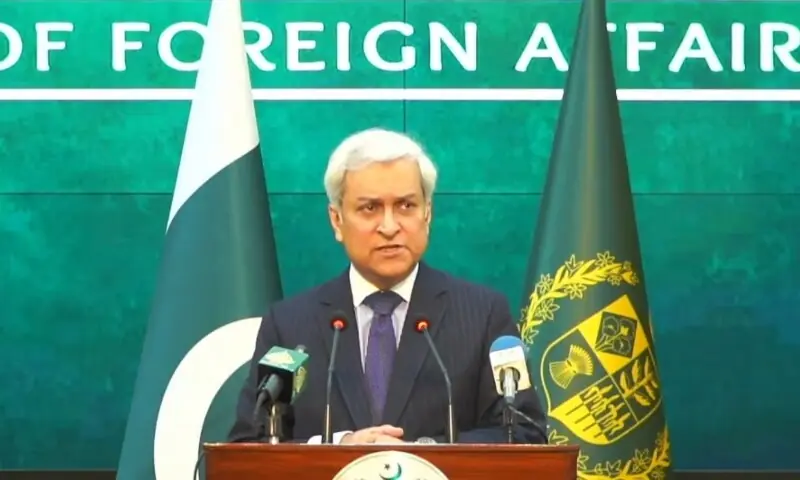
The statements came during the weekly news briefing conducted by Foreign Office spokesperson Tahir Andrabi, who repeatedly emphasized the resilience of Pakistan’s bilateral partnerships even as the nuclear-armed nation continues to grapple with the aftermath of last year’s brief but intense conflict with India and plays an active role in trying to stabilize tensions between the United States and Iran.
On ties with Abu Dhabi, Andrabi described the relationship as “strong, brotherly, built on strong foundation,” citing the presence of 2.2 million Pakistani nationals in the UAE, decades of friendly cooperation and bilateral trade approaching $8 billion. “We have traditionally been friendly and cooperative in all affairs,” he said. There is “absolutely no question” of any negative aspersions on the relationship between Islamabad and Abu Dhabi, he added, noting that the sentiment of mutual trust is shared in the UAE capital.
The comments were prompted by recent media reports alleging that the Gulf state had initiated a “large-scale expulsion” of Pakistani workers, particularly those from the Shia community — a claim the Interior Ministry has categorically denied. Minister of State for Interior Tallal Chaudhry had earlier described Pakistan’s relationship with the UAE as “absolutely fine.”
Andrabi and the ministry reported the figures as exaggerated and the coverage as “mala fide.” Deportations, when they occur, are routine and stem from violations of UAE laws, overstays or documentation issues, not from any country- or sect-specific policy, they said.
Pakistan’s defense relations with “brotherly” Gulf countries, Andrabi added, rest on institutional frameworks and long-term policy considerations, and are not swayed by any single visit or regional development.
Turning to India, Andrabi welcomed recent statements from across the border calling for renewed engagement, describing them as “a positive development.” He specifically referenced remarks by Dattatreya Hosabale, secretary-general of the Rashtriya Swayamsevak Sangh — the ideological parent of India’s ruling Bharatiya Janata Party — that a “window for dialogue with Pakistan” should always remain open, as well as supportive comments from retired Indian army chief Gen. Manoj Naravane.
“We hope that sanity will prevail in India, and warmongering, the belligerence that has been emanating for the past several months and even beyond, for past years, will fade away and pave the way for more such voices,” Andrabi said. Islamabad, he added, looks forward to an “efficient reaction” to such sentiments.
The two neighbors fought a sharp, high-tech war in May 2025 after India blamed Pakistan — without presenting evidence, Islamabad insists — for a deadly attack on tourists in the Pahalgam area of Indian-occupied Kashmir in April 2025. Pakistan denied any involvement and called for a neutral investigation. In response, New Delhi suspended the Indus Waters Treaty, among other punitive steps. Pakistan retaliated by halting all trade, closing its airspace to Indian flights and shutting the Wagah border crossing. On May 6, India launched overnight air strikes on Pakistani territory; Pakistan shot down five Indian jets in the initial tally, later revising the number to eight. After mutual strikes on air bases, the two sides agreed to a ceasefire on May 10 following American intervention.
When asked about Indian media reports of possible back-channel or “track two” contacts, Andrabi declined to engage. “About track two or backchannel — well I am not aware of that and do not wish to comment on those,” he said. “If I were to comment, there would be no backchannel. Backchannel or track two, the name is self-explanatory.”
Andrabi also clarified recent Chinese diplomacy, pushing back against what he called misrepresentations of a telephone call this week between Chinese Foreign Minister Wang Yi and Pakistan’s Deputy Prime Minister and Foreign Minister Ishaq Dar. Some local reports had portrayed Beijing as pressing Pakistan to “step up mediation efforts” in the US-Iran crisis in a manner implying a “do more” demand. That framing, Andrabi said, misrepresented the call “in both letter and spirit.”
The conversation, he insisted, was conducted with “traditional warmth and cordiality.” Wang, according to Andrabi and a readout from Chinese state media, appreciated Pakistan’s “constructive mediation role,” expressed full support for its efforts and commended Islamabad for facilitating talks and helping extend a temporary ceasefire. Wang reiterated China’s principled position and voiced hope that Pakistan would “maintain confidence and contribute to restoring regional peace at an early date,” Andrabi said. Both sides also underscored the need for a durable ceasefire and unimpeded passage through the Strait of Hormuz.
Pakistan has been deeply involved in shuttle diplomacy since the U.S. and Israel launched coordinated strikes on Iran on Feb. 28, prompting Iranian retaliation against Israeli and American targets. Islamabad helped broker a two-week ceasefire on April 8, hosted early rounds of talks and recently forwarded Tehran’s latest response to a U.S. proposal for a lasting settlement. Although negotiations have since stalled — notably after President Donald Trump rejected Iran’s most recent reply — Andrabi insisted “the peace process is intact” and “holding on.”
Prime Minister Shehbaz Sharif has spoken by telephone with the leaders of Qatar and Azerbaijan in recent days, while Dar has been in contact with his counterparts in Saudi Arabia, Iran, China, Austria and Singapore. On Monday alone, Dar met the U.S. chargé d’affaires in Islamabad, Natalie Baker; spoke with Saudi Foreign Minister Prince Faisal bin Farhan; and received a briefing from the U.N. secretary-general’s personal envoy for the Middle East, Jean Arnault. Pakistan, Andrabi said, believes “sincere dialogue is essential to advancing peace, security and shared prosperity in the region” and remains “engaged” and “hopeful.”
Copyright © 2021 Independent Pakistan | All rights reserved