By Staff Reporter
KARACHI: Authorities are investigating what senior police officials said a sophisticated, multi-city cocaine and narcotics trafficking operation that may extend beyond Pakistan’s borders, centered on a woman arrested this week in Karachi whom they have long suspected of running a major drug distribution ring.
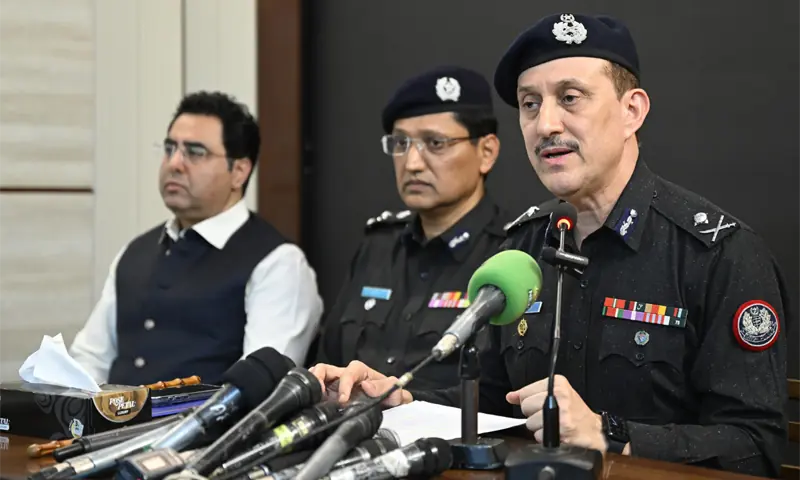
Karachi Additional Inspector General Azad Khan told reporters on Friday that forensic analysis of the suspect’s phones, financial records and contacts has uncovered evidence of coordination with individuals in Lahore, possible involvement of foreigners from African countries and facilitation by an unknown number of “harborers” — including, potentially, police personnel — who helped the network evade detection for years.
The suspect, Anmol, widely known by the alias Pinky, was detained late on the night of May 12 from an apartment in Karachi during a joint operation by local police and a civilian intelligence agency. She was found in possession of 1,540 grams of cocaine, 6,970 grams of other drugs and chemicals, and an unlicensed 9mm pistol with ammunition, according to a police statement issued after the briefing. On Wednesday, a Karachi court granted police a three-day physical remand to question her. Authorities have registered a fresh case based on drugs recovered from a nighttime raid on one of her previous residences.
Khan said the investigation, now led by a high-level team he heads that includes the deputy inspectors general for crime, special branch and counterterrorism, has identified links to at least 20 cases registered against Anmol in Sindh province — 17 older ones and three filed recently, including one with the federal Anti-Narcotics Force. Three additional cases have been registered against her in Lahore, he said, and authorities are seeking more details on their status.
Anmol has been formally shown as arrested in nine cases and acquitted in six earlier ones. She has been declared a proclaimed offender in three cases and an absconder in the ANF matter, Khan said. Separately, nine other cases naming her alleged riders — but not Anmol herself — are now being linked to her network.
The 35-year-old woman, according to police, has been involved in drug peddling since 2014-15, initially working with her husband, Rana Nasir, and dealing with his clients. She began selling drugs online in Karachi in 2018. When she came under official scrutiny here, she shifted operations toward Lahore, Khan said. She built what authorities describe as an organized network spanning multiple cities, taking orders via WhatsApp and arranging deliveries — often hidden inside food boxes — through riders on local buses or, later, third-party delivery services.
Investigators have so far identified nine dedicated riders she once employed directly. Eight were from Punjab province and would travel to Karachi to complete deliveries before returning; only one was local. After several riders were caught, Anmol changed tactics and began routing shipments through ordinary local delivery personnel, Khan said.
A forensic review of her mobile phone yielded more than 800 contacts. Location data has been obtained for 639 of them; only 132 are in Karachi. Roughly 300 of those contacts have been flagged by investigators as actively involved in drug-related activity. Officials plan to sort them into three categories: victims (addicts), accused (sellers) and harborers (those who facilitated the network through influence or protection). “Whether it is the police or anyone else,” Khan said, “we will treat them as its harborers.”
Financial records obtained so far paint a picture of substantial cash flow. A 500-page statement covering roughly 18 months of activity in one account showed transactions totaling more than 30 million Pakistani rupees. The largest single inflow — about 9 million rupees — came from an account in Lahore belonging to an individual identified only as Anna, Khan said. Police have traced six bank accounts linked to Anmol through her phone. Two men, Zeeshan and Sohail, owners of an entity called Fayyaz Communication, are alleged to have overseen financial transfers on her instructions, moving the equivalent of 30 million rupees from four private accounts into her network’s accounts over the course of a year.
The AIG said authorities are also examining possible connections between the network and at least one death. Anmol has been nominated in a murder case after investigators found her contact information linked to a drug user who subsequently died; police are treating the death as a homicide.
Khan disclosed that investigators believe the network’s main supply originated in Lahore, where products were prepared before being sent to Karachi. He said police have information suggesting six to eight foreigners from African countries, currently believed to be in Lahore, may be involved, along with about 20 women based in that city. Four names connected to the case have been forwarded for inclusion on the Exit Control List to prevent anyone from leaving the country; Khan said none belong to parliamentarians or their spouses.
Sindh police are coordinating with authorities in Punjab, the Anti-Narcotics Force, the Federal Investigation Agency, the National Cybercrime Investigation Agency and the Financial Monitoring Unit. Khan said he has spoken directly with the Punjab inspector general and that the two provincial forces will continue sharing information. A separate team is expected to be formed in Punjab.
Copyright © 2021 Independent Pakistan | All rights reserved