By Staff Reporter
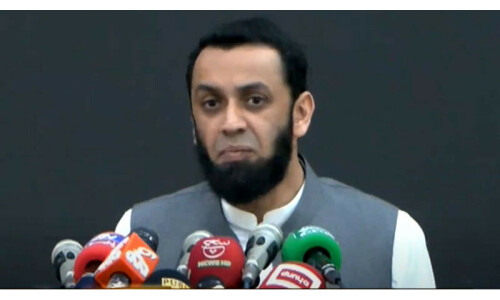
ISLAMABAD: Information Minister Attaullah Tarar on Monday rejected reports that the government was contemplating an increase in the minimum voting age from 18 to 25, calling the idea nothing more than rumor and insisting no such proposal was under active consideration.
“Why should we comment on rumours?… No such proposals are under our consideration,” Tarar said in response to a direct question from reporters. The clarification came after Adviser to the Prime Minister on Political and Public Affairs Rana Sanaullah stoked the debate in recent days by stating that the notion of raising the voting age was indeed being discussed in connection with a possible 28th Constitutional Amendment.
Appearing on a private television channel, Sanaullah drew a parallel between voting rights and candidacy rules, noting that candidates must be at least 25 years old to contest elections. “A person cannot contest an election until the age of 25, then […] if that is the case, the age for contesting elections should also be reduced to 18,” he said.
Under existing Pakistani election law, any citizen who is at least 18 years old as of Jan. 1 in the year when electoral rolls are prepared or revised — and who is a resident, or deemed a resident, of the relevant electoral area — is eligible to register and vote. The reported proposal would mark a significant departure from that standard, which has been in place for decades.
The discussion quickly drew sharp reactions from across the political spectrum. Barrister Gohar Ali Khan, chairman of the opposition Pakistan Tehreek-e-Insaf party, told reporters at Parliament House on Monday that he did not view the idea as a “serious proposal.” Citing United Nations definitions of youth as those between ages 15 and 29, Gohar warned that stripping 18-year-olds of the franchise would undermine the democratic process.
Separately, Sen. Kamran Murtaza of the Jamiat Ulema-e-Islam-Fazl (JUI-F) argued that legal adulthood at 18 should carry with it the right to vote. “If an 18-year-old person can get married, then they should also have the right to vote,” Murtaza said, adding that anyone mature enough to enter into marriage is equally capable of understanding the law.
The flurry of statements unfolded against a backdrop of persistent rumors about another major constitutional amendment. Law Minister Azam Nazeer Tarar, speaking in Lahore on Saturday, stressed that any move to amend the constitution would require broad consensus and said there were “currently no signs of a 28th Amendment.” “We are a coalition government; how can we proceed with constitutional amendments without consultation?” he asked during a media interaction.
Tarar pointed to past examples of cross-party agreement, including the consensus-driven process that produced the 18th Amendment in 2010, as potential models for future discussions. “All stakeholders will come together for dialogue on key issues requiring agreement,” he added. His remarks aligned with those of Pakistan Peoples Party Chairman Bilawal Bhutto-Zardari, who on Thursday told his party’s parliamentary meeting that no negotiations on a 28th Amendment had begun. “No talks have taken place yet on the 28th Amendment; [but] I do not know about tomorrow,” Bilawal said.
The denials also echoed comments by State Minister for Law Barrister Aqeel Malik, who had earlier pushed back against any suggestion that a new amendment might seek to roll back provisions of the landmark 18th Amendment, which significantly devolved power from the center to the provinces. The events show the sensitivity surrounding constitutional changes in Pakistan’s fragmented political landscape. With a coalition government in power and multiple opposition parties already voicing skepticism, any perceived shift in electoral rules — even one floated only in discussion — risks becoming a flashpoint.
Copyright © 2021 Independent Pakistan | All rights reserved