By Staff Reporter
ISLAMABAD: Pakistan’s Interior Minister Mohsin Naqvi arrived in the Iranian capital on Wednesday for talks with senior Iranian officials, his second visit in less than a week, as Islamabad pressed ahead with intensive mediation to prevent the resumption of hostilities between Washington and Tehran.
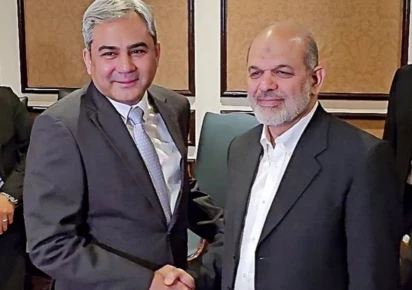
Naqvi held discussions with his Iranian counterpart, Interior Minister Eskandar Momeni, on the latest regional security situation, border management and matters of mutual interest, according to Iran’s state-run Islamic Republic News Agency. A brief statement on Naqvi’s official WhatsApp channel described the meeting as an exchange of views on “various matters.”
The visit comes as a fragile ceasefire, brokered by Pakistan and announced on April 8, holds but direct negotiations between the United States and Iran have stalled. Disputes over Iran’s uranium enrichment program and control of the Strait of Hormuz — the narrow waterway through which about one-fifth of the world’s oil and liquefied natural gas passes — have blocked progress since the first round of talks in Islamabad.
Pakistan has cast itself as a central go-between since the conflict erupted Feb. 28 with joint US-Israeli strikes on Iranian targets, which prompted Iranian retaliation and a near-total closure of the strait. Pakistani officials have shuttled proposals between the two sides, hosted the initial direct talks and coordinated with regional powers to keep diplomacy alive.
Iranian state media and Pakistani government sources said Naqvi’s mission is focused on a fresh US proposal aimed at reviving the talks. Multiple Pakistani officials, speaking on the condition of anonymity to discuss sensitive diplomacy, told Anadolu Agency that the mediation had reached a “critical phase.” Their priority, the sources said, is to solidify the ceasefire and persuade both capitals to return to direct negotiations in Islamabad.
During his stay, Naqvi also met Gen. Ahmad Vahidi, chief of Iran’s Islamic Revolutionary Guard Corps, Pakistan’s state broadcaster PTV News reported. He is expected to hold further talks with President Masoud Pezeshkian, Foreign Minister Seyed Abbas Araghchi and other senior figures.
The trip follows Naqvi’s visit over the weekend, when he met Pezeshkian, Araghchi, Parliament Speaker Mohammad Bagher Ghalibaf and Momeni. In those sessions, Pezeshkian praised Pakistan’s role in preventing the use of its territory for operations against Iran and credited Islamabad’s political and military leadership with helping stabilize the ceasefire.
Trump warns of renewed strikes; Iran vows wider war
The renewed diplomatic flurry coincides with fresh warnings from both sides. On Monday, President Donald Trump said he had postponed planned US strikes on Iran — originally set for Tuesday — at the urging of Gulf leaders who told him a deal was close. Trump told reporters on Wednesday that negotiations were in their “final stages.” “We’re going to give this one shot,” he said. “I’m in no hurry. Ideally I’d like to see few people killed, as opposed to a lot. We can do it either way.”
Iran responded with defiance. The Revolutionary Guard Corps warned Wednesday that any renewed US or Israeli aggression would ignite a conflict that “will this time spread far beyond the region.” Araghchi, Iran’s foreign minister, posted on social media that a return to war would bring “many more surprises.” Ghalibaf, whom Iranian officials have identified as Tehran’s chief negotiator, released an audio message saying Washington’s “overt and clandestine” moves showed it had not abandoned military objectives despite economic and political pressure. “We must strengthen our preparations for an effective and forceful response to any potential attacks,” he said. “Iran will never give in to intimidation, under any circumstances.”
Divergent proposals keep talks deadlocked
The two sides remain far apart on core issues. According to Pakistani sources familiar with the exchanges, the latest US proposal offers “slightly better incentives” on frozen Iranian assets and sanctions relief but makes “no new concession” on Iran’s nuclear program — the central sticking point. Washington insists the nuclear question, including limits on enriched uranium, must be resolved before any permanent ceasefire.
Iran, by contrast, has proposed handling the nuclear file in separate negotiations within 30 days after a permanent truce. Tehran also demands an end to conflicts on all fronts, lifting of sanctions, release of frozen assets, war reparations and recognition of its sovereignty over the Strait of Hormuz. Iranian officials have described Washington’s counter-conditions as including the transfer of 400 kilograms of enriched uranium to the United States, retention of only one Iranian nuclear facility and no war reparations. A proposal for third-party monitoring of the ceasefire remains under discussion, primarily on the Iranian side.
Pakistan coordinates with China, wins Saudi praise
Pakistan has worked in close lockstep with China throughout the crisis. Deputy Prime Minister and Foreign Minister Ishaq Dar told the Senate on Wednesday that Islamabad and Beijing had jointly crafted a five-point peace initiative — calling for a ceasefire, dialogue, protection of civilian and nuclear infrastructure, safe navigation through the Strait of Hormuz and adherence to the UN Charter.
The plan, developed during Dar’s March 31 visit to Beijing, has been endorsed by dozens of countries, he said. Dar highlighted constant coordination with Chinese Foreign Minister Wang Yi and noted that the two countries continue to align positions at the United Nations, the Shanghai Cooperation Organization and other forums. Prime Minister Shehbaz Sharif is scheduled to visit China from May 23 to 26.
Saudi Arabia, a key US partner in the Gulf, publicly endorsed Pakistan’s efforts on Wednesday. Foreign Minister Prince Faisal bin Farhan wrote on the social media platform X that Riyadh “highly appreciates the ongoing mediation efforts carried out by Pakistan” and urged Iran to seize the moment to advance negotiations and avoid escalation.
Economic stakes and limited traffic in the strait
The conflict has already exacted a heavy toll. The initial U.S.-Israeli bombing killed thousands in Iran; Iranian strikes and the Israeli campaign in Lebanon added to the casualties. Since the ceasefire, Iran has largely barred foreign vessels from the Strait of Hormuz except for its own ships and those of “friendly” nations. On Wednesday, two giant Chinese tankers carrying about 4 million barrels of oil exited the waterway after Tehran eased rules for Chinese shipping. A South Korean tanker also crossed, according to Seoul’s foreign minister.
Shipping data showed a modest increase in traffic — at least 54 vessels last week, roughly double the previous week — but still far below prewar levels of about 140 ships daily. Oil markets remained jittery. Benchmark Brent crude futures eased about 2.75 percent Wednesday morning to near $108 a barrel, reflecting both relief at the diplomatic activity and underlying anxiety over the possibility of renewed disruption.
Pakistani officials have repeatedly emphasized that the “clock on diplomacy has not stopped.” As one senior diplomatic source put it, Islamabad’s message to both Washington and Tehran is simple: “Do not give up on diplomatic efforts.”
Copyright © 2021 Independent Pakistan | All rights reserved