By Staff Reporter
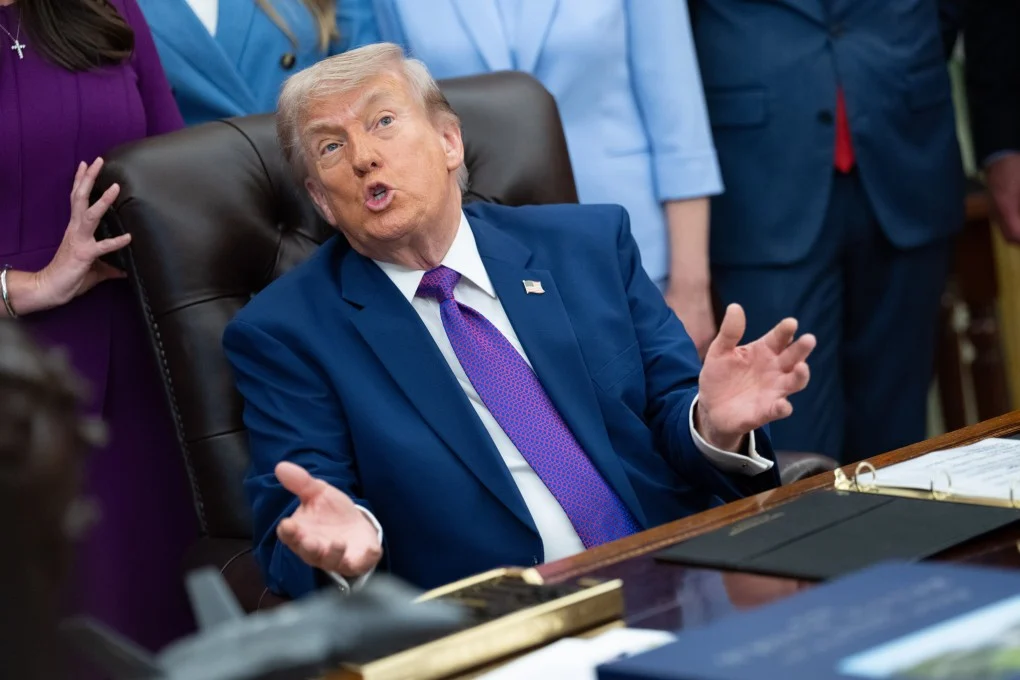
ISLAMABAD: US President Donald Trump on Monday raised the stakes in delicate negotiations to end the nearly three-month war with Iran, declaring he would accept nothing short of a transformative agreement even as his own secretary of state cautioned that a breakthrough he had seemed to promise over the weekend remained elusive.
“The deal with Iran will either be a great and meaningful one, or there will be no deal,” Trump wrote on Truth Social, the social media platform he uses as a primary instrument of foreign policy. The post came a day after he had claimed a peace memorandum with Tehran had been “largely negotiated.”
The whipsaw messaging illustrated the turbulent character of an endgame that has eluded both sides since a ceasefire took hold on April 8, six weeks after the United States and Israel launched strikes on Iran on Feb. 28, igniting a conflict that has upended global energy markets and reshaped the strategic landscape of the Middle East.
Even as Trump spoke in absolutes, Secretary of State Marco Rubio, appearing before reporters in New Delhi, offered a more qualified assessment. “We thought we might have some news last night, maybe today,” he said. “I wouldn’t read too much into it.”
Still, Rubio said there was “a pretty solid thing on the table” centered on Iran’s willingness to reopen the Strait of Hormuz, the narrow waterway through which roughly a fifth of the world’s oil and liquefied natural gas ordinarily flows. “We’re either going to have a good agreement or we’re going to have to deal with it another way,” he said. “We’d prefer to have a good agreement.”
In Tehran, Iranian Foreign Ministry spokesman Esmaeil Baghaei offered a carefully worded acknowledgment of progress — and an equally careful denial that a conclusion was near. “It is correct to say that we have reached a conclusion on a large portion of the issues under discussion,” he told reporters at a weekly briefing. “But to say that this means the signing of an agreement is imminent — no one can make such a claim.”
Baghaei also emphasised that nuclear issues had not yet entered the formal negotiating framework. The two sides, he said, remain focused first on “ending the war.” Any discussion of Iran’s contested nuclear program, he indicated, would follow only after an initial framework agreement was in place — a sequencing that Washington has not publicly accepted.
Separately, a senior Trump administration official, speaking on the condition of anonymity, told Reuters that Iran had agreed “in principle” to dispose of its stockpile of highly enriched uranium and reopen the Strait of Hormuz in exchange for the lifting of the American naval blockade. The official said Washington believed Supreme Leader Mojtaba Khamenei had endorsed the broad contours of such an arrangement, though Iran offered no immediate confirmation. Asked about Iranian resistance to surrendering enriched uranium, the official pushed back. “It’s a question about how,” he said.
The gap between those characterizations and Tehran’s public posture underscored how much work remains, even at what both sides have described as an advanced stage of negotiations.
A new and contentious demand
Into that already complicated diplomatic landscape, Trump on Monday introduced a sweeping new precondition: he said it should be “mandatory” that the Muslim-majority nations involved in brokering or benefiting from an Iran deal simultaneously sign the Abraham Accords, the normalization agreements his administration brokered between Israel and four Arab states — the United Arab Emirates, Bahrain, Sudan and Morocco — during his first term.
“After all the work done by the United States to try and pull this very complex puzzle together, it should be mandatory that all of these countries, at a minimum, simultaneously sign onto the Abraham Accords,” Trump wrote, listing Saudi Arabia, Qatar, Pakistan, Turkey, Egypt and Jordan as nations he had spoken with over the weekend.
He suggested Saudi Arabia and Qatar should move immediately, with others to follow. Nations unwilling to sign, he warned, were signaling “bad intention” and would be excluded from the deal altogether. He allowed that “one or two” countries with legitimate reasons might be excused. He then floated the notion, almost in passing, that Iran itself might one day wish to join.
The demand landed with immediate skepticism among analysts and, privately, among some of the governments named. Pakistan, which has served as a critical mediator between Washington and Tehran, has long maintained that normalization with Israel can come only after the establishment of a viable, contiguous Palestinian state with Jerusalem as its capital. A Pakistani source familiar with the diplomatic discussions told Reuters the statement reflected an attempt to link the Iran diplomacy to a broader push on the accords, but that the two tracks were “not interlinked and cannot be made so.”
Ali Vaez, the Iran project director at the International Crisis Group, was pointed in his assessment. “Trump is trying to sell an Iran deal as an Abraham Accords sequel: good for Israel, good for the region, tough enough for Washington,” he said. “But he is trading one fantasy for another — from forcing Iran to surrender to pretending a fragile deal can anchor a new Middle East order.”
Senator Lindsey Graham of South Carolina, a close Trump ally and staunch Israel supporter, amplified the president’s call on social media, calling it “a brilliant move” and warning that refusal to join the accords would represent “a major miscalculation” with “severe repercussions” for those countries’ relationships with Washington.
Charles Kupchan, a senior fellow at the Council on Foreign Relations who served on the National Security Council under President Obama, said the day’s crosscurrents were familiar. “I think this is kind of par for the course for the Trump administration,” he said. “One day they walk this way. The next day they walk that way.” Until the Iranians give a clear answer on surrendering enriched uranium and fully reopening the strait, he said, “I think one can say that we’re still far away from a lasting deal.”
On the ground and in the air
The diplomatic maneuvering unfolded against a backdrop of continued military and economic tension. Iran said Monday that it had shot down what it described as a “hostile” stealth drone using a newly deployed air defense system, with state media quoting unnamed officials as warning that “no more stealth drones can penetrate the skies of the Persian Gulf.” The drone’s origin was not identified.
Iran’s state television reported that 32 vessels, including five oil tankers, passed through the Strait of Hormuz in the past 24 hours with authorization from Iran’s Revolutionary Guard naval forces — a fraction of the 125 to 140 vessels that typically traversed the waterway daily before the conflict. Baghaei said any future passage regime would not involve tolls but would include fees for navigational services and environmental protections, to be formalized in a protocol with Oman.
Oil markets reacted sharply to the day’s hopeful signals. North Sea Brent crude fell to roughly $99 per barrel and West Texas Intermediate to about $92 — a drop of nearly five percent — though both prices remain well above pre-war levels. The conflict has driven sustained increases in the cost of fuel, fertilizer and food globally, a political liability that has weighed on Trump’s approval ratings and prompted efforts in Congress to curtail his war powers.
The human cost of the operation has also drawn attention. A congressional report found that the United States lost 42 aircraft during what the Pentagon has called Operation Epic Fury, including fighter jets and support planes.
Mediation efforts intensify
The focus of international diplomatic efforts shifted to Beijing on Monday, where Pakistani Prime Minister Shehbaz Sharif met with Chinese President Xi Jinping, accompanied by Army Chief Field Marshal Asim Munir, who had spent the previous weekend in Tehran in what Pakistani military officials described as intensive, high-level mediation talks.
China pledged to work with Pakistan “to make positive contributions to the early restoration of peace and stability in the Middle East.” Sharif told his Chinese counterparts that “things are moving in the right direction.”
Munir met with Iranian President Masoud Pezeshkian, parliament speaker and chief negotiator Mohammad Bagher Ghalibaf, Foreign Minister Abbas Araghchi and Interior Minister Eskandar Momeni during his Tehran visit. Pakistan’s military said the discussions produced “encouraging progress towards a final understanding,” though it stopped short of announcing any breakthrough.
Iran’s foreign minister and chief negotiator were separately in Doha on Monday for discussions with Qatar’s prime minister, according to an official briefed on the visit. Iran’s central bank governor also attended the Doha talks to address the potential release of tens of billions of dollars in frozen Iranian oil revenues — a central Iranian demand that, along with the lifting of broader sanctions, has complicated the negotiations considerably.
The ceasefire that has held since April 8 — extended indefinitely on April 21 at Pakistan’s request, hours before it was due to expire — has provided the diplomatic space for these talks, even as the underlying grievances remain unresolved. Iran has continued to assert control over Strait of Hormuz traffic; the United States has maintained its naval blockade of Iranian ports. Trump on Sunday reiterated that the blockade would “remain in full force and effect until an agreement is reached, certified, and signed.”
Two sources told Reuters that Israeli Prime Minister Benjamin Netanyahu has privately told confidants that Israel now has limited ability to shape Trump’s decision-making on the conflict — a striking acknowledgment of the constraints facing Washington’s closest regional ally. Netanyahu said Sunday that he and Trump had agreed that any final agreement “must eliminate the nuclear threat entirely.”
Copyright © 2021 Independent Pakistan | All rights reserved