By Staff Reporter
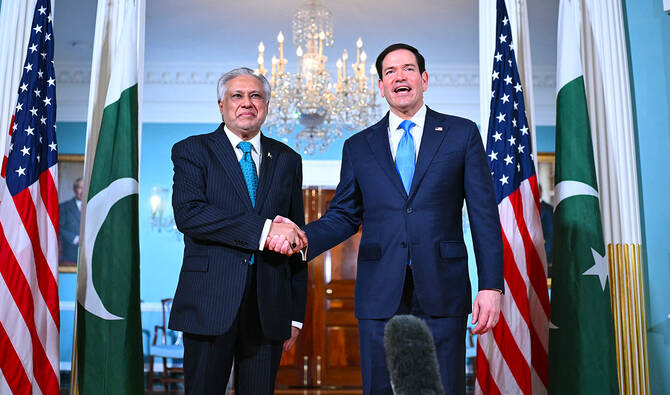
ISLAMABAD: US Secretary of State Marco Rubio met on Friday with Pakistan’s Deputy Prime Minister and Foreign Minister Ishaq Dar at the State Department, praising Islamabad’s diplomatic efforts to help broker an end to the conflict with Iran as negotiations over a potential ceasefire extension appeared to hang in the balance.
The meeting, which came hours after Rubio returned from a visit to India, showed Pakistan’s unusual position as a go-between for Washington and Tehran even as President Donald Trump signaled he was making a last-minute call on whether to approve a fragile agreement.
In a statement issued after the closed-door meeting, the State Department said Rubio thanked Dar for Pakistan’s “constructive role” in mediation between the United States and Iran. The two officials “agreed on the importance of working together to further strengthen a meaningful partnership that fosters security and prosperity for both Americans and Pakistanis,” the department added.
Rubio later echoed the sentiment in a post on X, writing that he had thanked Dar “for the role Pakistan continues to play in advancing peace in the Middle East” and that the two had committed to deeper cooperation for the security and prosperity of both nations.
The Foreign Office, in its own statement released in Islamabad, said Rubio had specifically acknowledged the country’s “sincere diplomatic and mediatory efforts for peace and stability in the region and beyond.” Both sides expressed satisfaction with the “positive momentum” in bilateral relations and agreed to expand cooperation in trade and investment, security, and counterterrorism. They also pledged to advance the partnership through high-level exchanges and shared interests in regional peace.
The Pakistani readout noted that the officials exchanged views on the rapidly evolving regional and global situation. Rubio also offered condolences for the victims of Sunday’s suicide bombing in Quetta that targeted a shuttle train, an attack that killed more than 10 people and wounded several others.
Dar arrived in Washington on Friday morning after three days of United Nations-related meetings in New York. He was greeted at the airport by Pakistan’s Ambassador to the United States, Rizwan Saeed Sheikh, and other senior embassy officials. Pakistani officials said he planned to depart for Islamabad later in the day.
The meeting occurred against a backdrop of intense diplomatic maneuvering over Iran. American media reports, including from Axios, have described negotiators from the two sides as close to a memorandum of understanding that would extend a shaky ceasefire for 60 days and open the door to broader talks on Tehran’s nuclear program. Trump, however, posted on social media on Friday that he was convening a Situation Room meeting to make a “final determination” on the matter.
In that post, Trump reiterated demands that Iran forswear nuclear weapons entirely and guarantee open shipping through the Strait of Hormuz. He said Iran would immediately begin removing mines from the strait, that the US naval blockade of Iranian ports would be lifted to allow oil tankers and commercial traffic to move, and that Iran’s enriched uranium stockpiles would be removed and destroyed in coordination with the United States, Iran, and the International Atomic Energy Agency. He added that “no money will be exchanged, until further notice,” and that only “items of far less importance have been agreed to.”
Iranian officials struck a notably more guarded note. Parliament Speaker Mohammad-Bagher Ghalibaf, who led Tehran’s delegation during direct talks hosted by Pakistan in Islamabad last month, wrote on X that Tehran placed “no trust in guarantees or words; only actions matter.” He added that Iran had gained leverage not through diplomacy but through the missiles it fired at US bases and allies when the conflict erupted on Feb. 28.
Iran’s Tasnim news agency, citing a source close to the negotiators, reported Friday that the proposed memorandum’s text had not been finalized and had undergone changes in recent days. Any deal, the source said, would be announced by Tehran, not unilaterally by Trump. Iranian media also indicated that Pakistan would be kept informed if agreement was reached.
Pakistan has positioned itself as a key facilitator since the fighting began in February, hosting rare direct US-Iran talks in Islamabad in April and maintaining channels with both sides and regional players. The proposed outline of the deal, according to US reporting, would guarantee unrestricted shipping through the Strait of Hormuz with no tolls or harassment, require Iran to clear all mines within 30 days, and commit the United States to lifting its naval blockade once commercial traffic resumed. Energy markets have swung sharply this week on the shifting prospects for such an accord.
Dar’s visit and the Rubio meeting come as Islamabad seeks both to burnish its credentials as a peacemaker and to deepen economic and security ties with Washington. The two governments have long described their relationship as strategically important, even as it has weathered periods of strain. Officials on neither side addressed reporters after the meeting. Dar’s office said he would brief Prime Minister Shehbaz Sharif upon his return to Islamabad.
Copyright © 2021 Independent Pakistan | All rights reserved