By Staff Reporter
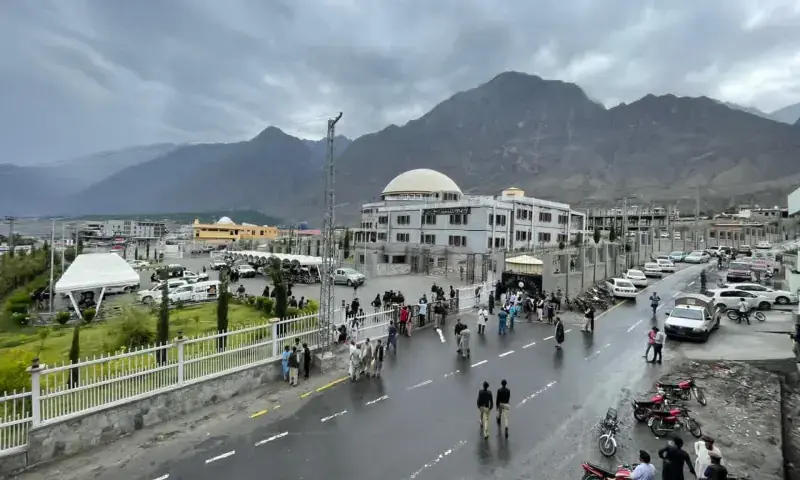
ISLAMABAD: Pakistan’s northernmost territory goes to the polls on Sunday for the first time in six years, after elections originally scheduled for February were postponed when winter snows rendered many of its mountain constituencies effectively unreachable. Nearly 960,000 voters are registered across Gilgit-Baltistan’s 24 general constituencies. The problems they want fixed are the same ones they brought to the ballot box in 2009, 2015 and 2020: electricity blackouts lasting up to 22 hours a day, broken roads in remote valleys, schools without teachers, and an unemployment crisis among a young population with few prospects. None of the major parties campaigning across the region in recent weeks has offered any serious plan to address them.
That is the central paradox of politics in Gilgit-Baltistan. The territory — which borders China, Afghanistan and Indian-administered Kashmir, and sits astride some of the world’s most critical water and transit routes — generates intense political interest at election time. Senior national leaders, including Nawaz Sharif, Bilawal Bhutto Zardari and Khawaja Saad Rafique have all held rallies here in the run-up to Sunday’s vote. Yet the practical consequences of successive assemblies have been modest enough that residents have grown accustomed to measuring their expectations accordingly.
“There is an electricity problem, a water problem, an infrastructure problem,” says Khawaja Khalid, a resident of Skardu, the region’s principal city, where an international airport has opened in recent years, and tourist numbers have climbed sharply. “We will support a person who knows how to solve these issues.” His neighbour Sadiq Sadpara gestures at the road outside. “You can see the condition of the roads. All the roads are broken. People have to face a lot of problems.” There are schools, he adds — “nice schools” — but no teachers in them. Skardu has become one of Pakistan’s most-visited destinations. Its residents are still waiting for the infrastructure to match.
THE ARITHMETIC OF DEPENDENCY
A total of 396 candidates are contesting the 24 general seats, among them 266 independents. The Pakistan Peoples Party has fielded 23 candidates; the PML-N 22. The Istehkam-i-Pakistan Party, formed by defectors from the PTI, is contesting 15 seats. The PTI itself has managed only ten candidates and will do so without its official electoral symbol, following an election commission decision that mirrors restrictions imposed on the party during last year’s national polls. Only eight women appear on the ballot across all parties and independents combined.
To form a government, a party needs 17 of the 33 assembly seats — 24 general seats supplemented by nine reserved for women and technocrats. The most crowded race is in Gilgit’s GBA-2 constituency, where 58 candidates are contesting a single seat.
Polling will run from 8am to 5pm at 2,450 stations staffed by more than 7,600 officials. GB chief election commissioner Raja Shahbaz Khan has delegated magistrate-level powers to returning officers across the territory, with instructions to enforce the electoral code strictly. The caretaker minister for information, Ghulam Abbas, has publicly urged residents to vote freely and without fear or pressure. The language of procedural reassurance is fully deployed. The question of whether it is sufficient is one that the region’s political history makes difficult to answer with confidence.
Political analyst Qaseem Naseem, who has tracked GB politics across multiple election cycles, identifies what he calls the territory’s defining electoral characteristic: its financial and administrative dependence on the federal government shapes how people vote. “Since Gilgit-Baltistan depends heavily on financial support and development funds from the federal government, voters often prefer parties that are in power at the federal level,” he says. The pattern has held with striking consistency. The PPP won the 2009 assembly elections when it governed in Islamabad. The PML-N swept the 2015 polls as the dominant federal party. The PTI secured a majority in 2020 at the height of Imran Khan’s premiership. With a PPP-PML-N coalition currently in power federally, both parties are competing hard for Sunday’s result — and the arithmetic of dependency suggests one of them is likely to benefit.
Naseem is careful to distinguish this from simple manipulation or blind loyalty. The logic, he argues, is rooted in the practical realities of governing a landlocked, high-altitude territory with no independent revenue base, limited infrastructure and an assembly with no formal constitutional standing. Roads, hydropower projects, healthcare facilities, schools — all depend on federal funding streams that flow more readily when the territory’s government and the centre are aligned. “Their concern isn’t so much which party raises the loudest slogans,” he says, “but which political force can bring about tangible results.”
AN UNEVEN CONTEST
The campaign has not proceeded on equal terms. While PPP, PML-N and IPP leaders moved freely through the region holding large rallies, PTI’s access was heavily restricted. Junaid Akbar, the party’s Khyber Pakhtunkhwa president, was arrested and expelled from GB while attempting to campaign. Senior party figures, including Asad Qaiser and Salman Akram Raja, were denied permission to hold events. Combined with the loss of the party’s electoral symbol, PTI’s candidates have effectively been fighting the campaign with one hand tied behind their backs — a situation their supporters say makes a fair result impossible to guarantee before a vote has been cast.
The GB election commission and caretaker administration have given formal assurances of impartiality. Independent observers will be watching closely. Clean elections, as analysts in the region have noted, are not measured solely on polling day; the conditions under which the campaign was conducted form an inseparable part of the democratic record.
Naseem notes that the political landscape has shifted considerably since earlier cycles, in ways that cut both ways for the region. “Unlike the past, when only a few major political leaders visited the region, today the central leadership of almost all major political and religious parties in Pakistan are actively campaigning here,” he says. That visibility reflects GB’s growing national profile — driven largely by the tourism boom, the China-Pakistan Economic Corridor’s transit routes through the territory, and the strategic weight it carries in the broader Kashmir context. Whether that attention translates into serious policy engagement, rather than election-season rallies, is what voters are increasingly asking.
RIGHTS DEFERRED
Beneath the immediate contest lies a question that no election can resolve but that shapes the terms of every political debate in the territory. Gilgit-Baltistan has something approaching provincial status but lacks the formal constitutional recognition that would give its residents representation in Pakistan’s senate, full citizenship rights, or a settled legal framework for its governance. The region has been administered by Pakistan since shortly after independence in 1947, when it was separated from the former princely state of Jammu and Kashmir that both India and Pakistan continue to claim in its entirety. Its constitutional limbo is not incidental to its politics; it is the condition within which all of its politics operates.
“Even after 78 years, the people of the region are still deprived of full constitutional rights,” Naseem says. “People want to be integrated into the national mainstream and granted their constitutional rights.” The assembly elected on Sunday will have no power to deliver this; that lies with parliament in Islamabad. Previous assemblies have oscillated between pressing the demand loudly and quietly setting it aside in exchange for development commitments. Which approach the next assembly takes will depend partly on its composition and partly on how much leverage it judges it holds over a federal government already under considerable pressure.
The constitutional question is also, analysts note, inseparable from Pakistan’s international position on Kashmir. Its argument that Kashmiris deserve free and fair self-determination is harder to sustain if the democratic process in its own administered territory is seen to fall short. The 1987 elections in Indian-administered Jammu and Kashmir, widely regarded as rigged, are still cited as the moment that shattered public faith in electoral politics across the valley and set in motion a decade of militancy. The lesson is not lost on those who observe GB politics from a regional perspective.
WHAT SUNDAY’S VOTE CAN AND CANNOT DO
Sadpara’s assessment of the situation in Skardu is blunt: “If these issues are not addressed, the problems will continue to increase.” He is not speaking as a partisan. He is speaking as someone who has watched several election cycles come and go while the roads remained broken and the schools remained understaffed and the tourists kept arriving to a region whose residents could not reliably keep their lights on after dark.
The candidates contesting Sunday’s elections have mostly offered slogans rather than solutions. The parties with the best organisational presence and the strongest federal connections are the ones best placed to win. Whether the winners will govern differently from their predecessors is the question that nearly a million voters in one of the world’s most extraordinary landscapes will be answering — with, by now, well-calibrated expectations about the answer.
Copyright © 2021 Independent Pakistan | All rights reserved