By Staff Reporter
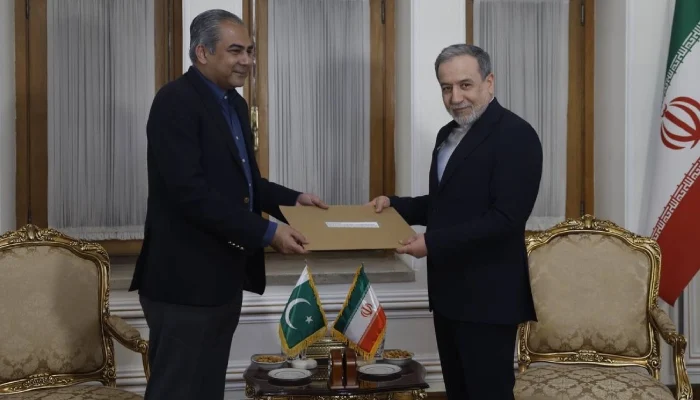
ISLAMABAD: A sealed brown envelope changed hands in Tehran on Sunday. In it, according to Iranian state media, was a written message from Pakistan’s prime minister addressed to Iran’s supreme leader — a man who has not been seen in public since he was wounded in the opening hours of a war that has now dragged on for one hundred days.
The interior minister, Mohsin Naqvi, handed the envelope to Iranian foreign minister Abbas Araghchi during talks in the Iranian capital, in what has become Islamabad’s latest — and perhaps most consequential — diplomatic intervention in a conflict that has shaken global energy markets, strained the Nato alliance, and left more than 3,500 people dead.
Naqvi arrived in Tehran on Saturday evening, telling reporters he had come bearing both a letter from Prime Minister Shehbaz Sharif and a “special letter” from Pakistan’s army chief, Field Marshal Asim Munir, for Ayatollah Mojtaba Khamenei. He declined to reveal the contents. “I think it’s a very important message,” he said.
Khamenei — who assumed the supreme leadership after his father was killed on the conflict’s first day — has remained out of public view since being wounded in the initial US and Israeli strikes of 28 February. His fate has become one of the war’s most closely guarded secrets, and one of its most destabilising uncertainties.
President Donald Trump, speaking to NBC’s Meet the Press in an interview recorded on Friday, did little to dispel the ambiguity. “I don’t want to say whether or not I know where he is,” he said, “but there’s a good probability that I do.” He added that he would be willing to speak directly with the supreme leader if it helped broker a settlement.
‘Very close to a deal — or I’m going to blow the hell out of them’
The diplomatic overture came as the conflict reached its symbolic centenary with no end in sight, and with both sides still trading blows. The US military said on Sunday it had shot down two Iranian drones over the Strait of Hormuz that it said posed a threat to international shipping — the latest in a series of such incidents. Hours earlier, US Central Command had destroyed four further drones and struck Iranian coastal radar installations. Tehran responded with a salvo of ballistic missiles aimed at Bahrain and Kuwait, both US allies, which American forces said were fully intercepted.
Iran’s foreign ministry condemned the US strikes as “flagrant” violations of the April ceasefire, denouncing what it called Washington’s “hostile and provocative behaviour”.
Since the preliminary truce took hold on 8 April — brokered in large part through Pakistan’s mediation — neither side has observed it with any consistency. US secretary of state Marco Rubio has maintained that the ceasefire is technically still in place, telling lawmakers last week that American strikes represent defensive measures rather than offensive escalation.
Trump’s own messaging has been characteristically volatile. On Tuesday he said a deal “could be reached over the weekend” and that Iran was “quite close to signing the document”. By Friday he was telling NBC: “It’s been three months now. It will take some time — as you know, the Vietnam War lasted 19 years.” In the same breath, he warned: “We’re very close to a deal, or I’m going to blow the hell out of them.”
The Strait, the sanctions and the $24 billion question
At the heart of the stalemate lies a set of interlocking demands that neither side has shown willingness to concede. Iran, whose economy was already buckled by years of Western sanctions before the war began, has made the release of approximately $24 billion in frozen assets a condition of any lasting settlement. Mohsen Rezaei, a military adviser to Khamenei, told CNN this week that negotiations had reached “a deadlock, and Trump must break this deadlock”.
Washington’s response has been to threaten to redirect those same frozen funds — not to Tehran, but to its Gulf allies to cover damage inflicted by Iranian missile strikes. “The Treasury will utilise all tools available to allow Iranian assets to be made available to our Gulf allies to support rebuilding and repairs,” said a source familiar with Treasury Secretary Scott Bessent’s thinking.
Trump, for his part, was categorical. He would not unfreeze assets or lift sanctions before a deal was signed. “Comes after,” he said when pressed. “If they behave, if they do a good job, we start talking.”
Iran has also insisted that any lasting agreement must extend to Lebanon, where Hezbollah — the Tehran-backed armed movement — has been fighting Israel since March. That demand collides directly with the political calculus of Israeli prime minister Benjamin Netanyahu, who faces elections later this year and has shown no appetite for halting Israel’s campaign in southern Lebanon until he judges Hezbollah to be neutralised as a military force.
On Sunday, Netanyahu announced that Israeli forces had struck “a militant command centre” in the southern suburbs of Beirut, Hezbollah’s stronghold, in response to what he described as fire towards Israeli territory. Lebanon’s state news agency said the strikes hit two apartments. Araghchi had previously warned that any attack on Beirut would trigger a “full-scale resumption” of the wider war.
Pakistan’s unlikely centrality
Few would have predicted, at the war’s outset, that Islamabad would emerge as its most active diplomatic broker. Yet Pakistan has spent the past three months relaying proposals between Washington and Tehran, with support from Qatar, Turkey and Egypt. Munir, the army chief, has been the principal architect of these back-channel efforts, hosting talks and carrying messages that formal diplomatic channels have struggled to sustain.
The breadth of Pakistan’s involvement was underscored on Saturday when Lebanon’s army commander, General Rodolphe Haikal, travelled to Islamabad at Munir’s invitation. The Lebanese military gave no official explanation for the visit, but a source with knowledge of the talks confirmed it was connected to Pakistan’s mediation. Beirut has its own pressing interest in any settlement: a definitive end to the Lebanon front, where an April ceasefire was rejected almost immediately by Hezbollah and a further conditional truce announced in recent days met the same fate.
Araghchi, interviewed by CNN ahead of Naqvi’s visit, described the experience of negotiating with the Trump administration in withering terms. “The main problem of negotiating with this administration is that you have to face so many changing positions, moving the goal posts, different statements, contradictory remarks,” he said. The process, he added, was “very cumbersome”.
A war that has already reshaped the world
One hundred days into the conflict, its consequences have spread well beyond the region. The closure of the Strait of Hormuz — through which roughly a fifth of the world’s oil and liquefied natural gas passes — has driven energy prices sharply higher, fuelling inflation and political anxiety across the developed world. Trump, facing midterm congressional elections in November, is acutely aware of the domestic cost. European governments, which declined his entreaties for military support, have watched the fractures in Nato widen with something between relief and unease.
More than 3,500 people have been killed in Iran since the war began, among them 13 American service personnel. The Iranian state has not collapsed, as some in Washington had expected when the elder Khamenei was killed in the opening strikes — a miscalculation that one senior regional official privately compared to expectations surrounding Venezuela’s Nicolás Maduro. Instead, Iran has absorbed the blows, closed the strait, and dug in.
The central obstacle to peace remains Iran’s nuclear programme. Indirect talks are reported to have come close to a framework under which Iran would lift its blockade of the Strait of Hormuz in exchange for a process leading to nuclear negotiations — but the gap between Trump’s insistence that Iran can “never” possess nuclear weapons and Tehran’s refusal to surrender its enrichment capabilities before sanctions relief is provided has not closed. Trump’s abandonment, in 2018, of the Obama-era nuclear agreement — under which Iran had reduced its centrifuge capacity by three-quarters and its enriched uranium stockpile by 98 percent — casts a long shadow over any new framework. Whatever deal Trump is prepared to accept, his aides have made clear it cannot be seen to resemble what his predecessor signed.
Copyright © 2021 Independent Pakistan | All rights reserved