By Staff Reporter
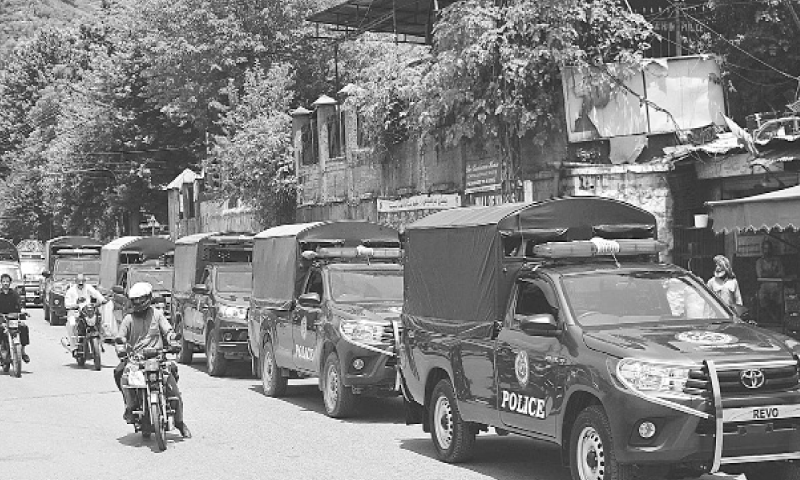
RAWLAKOT: Four police officers were killed and more than 20 others wounded on Sunday in some of the worst violence to strike Azad Jammu and Kashmir in years, as clashes between security forces and supporters of a newly banned protest movement turned a regional political standoff into open bloodshed.
The killings came just four days after the AJK government proscribed the Joint Awami Action Committee, a coalition that had spent months organising mass demonstrations against the territory’s political establishment and was preparing another protest for Monday. By Sunday evening, the territory’s police chief had declared the unrest an act of terrorism, its high court had weighed in on the constitutional dispute at the center of the crisis, and officials in Islamabad were insisting that nearly all of the group’s demands had already been addressed.
Whether anyone was listening was unclear. Mobile data services had been cut across much of Azad Kashmir, leaving residents and reporters unable to fully assess the scale of the violence or independently verify official accounts.
The confrontation began taking shape Friday night, when a local trader was shot during an encounter with law enforcement in Rawlakot, a city of roughly 50,000 in the Poonch district. The man’s death ignited immediate fury in a community already primed for confrontation. His family initially announced a Saturday funeral, then reversed course, returning the body to the Combined Military Hospital — locally known as CMH — apparently for a postmortem examination, and postponing the burial until Sunday.
The postmortem was never conducted. Through Saturday night and into Sunday, dozens of people maintained a sit-in outside the hospital. A senior administration official, speaking on condition of anonymity, described the demonstration as causing serious disruptions to patients, families, and ordinary commuters who needed access to the facility. Police repeatedly asked the crowd to disperse. They did not.
When a police party arrived on Sunday to move the protesters, witnesses said a confrontation quickly escalated. Officers deployed batons and fired tear gas canisters; demonstrators responded with stones. Then, according to police, gunfire erupted.
In a statement released on Sunday night, Liaqat Ali Malik, the inspector general of AJK police, said four of his officers had been shot and killed during a deliberate armed assault on the hospital. More than 20 additional security personnel sustained gunshot wounds, the statement said. Malik accused the banned organisation of orchestrating a “planned, armed and terrorist act” disguised as a political protest, and vowed that those responsible would face criminal prosecution.
“Direct firing on law-enforcement personnel, the resulting martyrdoms and gunshot injuries, and the subsequent attack on CMH Rawlakot clearly constitute terrorism,” Malik said in the statement.
The family of the slain trader, for their part, made clear they would not bury him until the government reversed its decision to outlaw the JAAC. “Our son faces the allegation of being a terrorist,” a family member was quoted as saying. “We will not bury him until the notification branding JAAC as a terrorist group is withdrawn.”
At least two protesters were also reported killed in the violence, with dozens more wounded. Locals feared the true toll could be considerably higher, but the communications blackout made independent confirmation nearly impossible.
A Movement Suppressed — or Emboldened?
The government’s decision to proscribe the JAAC on June 5 struck many observers as an extraordinary escalation. For months, the coalition had occupied an unusual position in Azad Kashmir’s political landscape: an unofficial opposition that commanded genuine popular support, pressing an agenda that mixed economic grievances — lower energy prices, free healthcare — with a charged constitutional demand to abolish 12 seats in the regional Legislative Assembly reserved for Kashmiri refugees.
Those refugee seats, held by descendants of Kashmiris who fled Indian-occupied Jammu and Kashmir in the conflicts of 1947 and 1965 and resettled across Pakistan’s mainland, have long been a source of friction in Azad Kashmir’s politics. The JAAC argued the seats were routinely exploited by Pakistani political parties to tilt the balance of power in Muzaffarabad, the territory’s capital. The government and its allies argued the seats were a constitutional guarantee for a displaced community that could not simply be negotiated away.
Earlier on Sunday, AJK police raided and sealed the group’s central office in Muzaffarabad, recovering a submachine gun, a 12-bore rifle, and a pistol from the premises. Officers said the weapons were evidence of the group’s alleged intent to foment unrest. A large crowd stood outside during the raid, but — in a detail that complicated the official narrative of an organisation primed for violence — there was no protest, no sloganeering, no apparent attempt to resist.
The Pakistan Tehreek-e-Insaf party seized on that contradiction and others. In a statement, PTI challenged the government’s characterisation of the JAAC as a terrorist organisation, noting months of official engagement that preceded the ban. “If JAAC was truly a terrorist organisation,” the party asked, “why did the government spend months negotiating with it, signing agreements with it, implementing its demands, holding meetings with its leadership and treating it as a legitimate stakeholder until yesterday?”
Minister for Parliamentary Affairs Tariq Fazal Chaudhry, appearing at a news conference on Sunday, dismissed such criticism. “It’s negative and false propaganda that the government hasn’t addressed the demands,” he said. “Out of 38 demands, 35 have been addressed.”
The Court’s Word
Into this volatile moment stepped the Azad Kashmir Supreme Court, which on Sunday released an advisory opinion — dated June 6 — responding to a presidential reference submitted by AJK President Chaudhry Latif Akbar. The opinion, written by Chief Justice Raja Saeed Akram Khan, addressed five constitutional questions the president had put to the court, including whether the refugee seats could be abolished, whether the current legislature had the authority to make such a sweeping constitutional change, and whether the state was obligated to protect the upcoming electoral process from being disrupted by pressure campaigns.
On every question, the court sided with constitutional order over popular agitation.
The refugee seats, the court held, are guaranteed by Article 22 of the AJK Constitution and are rooted in a legislative history stretching back to 1960. They were not a political convenience to be traded away but a “constitutional expression of a profound historical and juridical truth” arising from the displacement of hundreds of thousands of Kashmiris. Six seats represent refugees from the Jammu division; six represent those from the Kashmir Valley. Together, they reflect a displacement that the court described as one of the defining realities of the Kashmiri political condition.
Any effort to eliminate those seats, the court said, would require a formal constitutional amendment under Article 33’s prescribed procedures — a process involving a sitting legislature with a full democratic mandate, deliberation, consultation, and broad consensus. Executive orders could not accomplish it. Political agreements could not accomplish it. Mass protests most certainly could not.
“The amendment of the constitution is a solemn constitutional act, not a concession to be wrested from a government under duress,” Chief Justice Khan wrote. “It can only be accomplished through the process the constitution itself prescribes.”
The court also addressed the question of protest rights with some precision, affirming that peaceful assembly is a fundamental right while making clear it is not absolute. Road blockades, forced business closures, and supply-route disruptions, the court said, fall outside constitutional protection because they extinguish the rights of others. “The Constitution protects peaceful dissent,” the opinion stated. “It does not protect conduct that undermines public order.”
The court directed the AJK Election Commission to proceed with general elections, set for July 27, without interruption. The constitutional obligation to hold timely elections, it said, “admits of no exception.”
What Comes Next
The crisis in Azad Kashmir is now moving on multiple tracks simultaneously, each one capable of making the others worse.
The JAAC has been banned but has not disappeared. Its supporters — some of them, at least — appeared willing on Sunday to fire weapons at police rather than stand down. The government has moved to seal the group’s offices and initiated legal proceedings, but in a territory where mobile data has been cut, and information is difficult to verify, the potential for further violence is real.
The elections scheduled for July 27 hang over everything. The AJK Supreme Court has said they must proceed. The Election Commission has said preparations are underway. But holding a credible vote in a territory where an armed confrontation killed four police officers less than seven weeks before polling day will require a degree of stability that Sunday’s events did little to promise.
Copyright © 2021 Independent Pakistan | All rights reserved