By Staff Reporter
GILGIT: The Pakistan Peoples Party appeared on Sunday night to have won a commanding plurality in elections for the Gilgit-Baltistan Legislative Assembly, with unofficial returns from across the remote Himalayan territory showing the party leading in at least 10 of the 24 directly contested seats — even as its own leaders joined rival parties in accusing election officials of withholding the paperwork that stands between a result and a verified one.
By midnight, preliminary tallies — unconfirmed and subject to revision — showed the PPP ahead in a swath of constituencies stretching from Gilgit city through the Skardu district and into Ghizer. The Pakistan Muslim League-Nawaz held leads in six seats, with independent candidates — including several backed by the Pakistan Tehreek-e-Insaf, which has been stripped of its electoral symbol — ahead in seven more. The Majlis Wahdat-e-Muslimeen appeared to have taken one seat.
PPP Chairman Bilawal Bhutto Zardari, speaking before all results were in, declared that “the arrow is raining in Gilgit-Baltistan” — a reference to his party’s ballot symbol — and said the PPP intended to form the next government. But even as Bilawal claimed the high ground, his own party’s secretary general was on the phone with the chief election commissioner, lodging complaints.
A Day That Began Peacefully, and Ended in Recrimination
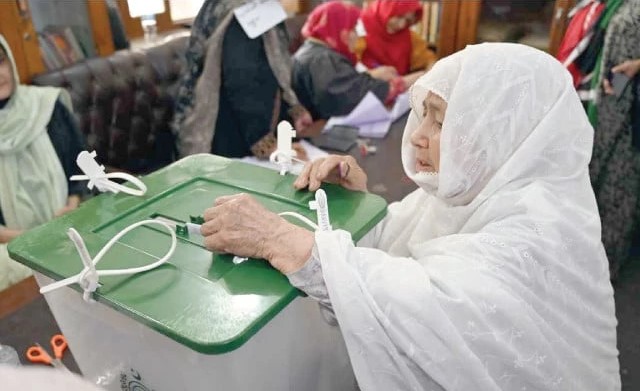
Polling opened at 8 a.m. and closed at 5 p.m. without interruption across all 10 districts of the territory, and officials were quick to describe the day in broadly favourable terms. Gilgit-Baltistan Chief Election Commissioner Raja Shahbaz Khan toured roughly a dozen polling stations in Gilgit city, spoke approvingly of the security arrangements, and told journalists that women were turning out in notably large numbers to vote — a development he called a sign of democratic maturity.
“The election process has been completed in a peaceful environment,” Raja Shahbaz said, adding that polling staff and law enforcement had performed their duties effectively.
Caretaker Interior Minister Sajid Ali Baig called the day largely peaceful while acknowledged that minor irregularities at certain locations had been addressed promptly.
But by evening, that measured tone had given way to something more contentious. From multiple directions, parties began alleging that presiding officers were refusing — or being pressured — to distribute Form-45, the official vote count that each polling station officer is required to prepare and hand to candidates’ representatives. Without those forms, candidates and parties have no independent means of verifying the tallies being released.
PPP Secretary General Nayyar Hussain Bukhari said the party’s agents were being prevented from obtaining the forms, and in some cases were being asked to leave polling areas altogether. “We have contacted the chief election commissioner and informed him about the matter,” Bukhari said. Party spokeswoman Shazia Marri called the delays “unacceptable” and alleged that voter rolls had been altered before the election and that at least one polling station had been physically relocated while voting was underway.
That last allegation referred to a station in the Bunji area of Astore, where the PPP said a polling location serving 206 registered voters had been moved from a roadside site to a hilltop overnight — a change the party characterized as an effort to suppress its support. The party said residents had responded by blocking the Gilgit-Skardu Road in protest.
PPP leader Nadeem Afzal Chan went further, accusing two unnamed federal ministers of pressuring the district administration to influence results. “The presence of Amir Muqam and Aleem Khan in GB and their activities go against the requirements of a fair election,” Chan said. He alleged that presiding officers had been told not to release Form-45 and called on the election commission to provide them protection.
The chief election commissioner subsequently issued a directive to returning officers in all 24 constituencies, instructing them to ensure the issuance of verified Form-45 results in accordance with the Elections Act 2017. “Form-45 is being issued at all polling stations where vote counting has concluded,” Raja Shahbaz said.
PTI: ‘A Blot on the Electoral Process’
The PTI, whose candidates ran as independents after the Supreme Court stripped the party of its cricket-bat symbol in January 2024, offered an even sharper set of allegations. The party said its candidates held clear leads until 7 p.m., after which it began receiving reports from constituencies where turnout figures had climbed above 80 percent and individual ballot boxes were said to contain 700 to 800 votes — figures the party called implausible.
“This is a blot on the entire electoral process and its transparency,” the party said in a statement.
The PTI also claimed that its polling agents were being denied Form-46 — the form that certifies the result at the constituency level — and that party members in Nagar and elsewhere had caught rivals in possession of counterfeit ballots. It alleged that voter lists had been manipulated before election day, that polling schemes had been altered using police and administrative pressure, and that its candidates and workers had been “systematically harassed and pressurised.”
“This rigging is part of a well-planned and systematic conspiracy,” the party said. It demanded the immediate release of station-level results, the prompt issuance of Form-45 and Form-46 to all candidates, and a swift inquiry into polling stations with suspicious turnout figures.
The Gilgit-Baltistan Supreme Appellate Court had, in the days before the vote, issued an order directing the election commission to conduct the polls in a “transparent, impartial and fair manner” — a directive that came after Khyber Pakhtunkhwa Chief Minister Sohail Afridi wrote to Chief Justice Sardar Muhammad Shamim Khan requesting equal treatment for all parties.
The Results, Constituency by Constituency
Where returns had come in, the picture was uneven. In GBA-1 (Gilgit-I), PPP regional president Amjad Hussain led with 10,594 votes over PML-N’s Muhammad Shafiq Uddin. In GBA-3 (Gilgit-III), a PTI-backed independent, Syed Sohail Abbas, was ahead of the PPP’s Aftab Haider.
In the Nagar area, PPP candidates Muhammad Ali Akhtar in GBA-4 and Zulfiqar Ali Murad in GBA-5 held leads. In GBA-6 (Hunza), PTI-backed independent Naiknam Karim was ahead of the PPP’s Imtiazul Haq.
In the Skardu district, the PPP showed particular strength: Syed Tauqeer Mehdi led in GBA-7, Fida Muhammad Nashad in GBA-9, Nasir Ali Khan in GBA-10, Iqbal Hassan in GBA-11 (Kharmang), and Imran Nadeem in GBA-12 (Shigar). The one exception in the district was GBA-8, where MWM’s Muhammad Kazim edged out the PPP’s Muhammad Ali Shah by a margin of roughly 350 votes — 10,474 to 10,118.
The PML-N showed a concentrated base in Astore, where Rana Farman Ali and Rana Muhammad Farooq were leading in GBA-13 and GBA-14, respectively. The party also held leads through Abdul Jahan in GBA-20 (Ghizer), where it prevailed with 6,917 votes to the PPP’s 6,758, and Muhammad Ibrahim Sanai in GBA-22 (Ghanche).
In the Ghanche district, three independent candidates appeared headed for victory. Anwar Ali won GBA-23 with 12,117 votes, while Asad Shafiq led in GBA-24. Independent Aman Ali took GBA-21 (Ghizer) with 9,938 votes, well ahead of the PPP’s Muhammad Ayub Shah.
GBA-2 (Gilgit-II) remained closely watched. Former chief minister and PML-N regional president Hafiz Hafeezur Rehman, who governed the territory from 2015 to 2020 before the PTI swept the 2020 elections, was holding a lead there. He and Amjad Hussain were considered the two leading candidates for the chief ministership should final results hold.
The Stakes and the Setting
The election was held after a four-month delay attributed to the brutal winters that routinely cut off large sections of the territory. Of the assembly’s 33 total seats, 24 are filled through direct elections; the remaining nine — six reserved for women and three for technocrats — are distributed through proportional representation based on party performance in the general seats.
In all, 403 candidates filed to contest the 24 seats, though the ballot ultimately included 396, among them just eight women. Of the total, 266 ran as independents — a figure inflated by the PTI’s forced absence from the official party roster. The territory’s 963,034 registered voters, including 566,097 men and 396,937 women, cast ballots across 1,391 polling stations. Of those stations, 551 were designated highly sensitive and 349 sensitive; the district of Diamer, historically volatile, had 119 highly sensitive stations out of 174 total.
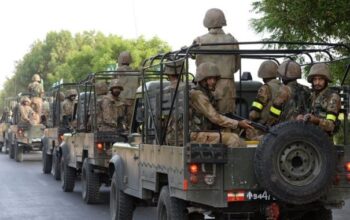
Security was extensive. More than 17,500 personnel were deployed, including 6,000 officers from the Punjab police and 2,000 from the Islamabad police, supplemented by Gilgit-Baltistan Scouts and contingents from Sindh. Inspector General of Police Nasir Akbar Khan said law enforcement was on high alert throughout the day, with additional forces positioned at sensitive locations.
The PPP and PML-N competed with the most organizational muscle. Bilawal campaigned across multiple districts, promising constitutional rights for the territory, land ownership for residents, and eventually, GB’s recognition as Pakistan’s fifth province. PML-N President Nawaz Sharif traveled to Gilgit for rallies, while Rehman’s team said it had organized more than 200 corner meetings, 40 public gatherings, and 11 major rallies during the campaign.
The PTI, which won decisively in the 2020 elections when it also controlled the federal government, had no such organizational infrastructure this time. Its chief minister from that cycle, Khalid Khurshid Khan, was disqualified in 2023 over an alleged fake degree, and the resulting coalition government — formed by defectors from the PTI alongside PPP and PML-N members — had governed since then under Haji Gulbar Khan.
Copyright © 2021 Independent Pakistan | All rights reserved