By Staff Reporter
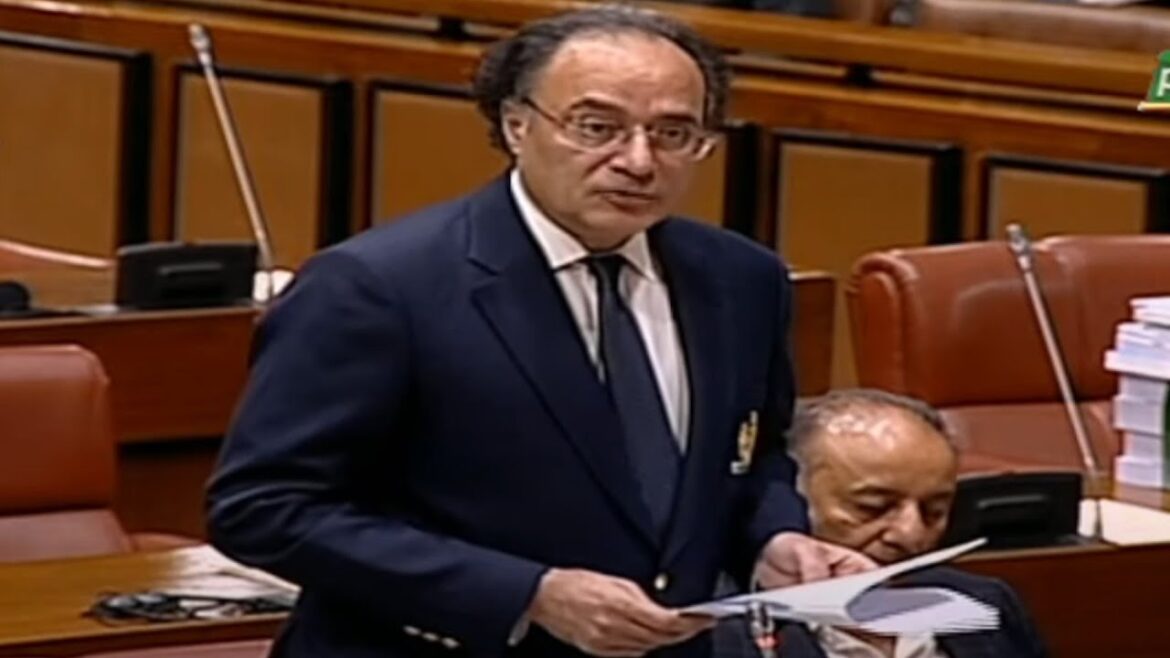
ISLAMABAD: The Finance Minister Muhammad Aurangzeb will present the federal budget for fiscal year 2026–27 to the National Assembly on Friday, capping weeks of political horse-trading that saw the date shift three times and exposed deep fissures between the federal government and its provincial partners over the division of national revenues.
The announcement, confirmed Wednesday by Aurangzeb’s adviser Khurram Schehzad on X, comes as the government races to secure parliamentary approval before the Ashura holiday — a tight window that has prompted the ruling coalition to schedule continuous sessions through weekends, with a target of June 23 or 24 for final passage.
The Economic Survey for FY2025-26, the pre-budget document that will lay out GDP growth, tax revenues, and sectoral performance for the outgoing fiscal year, is to be launched Thursday at 2:20 p.m. by Aurangzeb himself. Budget sessions of both the National Assembly and Senate have been summoned by President Asif Ali Zardari.
A Coalition Held Together by Arithmetic
The path to Friday’s presentation was anything but smooth. The budget was originally scheduled for June 5, pushed to June 10, and ultimately deferred again to June 12 as consultations with coalition partners dragged on. The central dispute: the federal government’s demand for more than Rs1 trillion in additional resources for what officials have described as “strategic needs” — a category that has drawn scrutiny given the country’s tight fiscal position under an International Monetary Fund programme.
A breakthrough of sorts came Monday, when Prime Minister Shehbaz Sharif’s Pakistan Muslim League-Nawaz and its principal coalition ally, the Pakistan Peoples Party, agreed on a broad framework. Under the arrangement, provincial shares from the federal divisible pool will be frozen at the current year’s levels, with any incremental revenue collected by the Federal Board of Revenue above this year’s baseline retained entirely by the Centre. That additional amount — described by informed sources as dynamic rather than fixed — could range between Rs1.3 trillion and Rs1.7 trillion depending on FBR outperformance.
Notably absent from the deal are Balochistan and Khyber Pakhtunkhwa, two of the country’s four provinces, adding a layer of political fragility to an arrangement the government is already presenting as settled. The National Economic Council, the federation’s apex economic decision-making forum, convened Wednesday after three previous postponements to ratify federal and provincial development plans ahead of the budget. Sharif, who chaired the session, said consultations with provinces had been conducted “with extreme seriousness” and that decisions were made “in the best interest of Pakistan.”
Record Development Budget, Trimmed Allocations
Despite the fiscal constraints, the government has unveiled what it is billing as a record national development programme of Rs4.715 trillion. Provincial annual development plans account for the largest slice at Rs3.138 trillion, up 9.6% from the current year. The federal Public Sector Development Programme comes in at Rs1.126 trillion, a 12.6% increase, while state-owned enterprise allocations rise 27% to Rs451 billion.
The headline figure, however, masks significant reallocation within the federal programme. Under IMF oversight, most sectoral allocations have been trimmed to create room for PML-N’s signature national highways programme, a new Rs87 billion carve-out for coalition partners, and Rs70 billion earmarked for ruling-party lawmakers’ local schemes — a line item that opposition figures are likely to scrutinise closely.
Aurangzeb told senators Wednesday that the government is targeting Rs13 trillion in revenue for the current fiscal year, a figure that frames the ambition of the FY27 budget even as this year’s collections remain on uncertain ground. He also reiterated that commitments on the petroleum levy remain embedded in the government’s fiscal framework — a nod to IMF conditionality — and noted that, unlike 2022, Pakistan had absorbed flood-related losses without making international appeals, relying instead on domestic resources.
The Fuel-Price Political Minefield
Wednesday’s Senate session offered a preview of the political dynamics Aurangzeb will navigate in the budget debate. Senator Mohsin Aziz of the opposition charged that petrol prices had risen 200% under the current government, arguing that consumers had been left to bear the burden while the government reduced jet fuel costs for airlines. He said petroleum levy revenues were failing to reach ordinary citizens and that public expenditure had not been brought under control.
Aurangzeb defended the government’s record while acknowledging the difficulty of the moment. He told lawmakers that when the Middle East conflict erupted, it was unclear whether it would last a week or a month; it has now dragged on for three and a half months with continued economic spillovers. The government initially elected to pass through the price impact, he said, before reversing course and providing Rs129 billion in subsidies over three weeks — a decision that, by his own account, drew criticism from multiple directions.
The subsidies were funded through cuts to the PSDP. Of the total, Rs5.4 billion has been disbursed so far, including targeted relief for 800,000 motorcycle users and more than Rs4 billion channelled to farmers. The minister cautioned that even if the conflict were resolved immediately, its economic effects could persist well into the coming year.
Widening the Tax Base
On the revenue side, the government is pressing ahead with efforts to draw Pakistan’s large informal economy into the tax net. Last week it unveiled the Fixed Tax Asaan Scheme, a simplified regime targeting small traders and shopkeepers with annual turnover of up to Rs200 million.
The government is also weighing a relaxation of restrictions on overseas remittances in the budget, according to financial industry sources. Pakistanis living abroad in several countries have faced difficulties shielding their foreign investments and liquid assets under the current framework, and easing those restrictions could bolster remittance inflows — a critical source of foreign exchange in an economy that has repeatedly flirted with balance-of-payments distress.
Copyright © 2021 Independent Pakistan | All rights reserved