By Staff Reporter
ISLAMABAD: Pakistan’s economy expanded at its fastest pace in four years in fiscal 2026, hitting a record nominal size of $452 billion, yet fell short of the government’s own growth target as a confluence of floods, US tariff uncertainty and an escalating Middle East conflict weighed on output in the second half of the year.
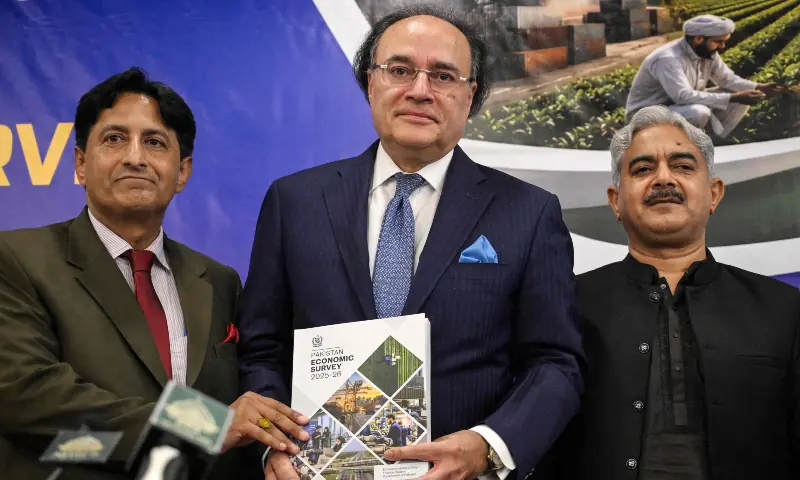
Gross domestic product grew 3.7% in the fiscal year ended June 2026, according to the Pakistan Economic Survey released on Thursday, topping the 3.2% recorded in fiscal 2025 but missing the government’s 4.2% target. Finance Minister Muhammad Aurangzeb, flanked by cabinet colleagues at a press conference in Islamabad, attributed the shortfall squarely to factors beyond Islamabad’s control.
“If I were sitting with you in January or February, we had a very strong view that this year’s growth will exceed 4%,” Aurangzeb said. “But as you all know, we were affected by the conflict in the Middle East.”
The survey’s release, a day ahead of the federal budget scheduled for Friday, marked a moment of measured optimism for a government that has spent the better part of two years shepherding Pakistan through a bruising stabilization program under an International Monetary Fund Extended Fund Facility. The country’s debt-to-GDP ratio fell to 68.5% from 70.7% a year earlier and 75% in 2023, its fiscal deficit narrowed to 0.7% of GDP in the first nine months of the year from 2.6% in the same period last year, and foreign exchange reserves climbed 49% year-on-year to $17.2 billion as of May 29.
“The trajectory that we had to take from stabilisation to growth — we stayed on that journey,” Aurangzeb said.
Exogenous Shocks
The minister enumerated what he called three exogenous shocks that clipped the expansion: trade volatility triggered by US tariff announcements at the start of the fiscal year, severe monsoon flooding in August and September 2025 that inundated agricultural land, and the regional military conflict that erupted in March and sent energy prices surging.
The conflict’s fingerprints were visible across the macroeconomic data. Inflation, which had been running at a benign 7.3% in March, spiked to 10.9% in April as global oil prices climbed and supply chains buckled. Average consumer price inflation for the July-May period was 6.7%, the survey said. The State Bank responded by raising its policy rate, reversing a cutting cycle that had been a centerpiece of the stabilization narrative.
Oil imports, which Aurangzeb said had risen above $1 billion in April, were cut to roughly $500 million in May as the government moved to manage inflows. The minister warned, however, that the second-order effects of the conflict — higher inflation and tighter monetary policy — would continue to reverberate. He said Pakistan’s leadership was engaged in mediation efforts, but acknowledged that energy infrastructure “has been hit and continues to be hit.”
The World Economic Outlook published by the IMF in April projected global growth would moderate to 3.1% in 2026 from 3.7% a year earlier, while global headline inflation was seen rising to 4.4% from 4.1%, providing some external context for Pakistan’s own deceleration.
Sectoral Performance
The survey painted a broadly positive, if uneven, picture across the economy’s main sectors. The agriculture sector expanded 2.9%, more than doubling its 1.5% growth rate from fiscal 2025, a resilience Aurangzeb credited to the crop sub-sector’s recovery despite the summer flooding. Livestock, he said, “continues to go from strength to strength.”
Industrial output rose 3.5%, with large-scale manufacturing — the economy’s bellwether sector — posting 6.1% growth, its strongest in four years. Positive momentum spread across 16 of the sector’s 22 sub-industries, including food, textiles and wearing apparel. Cement demand surged 10%, fertilizer 17%, petroleum 5%, automobiles 31% and mobile phones 9%.
“It’s not one single sector that is leading or contributing to this 6.1% turnaround in LSM,” the minister said. “It is broad-based growth.”
Services, which account for roughly 58% of GDP, grew 4.1%, also a four-year high, led by the communications and information sub-sector, which expanded 7.5%. Aurangzeb cited the sub-sector as central to Pakistan’s evolving digital economy.
Per capita income rose 9% to $1,901, up from $1,751 a year earlier, and the economy’s nominal size in rupee terms rose 11.3% to Rs126.9 trillion from Rs114 trillion, reflecting a combination of real growth and price effects.
Fiscal Discipline, Trade Pressures
The primary surplus — a key IMF program metric — improved to 3.2% of GDP from 3.0% a year earlier, while tax revenues rose 11.3% to Rs10.17 trillion. Federal Board of Revenue collections climbed 10.1% to Rs9.3 trillion. FBR Chairman Rashid Mahmood Langrial noted that aggregate revenue had grown by $14 billion over two years, a 46% increase. The government credited digital production monitoring in the cement and sugar sectors with generating Rs60 billion in additional revenue, while AI-based audit selection yielded a further Rs34 billion.
Aurangzeb separately said that mark-up payments fell 23%, freeing fiscal space as borrowing costs eased.
On the external side, the picture was more complicated. Goods exports for July-March fell to $22.7 billion from $24.7 billion a year earlier, dragged lower by a $1.1 billion decline in rice shipments and a $400 million drop in sugar exports — a combination the minister characterized as a one-off event in food trade. Textile exports improved over the same period, and sports goods shipments rose 18% year-on-year. Aurangzeb drew particular attention to the FIFA World Cup football, which he said was manufactured in Pakistan.
IT exports reached $3.8 billion in the July-April period and were on track to exceed $4.5 billion by year-end, he said. Income generated by freelancers rose sharply to $959 million from $642 million in fiscal 2025.
Imports rose 6.9% to $50.7 billion in the July-March period, driven by vehicles, food and capital goods. Aurangzeb said the total import bill could reach $70 billion for the full year, above earlier government expectations, largely because of elevated petroleum prices.
Despite the import surge, the current account deficit remained contained at $252 million in the July-April period, underpinned by record remittance flows. Workers’ remittances reached $33.9 billion in the first ten months of the fiscal year, up 9% year-on-year, with April alone recording a monthly high of $4.3 billion. The minister projected full-year remittances of $41 billion to $42 billion, and pushed back firmly against the notion that reliance on worker transfers is a structural vulnerability.
“Remittances are and will remain a very important component of our external balancing position,” he said.
Markets, Investment and the Budget Ahead
The KSE-100 index gained 18.4% in the July-March period, outperforming most major global equity benchmarks. Eleven initial public offerings were listed on the Pakistan Stock Exchange this fiscal year — the most in two decades — and the investor base exceeded 563,000. The survey attributed the rally to strong corporate earnings, a declining policy rate, lower inflation and the successful completion of IMF program reviews. Deposits under the Roshan Digital Account scheme, aimed at overseas Pakistanis, hit a record $12.7 billion.
Investment as a share of GDP held steady at 14.4%, supported primarily by private sector capital formation. National savings stood at 14.1% of GDP, indicating limited dependence on external financing, the survey said.
Poverty, however, crept higher: the national headcount ratio rose to 28.9% in fiscal 2025, the latest available data, reflecting the cumulative toll of inflation, flooding and economic adjustment. The government said it had raised the budget allocation for the Benazir Income Support Programme to Rs722.5 billion to cushion lower-income households.
Asked about discussions with the IMF on budgetary targets ahead of the Friday budget presentation, Aurangzeb was characteristically brief. “We are in talks with them, and the discussions are progressing positively,” he said.
Planning Minister Ahsan Iqbal offered a more pointed assessment of the country’s structural challenges. Pakistan had not yet succeeded in building an export-led economy, he said, and sustainable growth ultimately hinged on policy continuity and political stability. “Long-term economic progress can only be achieved through consistent policymaking,” he added.
For fiscal 2027, the National Economic Council on Wednesday approved a development outlay of Rs3.67 trillion, including Rs838 billion in foreign financing, and set a GDP growth target of 4% — the same threshold that eluded the government this year.
Copyright © 2021 Independent Pakistan | All rights reserved