By Staff Reporter
ISLAMABAD: The Foreign Office again warned on Thursday that any deliberate effort by India to block the flow of water across their shared border would constitute an act of war under the United Nations Charter, issuing another public rebuke as New Delhi increased its aggressive posture over one of South Asia’s most volatile fault lines.
The warning came one day after India’s water resources minister, C.R. Patil, told an Indian news agency that his government was actively working to ensure that “not a single drop of water” would reach Pakistan — steps he said were being taken on direct orders from Prime Minister Narendra Modi. The remarks landed with the force of a provocation in Islamabad, where water is not a diplomatic abstraction but the lifeblood of a largely agrarian economy and a population of more than 250 million people.
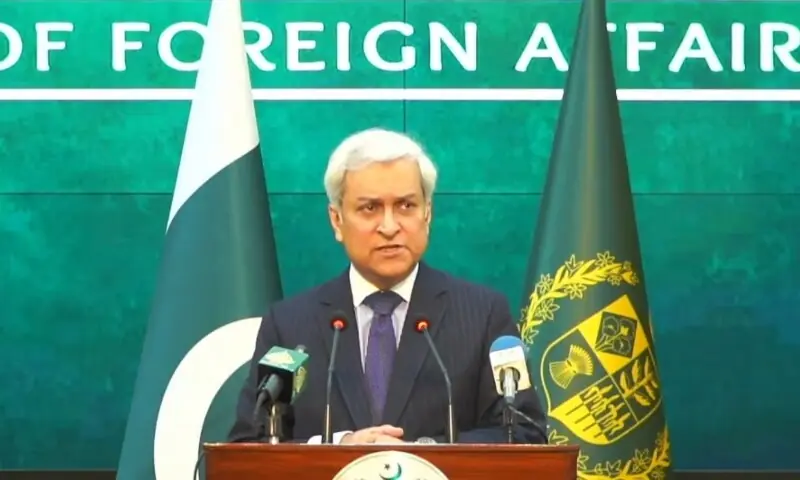
“Any attempt to block or substantially curtail water that is vital to the livelihood, agriculture and well-being of over 250 million Pakistanis would be a deeply irresponsible act,” Foreign Office spokesman Tahir Hussain Andrabi said at his weekly media briefing, adding that such a move would violate both international law on transboundary rivers and the terms of India and Pakistan’s own bilateral agreement.
“Any such act,” he continued, “would be treated with utmost seriousness and could possibly amount to an act of war under Article 51 of the United Nations Charter.”Andrabi said Pakistan “firmly rejects any notion that water can be treated as a political tool or instrument of coercion or a weapon,” calling it a direct threat to regional peace and security. He said the burden of any resulting instability “would fall squarely on India’s shoulders.”
India suspended its participation in the Indus Waters Treaty last year after relations between the two nuclear-armed neighbours deteriorated sharply in the aftermath of a deadly militant attack in occupied Kashmir that New Delhi blamed on Islamabad — a charge Pakistan denied. The 1960 treaty, brokered by the World Bank, governs the allocation of rivers from the Indus system, which sustains hundreds of millions of people across both countries and is considered one of the most consequential water-sharing agreements in the world.
Pakistan said it would “vigorously” defend its rights through diplomatic, legal, political and economic channels, and pledged to closely monitor conditions in occupied Kashmir, the Himalayan headwaters from which the rivers descend.
Nuclear Warning
The water dispute was not the only front on which Pakistan pressed its case Thursday. Andrabi said the findings of a recent report by the Stockholm International Peace Research Institute documenting an expansion of India’s nuclear arsenal came as no surprise to Islamabad — and may, in fact, understate the scale of the buildup. “It broadly corroborates concerns that Pakistan has consistently been raising regarding India’s continued vertical proliferation,” Andrabi said, adding that the actual scope of India’s arsenal may not be “fully reflected” in the SIPRI data.
He pointed to specific developments he said were destabilizing: the cannisterization of Indian missile systems, the expansion of sea-based nuclear-capable submarines, and the pursuit of intercontinental ballistic missiles with ranges that, he argued, went well beyond India’s immediate neighborhood. “These developments enhance operational readiness, complicate crisis stability, and carry implications that extend beyond South Asia,” Andrabi said.
He warned of “grave consequences” for international peace and security, urging the international community — and the advanced-technology suppliers that enable such capabilities — to take note of what he described as an increasingly dangerous trajectory. Pakistan, he said, did not seek an arms race and was “not interested in matching warheads and ammunition by number,” but would continue working to preserve strategic stability and deter what he called the possibility of Indian aggression.
11 Sailors Still Held Off Somalia
Andrabi spent considerable time at the briefing addressing a hostage crisis that has dragged into its seventh week with no resolution in sight — the plight of 11 Pakistani seafarers among the crew of a vessel seized by Somali pirates in the Arabian Sea. The MT Honour 25 was hijacked on April 21 off the coast of Somalia’s semi-autonomous Puntland region. Its crew of 17 included Pakistanis as well as nationals from Indonesia, India, Myanmar and Sri Lanka. Families of the hostages have grown increasingly alarmed as conditions aboard the vessel have reportedly worsened.
“Sadly, despite our best efforts, we have not been able to secure their release,” Andrabi acknowledged. “They have remained in captivity for around 50 days now.” He said the government had engaged with Somali authorities, the vessel’s shipowner and tribal intermediaries in Puntland — a layered negotiation made more fraught, he explained, by the fact that the pirates and the shipowner belong to different tribes in a region where customary law and clan allegiances shape the resolution of such disputes as much as any formal government channel..
Deputy Prime Minister and Foreign Minister Ishaq Dar has spoken directly with his Somali counterpart, Foreign Minister Abdisalam Abdi Ali, conveying what Andrabi described as “grave concern” over the situation and pressing for improvements to the captives’ living conditions. The Somali minister assured Dar of his government’s “continued and sincere” efforts, the spokesman said, and the two agreed to stay in close contact until the matter is resolved.
Pakistan’s ambassador to Somalia, based in Djibouti, has dispatched teams to Mogadishu. The Somali ambassador in Islamabad was summoned to the Foreign Ministry for talks. Interministerial meetings are underway, with another senior-level session at the Foreign Office scheduled for next week. “We urge patience, though we deeply sympathize with the relatives of these individuals,” Andrabi said.
Pakistan Urges Restraint on Iran
Andrabi also addressed the widening military confrontation between the United States and Iran, expressing deep concern about the latest round of exchanges and calling on all parties to step back from the brink. Pakistan’s appeal came as the United States Central Command said it had carried out a fresh round of airstrikes on Iranian military surveillance systems, communications infrastructure and air-defense sites. Iran responded by striking Bahrain, Kuwait and Jordan. Kuwait closed its airspace and flights were diverted from Kuwait International Airport, which had already sustained a direct Iranian hit in recent days that killed at least one person.
The back-and-forth strikes marked the third such exchange this week in a conflict that began with U.S. and Israeli attacks on Iran on Feb. 28, and has since disrupted global energy markets, raised food prices and rattled shipping in the Strait of Hormuz.” Pakistan reaffirms its support for the peaceful resolution of all outstanding issues,” Andrabi told reporters. “We are of the view that diplomacy and dialogue should be the guiding principles for achieving a negotiated settlement of all contentious issues.”
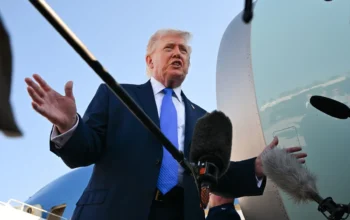
President Trump, speaking at the White House on Wednesday, acknowledged that Pakistan had played a quiet but active mediating role — specifically crediting Army Chief Field Marshal Asim Munir and Prime Minister Shehbaz Sharif with helping broker a temporary pause in hostilities at his request. He described the two Pakistani leaders as “great” and said Pakistan remained engaged in persuading Tehran to reach an agreement. “They became friendly to me, very friendly, and they’re close to Iran,” Trump said. “And they work, and they still are working on trying them to do what’s right.”
Pakistani Deportees From UAE
Andrabi also pushed back on reports that Pakistan’s nationals were being deported from the United Arab Emirates in large numbers, in what some observers had linked to Islamabad’s tilt toward Iran during the regional conflict. He said both Pakistani and Emirati authorities had rejected that characterization, attributing the deportations to immigration violations and legal infractions rather than political considerations. He put the total number of deportees at between 3,000 and 4,000 — far below the five- and six-figure estimates that have circulated on social media and in some press reports.
Pakistanis deported from the UAE who were unable to recover savings, property or other assets left behind could seek assistance through Pakistani diplomatic missions in the country, Andrabi said, expressing confidence that Emirati authorities would not hold the private assets of individual citizens. The UAE is home to one of the largest Pakistani expatriate communities anywhere in the world and is a major source of remittances that help sustain Pakistan’s economy.
Copyright © 2021 Independent Pakistan | All rights reserved